Bodawatta Kasun H, Sam Katerina, Jønsson Knud A, Poulsen Michael
Section for Ecology and Evolution, Department of Biology, University of Copenhagen, Copenhagen, Denmark.
Section for Biosystematics, Natural History Museum of Denmark, Copenhagen, Denmark.
Front Microbiol. 2018 Aug 10;9:1830. doi: 10.3389/fmicb.2018.01830. eCollection 2018.
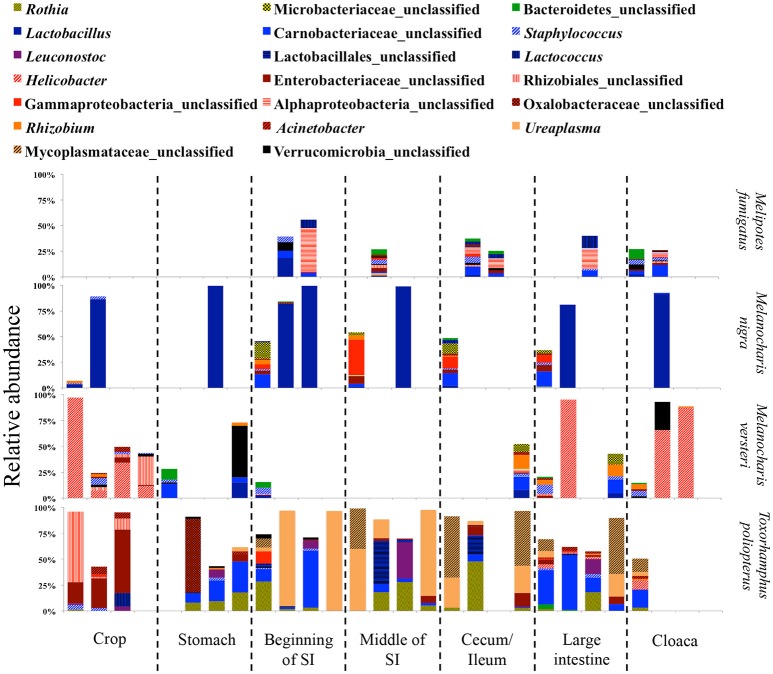
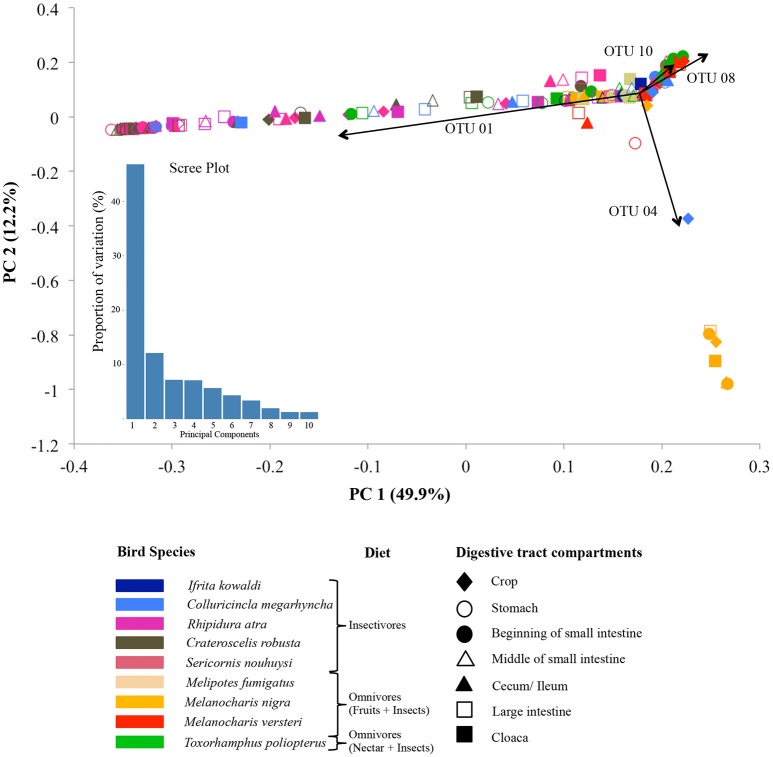
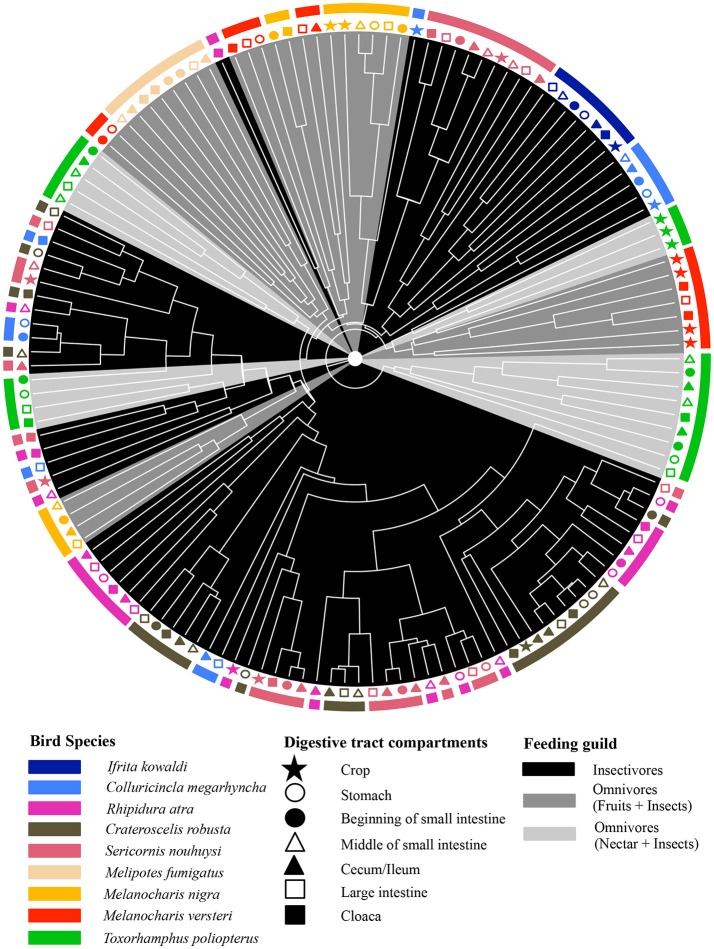
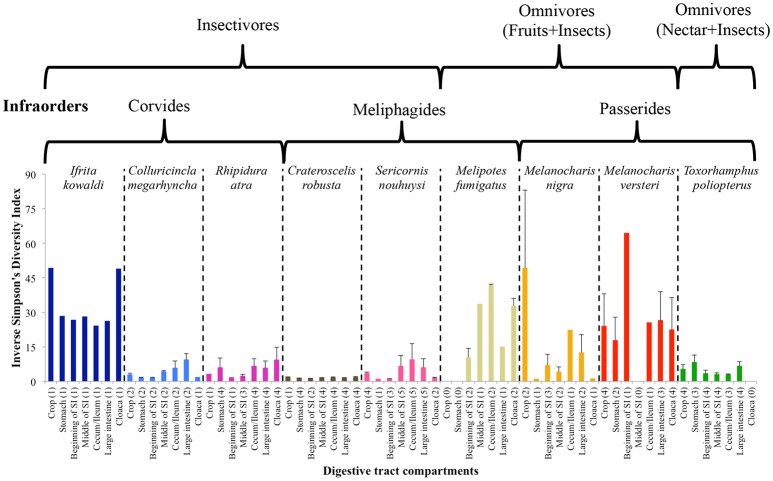
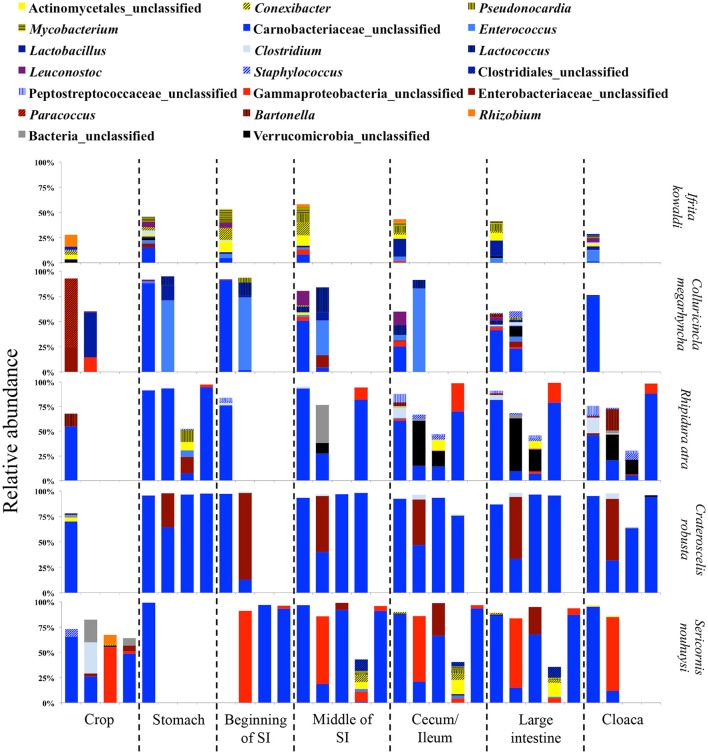
The digestive tract microbiota (DTM) plays a plethora of functions that enable hosts to exploit novel niches. However, our understanding of the DTM of birds, particularly passerines, and the turnover of microbial communities along the digestive tract are limited. To better understand how passerine DTMs are assembled, and how the composition changes along the digestive tract, we investigated the DTM of seven different compartments along the digestive tract of nine New Guinean passerine bird species using Illumina MiSeq sequencing of the V4 region of the 16S rRNA. Overall, passerine DTMs were dominated by the phyla Firmicutes and Proteobacteria. We found bird species-specific DTM assemblages and the DTM of different compartments from the same species tended to cluster together. We also found a notable relationship between gut community similarity and feeding guilds (insectivores vs. omnivores). The dominant bacterial genera tended to differ between insectivores and omnivores, with insectivores mainly having lactic acid bacteria that may contribute to the breakdown of carbohydrates. Omnivorous DTMs were more diverse than insectivores and dominated by the bacterial phyla Proteobacteria and Tenericutes. These bacteria may contribute to nitrogen metabolism, and the diverse omnivorous DTMs may allow for more flexibility with varying food availability as these species have wider feeding niches. In well-sampled omnivorous species, the dominant bacterial genera changed along the digestive tracts, which was less prominent for insectivores. In conclusion, the DTMs of New Guinean passerines seem to be species specific and, at least in part, be shaped by bird diet. The sampling of DTM along the digestive tract improved capturing of a more complete set of members, with implications for our understanding of the interactions between symbiont and gut compartment functions.
消化道微生物群(DTM)发挥着众多功能,使宿主能够开拓新的生态位。然而,我们对鸟类尤其是雀形目鸟类的DTM以及消化道微生物群落的更替了解有限。为了更好地理解雀形目鸟类DTM是如何组装的,以及其组成沿消化道如何变化,我们使用16S rRNA V4区域的Illumina MiSeq测序技术,对9种新几内亚雀形目鸟类消化道的7个不同区段的DTM进行了研究。总体而言,雀形目鸟类的DTM以厚壁菌门和变形菌门为主。我们发现了鸟类物种特异性的DTM组合,并且同一物种不同区段的DTM倾向于聚集在一起。我们还发现肠道群落相似性与取食类群(食虫动物与杂食动物)之间存在显著关系。食虫动物和杂食动物的优势细菌属往往不同,食虫动物主要含有可能有助于碳水化合物分解的乳酸菌。杂食动物的DTM比食虫动物更多样化,以变形菌门和柔膜菌门为主。这些细菌可能有助于氮代谢,多样的杂食动物DTM可能使这些物种在食物供应变化时具有更大的灵活性,因为它们有更广泛的取食生态位。在抽样充分的杂食动物物种中,优势细菌属沿消化道发生变化,而在食虫动物中这种变化不太明显。总之,新几内亚雀形目鸟类的DTM似乎具有物种特异性,并且至少部分地受鸟类饮食的影响。沿消化道对DTM进行采样有助于更全面地捕获其成员,这对我们理解共生体与肠道区段功能之间的相互作用具有重要意义。