Pye Havala O T, Murphy Benjamin N, Xu Lu, Ng Nga L, Carlton Annmarie G, Guo Hongyu, Weber Rodney, Vasilakos Petros, Appel K Wyat, Budisulistiorini Sri Hapsari, Surratt Jason D, Nenes Athanasios, Hu Weiwei, Jimenez Jose L, Isaacman-VanWertz Gabriel, Misztal Pawel K, Goldstein Allen H
National Exposure Research Laboratory, US Environmental Protection Agency, Research Triangle Park, NC, USA.
School of Chemical and Biomolecular Engineering, Georgia Institute of Technology, Atlanta, GA, USA.
Atmos Chem Phys. 2017;17(1):343-369. doi: 10.5194/acp-17-343-2017.
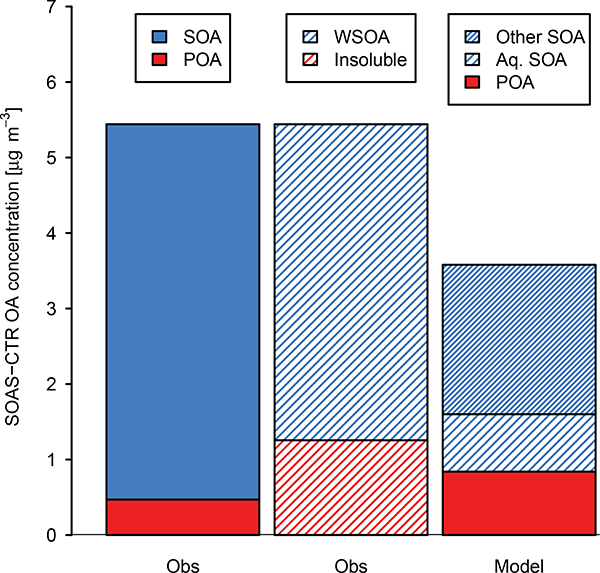
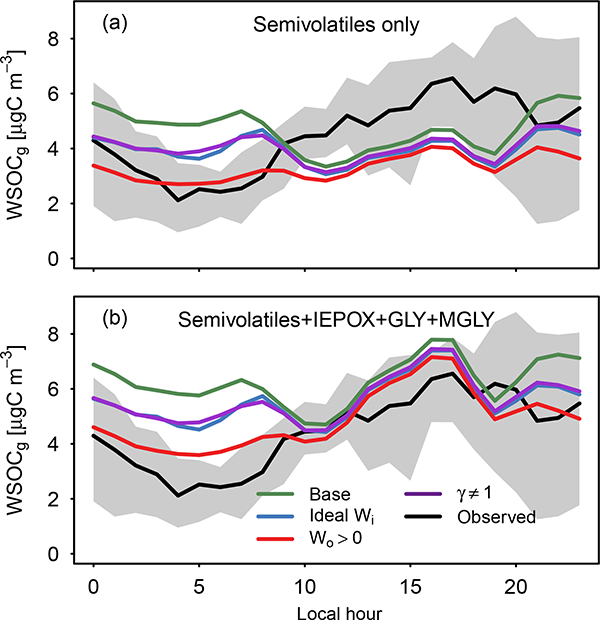
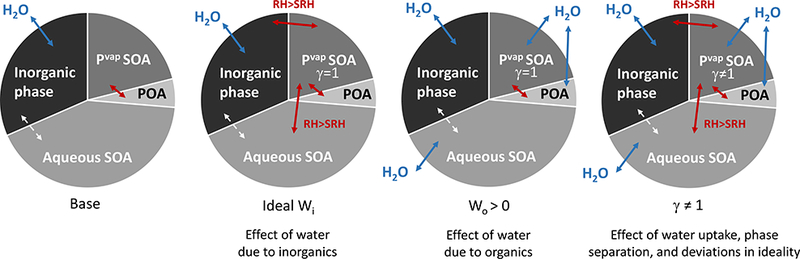
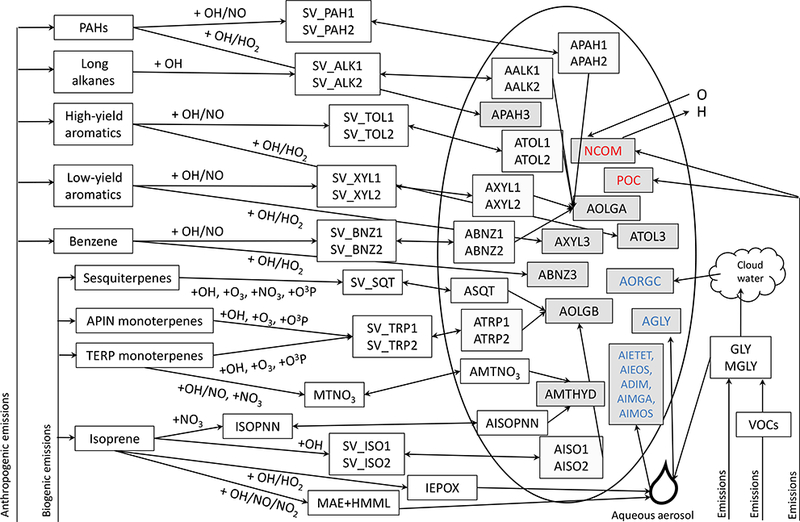
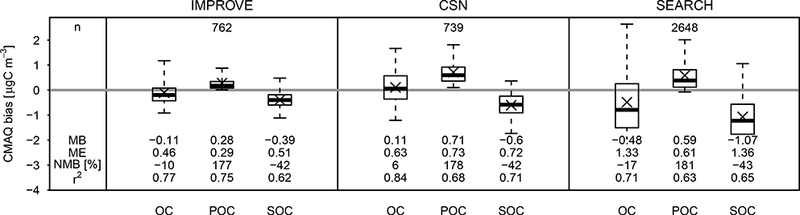
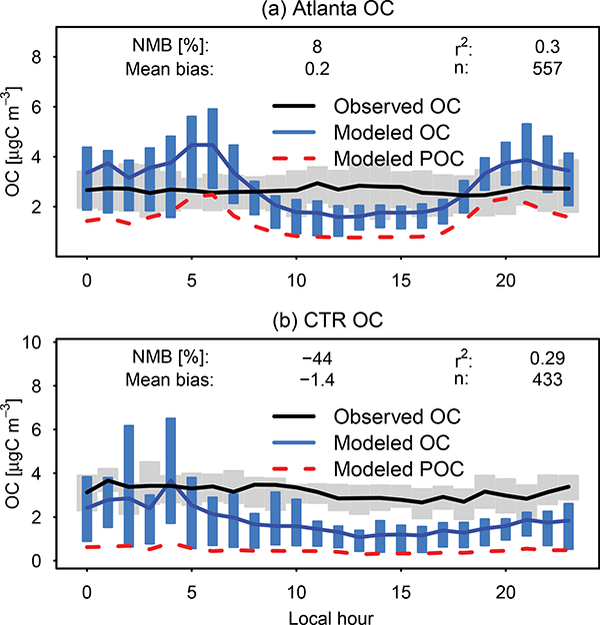
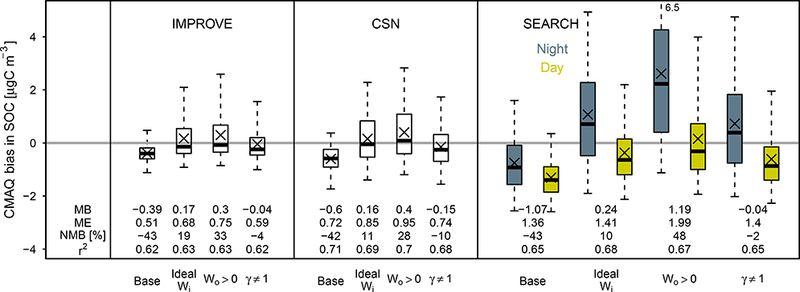
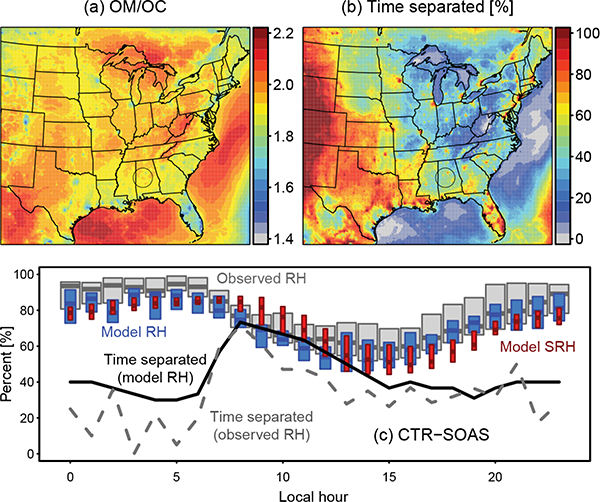
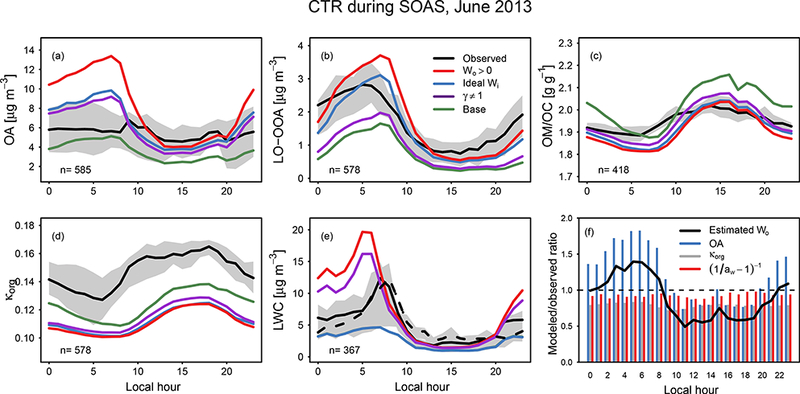
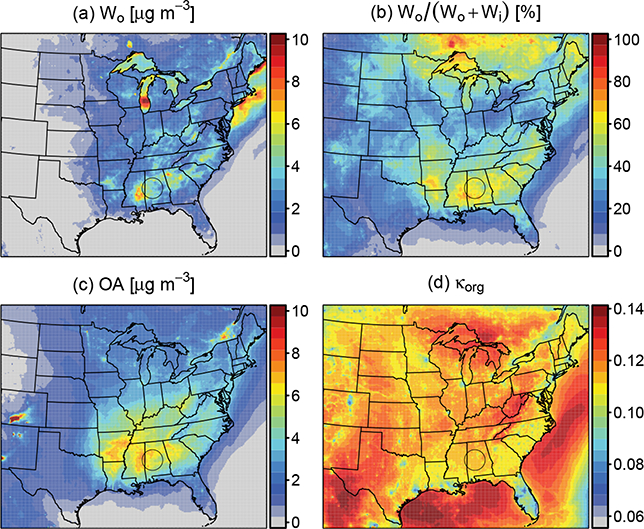
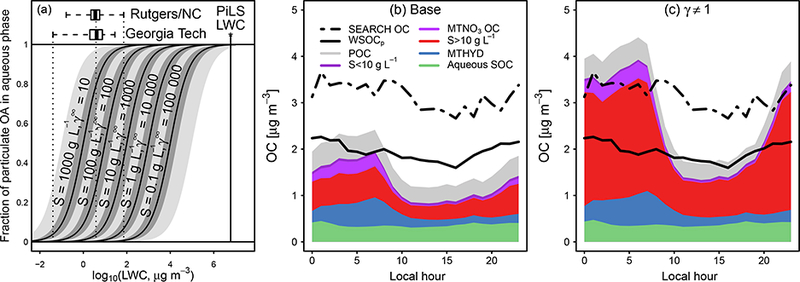
Organic compounds and liquid water are major aerosol constituents in the southeast United States (SE US). Water associated with inorganic constituents (inorganic water) can contribute to the partitioning medium for organic aerosol when relative humidities or organic matter to organic carbon (OM/OC) ratios are high such that separation relative humidities (SRH) are below the ambient relative humidity (RH). As OM/OC ratios in the SE US are often between 1.8 and 2.2, organic aerosol experiences both mixing with inorganic water and separation from it. Regional chemical transport model simulations including inorganic water (but excluding water uptake by organic compounds) in the partitioning medium for secondary organic aerosol (SOA) when RH > SRH led to increased SOA concentrations,· particularly at night. Water uptake to the organic phase resulted in even greater SOA concentrations as a result of a positive feedback in which water uptake increased SOA, which further increased aerosol water and organic aerosol. Aerosol properties· such as the OM/OC and hygroscopicity parameter (), were captured well by the model compared with measurements during the Southern Oxidant and Aerosol Study (SOAS) 2013. Organic nitrates from monoterpene oxidation were predicted to be the least water-soluble semivolatile species in the model, but most biogenically derived semivolatile species in the Community Multiscale Air Quality (CMAQ) model were highly water soluble and expected to contribute to water-soluble organic carbon (WSOC). Organic aerosol and SOA precursors were abundant at night, but additional improvements in daytime organic aerosol are needed to close the model-measurement gap. When taking into account deviations from ideality, including both inorganic (when RH > SRH) and organic water in the organic partitioning medium reduced the mean bias in SOA for routine monitoring networks and improved model performance compared to observations from SOAS. Property updates from this work will be released in CMAQ v5.2.
有机化合物和液态水是美国东南部(SE US)气溶胶的主要成分。当相对湿度或有机物质与有机碳的比率(OM/OC)较高,使得分离相对湿度(SRH)低于环境相对湿度(RH)时,与无机成分相关的水(无机水)可成为有机气溶胶的分配介质。由于美国东南部的OM/OC比率通常在1.8至2.2之间,有机气溶胶既会与无机水混合,也会与之分离。当RH > SRH时,在二次有机气溶胶(SOA)的分配介质中纳入无机水(但不包括有机化合物对水的吸收)的区域化学传输模型模拟导致SOA浓度增加,尤其是在夜间。水吸收进入有机相导致SOA浓度进一步增加,这是由于一种正反馈机制,即水吸收增加了SOA,进而进一步增加了气溶胶水和有机气溶胶。与2013年南方氧化剂和气溶胶研究(SOAS)期间的测量结果相比,该模型很好地捕捉到了气溶胶特性,如OM/OC和吸湿参数()。模型预测单萜烯氧化产生的有机硝酸盐是水溶性最低的半挥发性物质,但社区多尺度空气质量(CMAQ)模型中大多数生物源半挥发性物质具有高水溶性,并预计会对水溶性有机碳(WSOC)有贡献。有机气溶胶和SOA前体在夜间含量丰富,但需要进一步改进白天的有机气溶胶模型以缩小模型测量差距。考虑到非理想偏差,在有机分配介质中纳入无机水(当RH > SRH时)和有机水,减少了常规监测网络中SOA的平均偏差,并与SOAS的观测结果相比提高了模型性能。这项工作的属性更新将在CMAQ v5.2中发布。