The Institute of Vegetables and Flowers, Chinese Academy of Agricultural Sciences, Beijing 100081, China.
College of Agricultural and Biological Engineering, Heze University, Heze 274015, China.
Int J Mol Sci. 2018 Aug 24;19(9):2497. doi: 10.3390/ijms19092497.
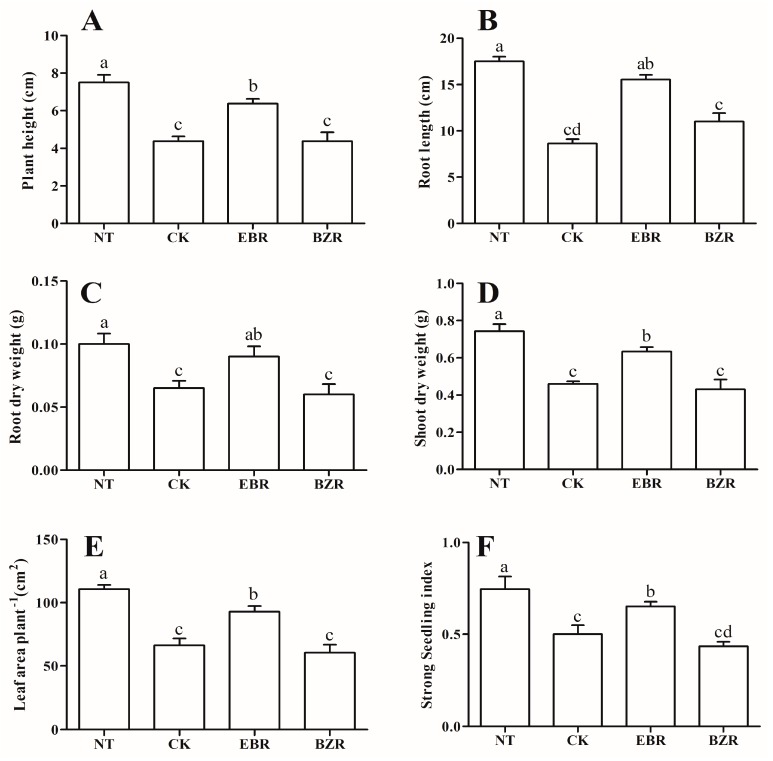
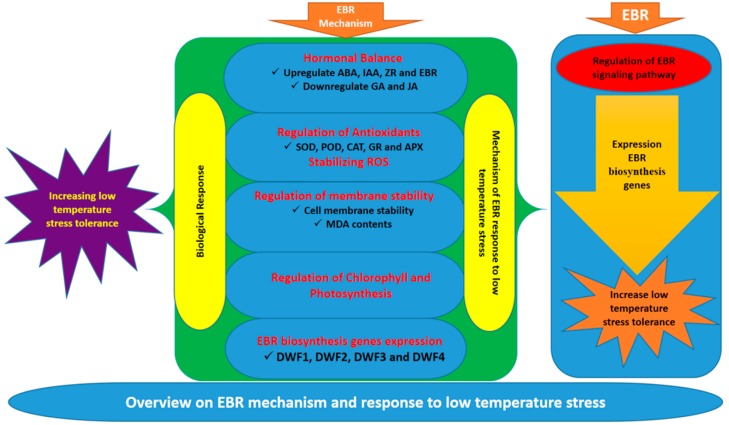
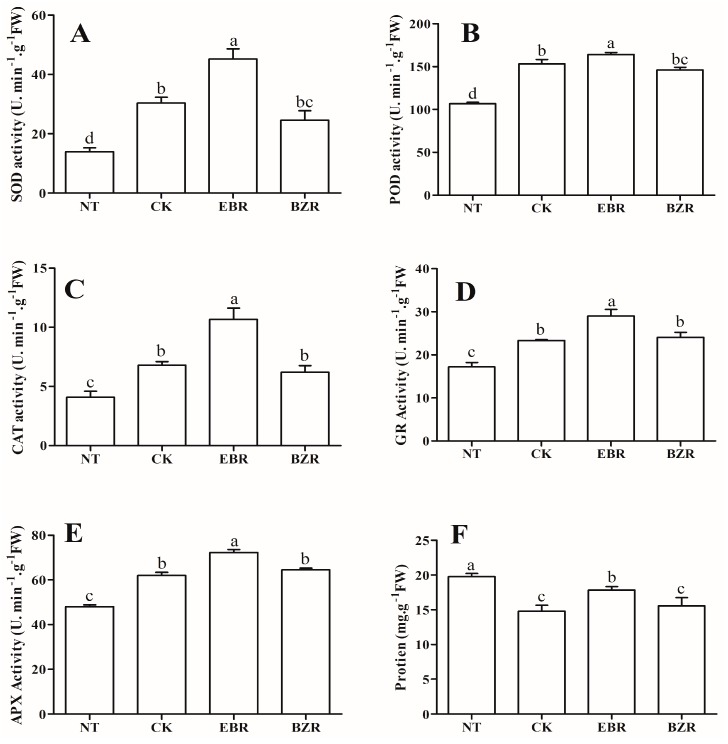
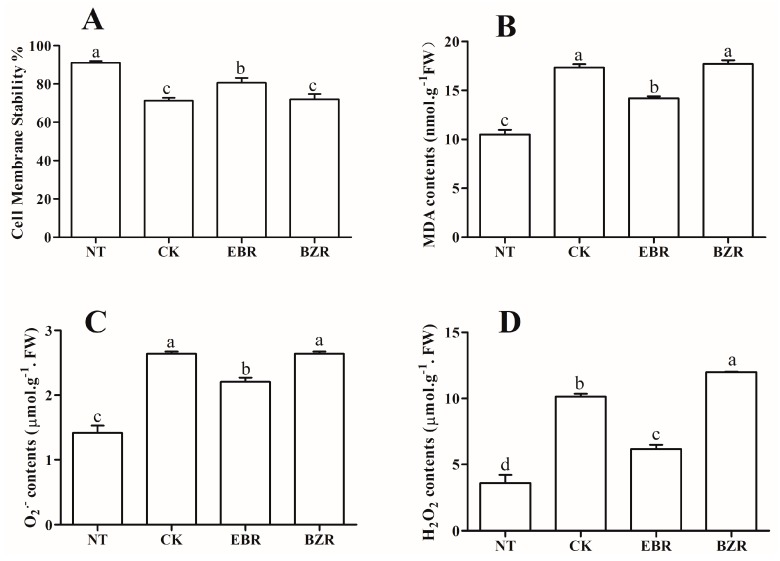
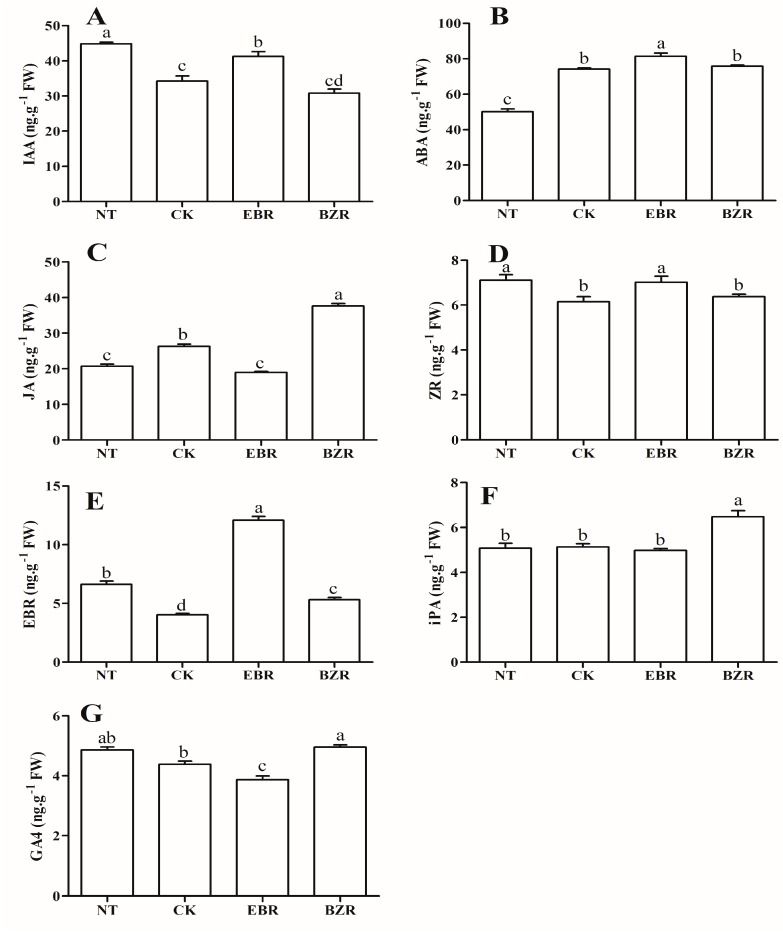
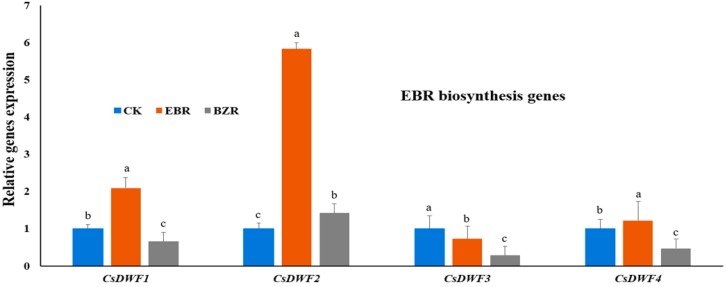
Phytohormone biosynthesis and accumulation are essential for plant growth and development and stress responses. Here, we investigated the effects of 24-epibrassinolide (EBR) on physiological and biochemical mechanisms in cucumber leaves under low-temperature stress. The cucumber seedlings were exposed to treatments as follows: NT (normal temperature, 26 °C/18 °C day/night), and three low-temperature (12 °C/8 °C day/night) treatments: CK (low-temperature stress); EBR (low-temperature and 0.1 μM EBR); and BZR (low-temperature and 4 μM BZR, a specific EBR biosynthesis inhibitor). The results indicated that low-temperature stress proportionately decreased cucumber seedling growth and the strong seedling index, chlorophyll (Chl) content, photosynthetic capacity, and antioxidant enzyme activities, while increasing reactive oxygen species (ROS) and malondialdehyde (MDA) contents, hormone levels, and EBR biosynthesis gene expression level. However, EBR treatments significantly enhanced cucumber seedling growth and the strong seedling index, chlorophyll content, photosynthetic capacity, activities of antioxidant enzymes, the cell membrane stability, and endogenous hormones, and upregulated EBR biosynthesis gene expression level, while decreasing ROS and the MDA content. Based on these results, it can be concluded that exogenous EBR regulates endogenous hormones by activating at the transcript level EBR biosynthetic genes, which increases antioxidant enzyme capacity levels and reduces the overproduction of ROS and MDA, protecting chlorophyll and photosynthetic machinery, thus improving cucumber seedling growth.
植物激素的生物合成和积累对于植物的生长发育和应激反应至关重要。在这里,我们研究了 24-表油菜素内酯(EBR)对低温胁迫下黄瓜叶片生理生化机制的影响。将黄瓜幼苗暴露于以下处理中:NT(正常温度,26°C/18°C 昼夜)和三种低温(12°C/8°C 昼夜)处理:CK(低温胁迫);EBR(低温和 0.1 μM EBR);和 BZR(低温和 4 μM BZR,一种特定的 EBR 生物合成抑制剂)。结果表明,低温胁迫成比例地降低了黄瓜幼苗的生长和强苗指数、叶绿素(Chl)含量、光合作用能力和抗氧化酶活性,同时增加了活性氧(ROS)和丙二醛(MDA)含量、激素水平和 EBR 生物合成基因表达水平。然而,EBR 处理显著增强了黄瓜幼苗的生长和强苗指数、叶绿素含量、光合作用能力、抗氧化酶活性、细胞膜稳定性和内源性激素水平,并上调了 EBR 生物合成基因表达水平,同时降低了 ROS 和 MDA 含量。基于这些结果,可以得出结论,外源 EBR 通过激活转录水平的 EBR 生物合成基因来调节内源性激素,从而增加抗氧化酶能力水平并减少 ROS 和 MDA 的过度产生,保护叶绿素和光合作用机制,从而改善黄瓜幼苗的生长。