El-Kalla Ferial, Mansour Loai, Kobtan Abdelrahman, Elzeftawy Asmaa, Abo Ali Lobna, Abd-Elsalam Sherief, Elyamani Sahar, Yousef Mohamed, Amer I, Mourad H, Elhendawy Mohamed
Tropical Medicine and Infectious Diseases Department, Faculty of Medicine, Tanta University, Tanta, Egypt.
Hepatology and Gastroenterology Department, Faculty of Medicine, Kafrelsheikh University, Kafr Elsheikh, Egypt.
Gastroenterol Res Pract. 2018 Jul 29;2018:9067583. doi: 10.1155/2018/9067583. eCollection 2018.
Portal hypertensive gastropathy (PHG) is a common anomaly with potential for bleeding found in portal hypertension. Blood ammonia levels correlate well with liver disease severity and existence of portosystemic shunts. Increased ammonia results in vasodilation and hepatic stellate cell activation causing and exacerbating portal hypertension.
To assess the relation of blood ammonia to the presence and severity of portal hypertensive gastropathy in cirrhosis.
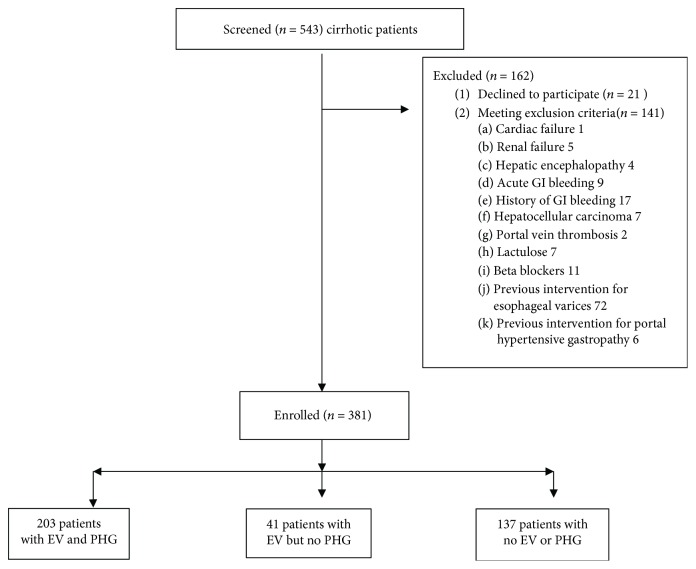
This cross-sectional study included 381 cirrhotics undergoing screening for esophageal varices (EV) divided into a portal hypertensive gastropathy group (203 patients with EV and PHG), esophageal varix group (41 patients with EV but no PHG), and control group (137 patients with no EV or PHG). A full clinical examination, routine laboratory tests, abdominal ultrasonography, child score calculation, and blood ammonia measurement were performed for all patients.
Blood ammonia, portal vein, splenic vein, and splenic longitudinal diameters were significantly higher and platelet counts lower in patients with EV and EV with PHG than controls. Patients having EV with PHG had significantly higher bilirubin and ammonia than those with EV but no PHG. Severe PHG was associated with significantly higher ammonia, EV grades, and superior location and a lower splenic longitudinal diameter than mild PHG. The PHG score showed a positive correlation with blood ammonia and a negative correlation with splenic longitudinal diameter.
Blood ammonia levels correlate with the presence, severity, and score of portal hypertensive gastropathy in cirrhosis suggesting a causal relationship and encouraging trials of ammonia-lowering treatments for the management of severe PHG with a tendency to bleed.
门脉高压性胃病(PHG)是门脉高压中一种常见的、有出血风险的异常情况。血氨水平与肝脏疾病严重程度及门体分流的存在密切相关。血氨升高会导致血管舒张和肝星状细胞激活,从而引发并加重门脉高压。
评估血氨与肝硬化患者门脉高压性胃病的存在及严重程度之间的关系。
这项横断面研究纳入了381例接受食管静脉曲张(EV)筛查的肝硬化患者,分为门脉高压性胃病组(203例有EV和PHG的患者)、食管静脉曲张组(41例有EV但无PHG的患者)和对照组(137例无EV或PHG的患者)。对所有患者进行了全面的临床检查、常规实验室检查、腹部超声检查、Child评分计算和血氨测定。
有EV和有EV合并PHG的患者的血氨、门静脉、脾静脉及脾脏纵径显著高于对照组,血小板计数则低于对照组。有EV合并PHG的患者的胆红素和血氨显著高于有EV但无PHG的患者。重度PHG与显著更高的血氨、EV分级、更高的位置以及比轻度PHG更低的脾脏纵径相关。PHG评分与血氨呈正相关,与脾脏纵径呈负相关。
血氨水平与肝硬化患者门脉高压性胃病的存在、严重程度及评分相关,提示存在因果关系,并鼓励开展降低血氨治疗的试验,以管理有出血倾向的重度PHG。