Suárez-Llanos José Pablo, Mora-Mendoza Alejandra, Benítez-Brito Néstor, Pérez-Méndez Lina, Pereyra-García-Castro Francisca, Oliva-García José Gregorio, Palacio-Abizanda José Enrique
Endocrinology and Nutrition Department, Hospital Universitario Nuestra Señora de Candelaria, Santa Cruz de Tenerife, Spain.
Research Unit, Hospital Universitario Nuestra Señora de Candelaria and Primary Healthcare, CIBER CIBER, Respiratory Diseases, Instituto de Salud Carlos III, Madrid, Spain.
Arch Med Sci. 2018 Aug;14(5):1020-1024. doi: 10.5114/aoms.2017.66084. Epub 2017 Feb 20.
There is no gold-standard method for hospital nutrition screening. The new screening tool termed Control of Food Intake, Protein, and Anthropometry (CIPA) gives positive results when at least one of the following parameters is met: control of food intake for 72 h < 50%, serum albumin < 3 g/dl, body mass index < 18.5 kg/m or mid-upper arm circumference ≤ 22.5 cm. This method was validated in comparison with Subjective Global Assessment (SGA) in hospitalized patients with non-surgical pathologies.
A prospective, longitudinal study was performed on 221 consecutively enrolled patients. Prevalence or risk of malnutrition was estimated with CIPA vs. SGA screening at hospital admission and the concordance (k index - ) between the two methods and their sensitivity (S) and specificity (SP) were studied. Mean length of stay (LOS), mortality, and rate of early readmission were analyzed.
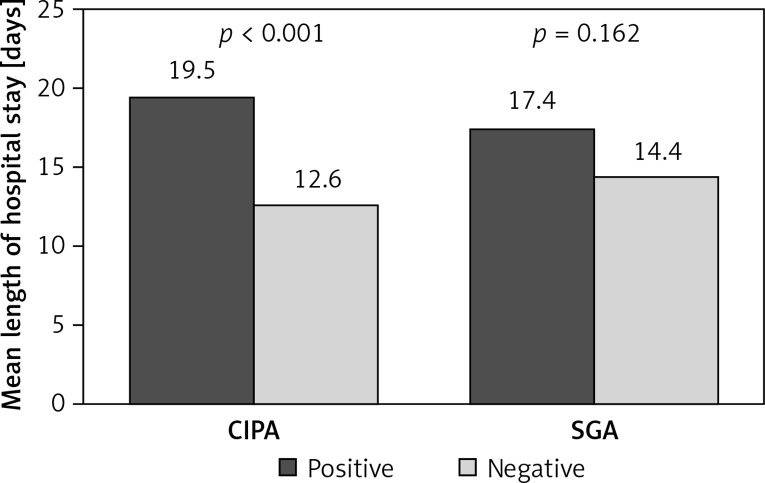
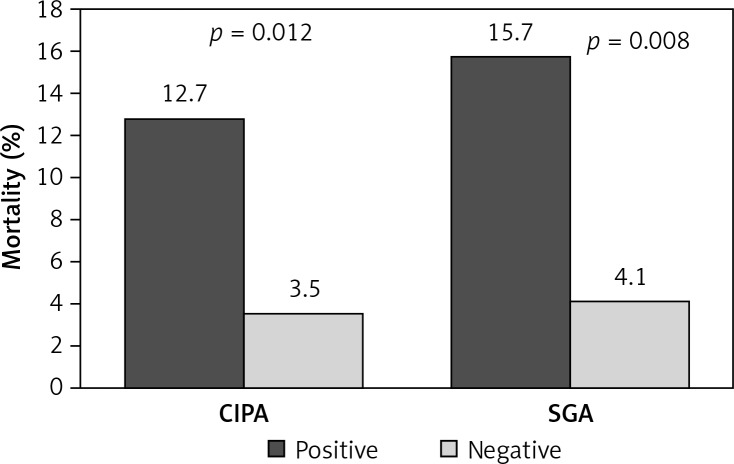
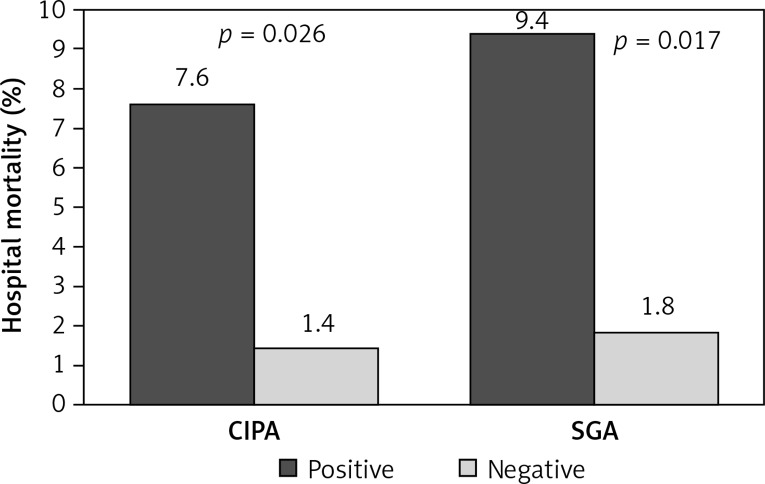
The prevalence or risk of malnutrition identified by CIPA and SGA was 35.7% and 23.1%, respectively. was 0.401 ( < 0.001); S and SP of CIPA vs. SGA were 72.5% and 75.3%, respectively. In contrast to SGA, CIPA-positive patients had an increased mean LOS compared to the negative ones (19.53 vs. 12.63 days, < 0.001). Both methods detected a major risk of mortality in positive patients, but no difference in early readmission.
The CIPA and the SGA screening tools detect patients with a higher risk of mortality, but only CIPA identifies patients with an increased mean LOS. CIPA screening proved valid for use in non-surgical inpatients.
目前尚无医院营养筛查的金标准方法。新的筛查工具“食物摄入量、蛋白质及人体测量学控制”(CIPA)在满足以下至少一项参数时呈阳性结果:72小时食物摄入量控制<50%、血清白蛋白<3g/dl、体重指数<18.5kg/m²或上臂中部周长≤22.5cm。该方法已在患有非手术疾病的住院患者中与主观全面评定法(SGA)进行了比较验证。
对连续纳入的221例患者进行了一项前瞻性纵向研究。在入院时采用CIPA与SGA筛查评估营养不良的患病率或风险,并研究两种方法之间的一致性(k指数)及其敏感性(S)和特异性(SP)。分析了平均住院时间(LOS)、死亡率和早期再入院率。
CIPA和SGA确定的营养不良患病率或风险分别为35.7%和23.1%。k指数为0.401(P<0.001);CIPA与SGA相比的敏感性和特异性分别为72.5%和75.3%。与SGA不同,CIPA阳性患者的平均住院时间比阴性患者长(19.53天对12.63天,P<0.001)。两种方法均检测出阳性患者有较高的死亡风险,但早期再入院率无差异。
CIPA和SGA筛查工具均能检测出死亡风险较高的患者,但只有CIPA能识别出平均住院时间延长的患者。CIPA筛查被证明适用于非手术住院患者。