Suárez-Llanos José Pablo, Vallejo-Torres Laura, García-Bello Miguel Ángel, Hernández-Carballo Carolina, Calderón-Ledezma Eduardo Mauricio, Rosat-Rodrigo Adriá, Delgado-Brito Irina, Pereyra-García-Castro Francisca, Benitez-Brito Nestor, Felipe-Pérez Nieves, Ramallo-Fariña Yolanda, Romero-Pérez Juan Carlos
Endocrinology and Nutrition Department, University Hospital Nuestra Señora de Candelaria, Santa Cruz de Tenerife, Spain.
Department of Quantitative Methods in Economics and Management, University of Las Palmas de Gran Canaria, Spain.
Arch Med Sci. 2019 Jan 11;16(2):273-281. doi: 10.5114/aoms.2018.81128. eCollection 2020.
Hospital malnutrition is very common and worsens the clinical course of patients while increasing costs. Lacking clinical-economic studies on the implementation of nutrition screening encouraged the evaluation of the CIPA (Control of Food Intake, Protein, Anthropometry) tool.
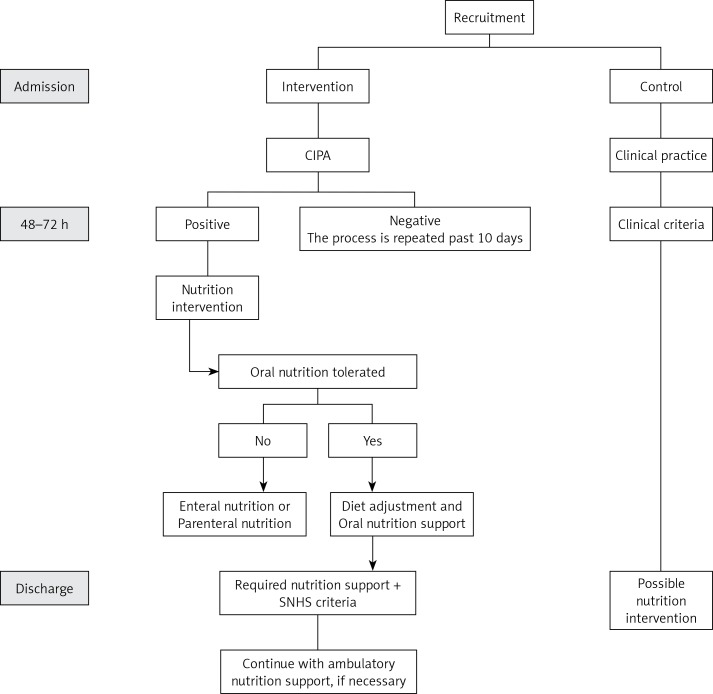
An open, non-randomized, controlled clinical trial was conducted on patients admitted to internal medicine and general and digestive surgery wards, who were either assigned to a control (standard hospital clinical care) or to an intervention, CIPA-performing ward (412 and 411, respectively; = 823). Length of stay, mortality, readmission, in-hospital complications, and quality of life were evaluated. Cost-effectiveness was analysed in terms of cost per quality-adjusted life years (QALYs).
The mean length of stay was higher in the CIPA group, though not significantly (+ 0.95 days; = 0.230). On the surgical ward, more patients from the control group moved to critical care units ( = 0.014); the other clinical variables did not vary. Quality of life at discharge was similar ( = 0.53), although slightly higher in the CIPA group at 3 months ( = 0.089). Patients under CIPA screening had a higher mean cost of € 691.6 and a mean QALY gain over a 3-month period of 0.0042. While the cost per QALY for the internal medicine patients was € 642 282, the results for surgical patients suggest that the screening tool is both less costly and more effective.
The CIPA nutrition screening tool is likely to be cost-effective in surgical but not in internal medicine patients.
医院营养不良非常普遍,会使患者的临床病程恶化,同时增加成本。缺乏关于营养筛查实施情况的临床经济学研究促使对CIPA(食物摄入量、蛋白质、人体测量学控制)工具进行评估。
对内科、普通外科和消化外科病房收治的患者进行了一项开放、非随机对照临床试验,这些患者被分配到对照组(标准医院临床护理)或干预组,即实施CIPA的病房(分别为412例和411例;共823例)。评估住院时间、死亡率、再入院率、院内并发症和生活质量。从每质量调整生命年(QALY)的成本角度分析成本效益。
CIPA组的平均住院时间较长,但差异无统计学意义(增加0.95天;P = 0.230)。在外科病房,对照组更多患者转入重症监护病房(P = 0.014);其他临床变量无差异。出院时的生活质量相似(P = 0.53),尽管CIPA组在3个月时略高(P = 0.089)。接受CIPA筛查的患者平均成本高出691.6欧元,在3个月期间平均QALY增益为0.0042。虽然内科患者每QALY的成本为642282欧元,但外科患者的结果表明筛查工具成本更低且更有效。
CIPA营养筛查工具在外科患者中可能具有成本效益,但在内科患者中并非如此。