Ismail Rola, Hansen Allan K, Parbo Peter, Brændgaard Hans, Gottrup Hanne, Brooks David J, Borghammer Per
Department of Nuclear Medicine and PET Centre, Aarhus University Hospital, Aarhus, Denmark.
Department of Neurology, Aarhus University Hospital, Aarhus, Denmark.
Int J Alzheimers Dis. 2018 Jul 30;2018:6852303. doi: 10.1155/2018/6852303. eCollection 2018.
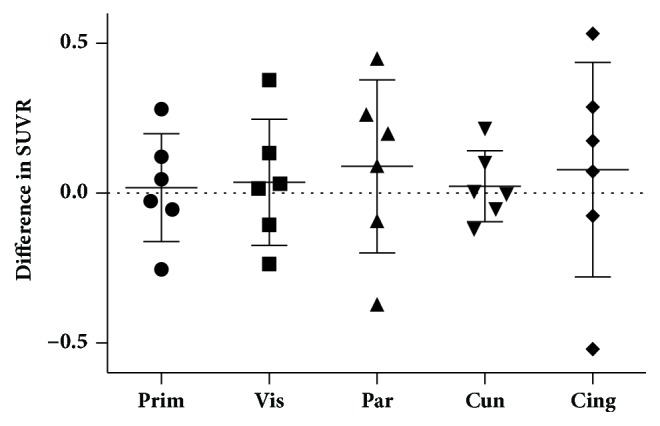
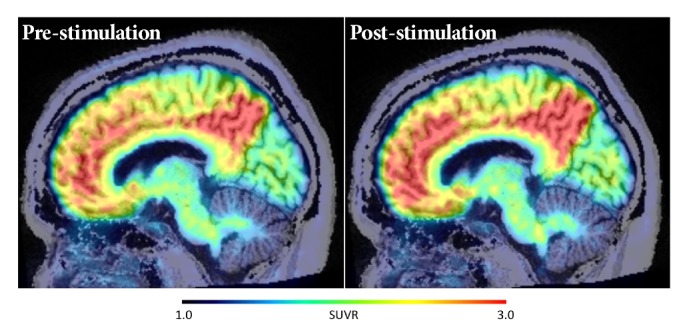
Alzheimer's disease (AD) is a progressive neurodegenerative disorder. AD pathology is characterized by abnormal aggregation of the proteins amyloid- (A) and hyperphosphorylated tau. No effective disease modifying therapies are currently available. A short-duration intervention with 40 Hz light flicker has been shown to reduce brain A load in transgenic mice. We aimed to test the effect of a similar short-duration 40 Hz light flicker regime in human AD patients. We utilized a Light Emitting Diode (LED) light bulb with a 40 Hz flicker. Six A positive patients received 10 days of light therapy, had 2 hours of daily exposure, and underwent a postintervention PiB PET on day 11. After 10 days of light therapy, no significant decrease of PiB SUVR values was detected in any volumes of interest tested (primary visual cortex, visual association cortex, lateral parietal cortex, precuneus, and posterior cingulate) or in the total motor cortex, and longer treatments may be necessary to induce amyloid removal in humans.
阿尔茨海默病(AD)是一种进行性神经退行性疾病。AD病理学的特征是蛋白质淀粉样蛋白-β(Aβ)异常聚集和tau蛋白过度磷酸化。目前尚无有效的疾病修饰疗法。已证明对转基因小鼠进行短时间的40赫兹光闪烁干预可降低脑内Aβ负荷。我们旨在测试类似的短时间40赫兹光闪烁方案对人类AD患者的影响。我们使用了一个具有40赫兹闪烁的发光二极管(LED)灯泡。六名Aβ阳性患者接受了10天的光疗,每天照射2小时,并在第11天进行了干预后匹兹堡化合物B(PiB)正电子发射断层扫描(PET)。经过10天的光疗后,在任何测试的感兴趣区域(初级视觉皮层、视觉联合皮层、外侧顶叶皮层、楔前叶和后扣带回)或整个运动皮层中均未检测到PiB标准化摄取值(SUVR)的显著降低,可能需要更长时间的治疗才能诱导人类脑内淀粉样蛋白清除。