1 College of Nursing, Washington State University, Spokane, WA, USA.
2 Program of Excellence in Addictions Research (PEAR), Washington State University, Spokane, WA, USA.
Clin Trials. 2018 Dec;15(6):587-599. doi: 10.1177/1740774518796151. Epub 2018 Aug 29.
BACKGROUND/AIMS: American Indian adults have some of the highest alcohol abstinence rates compared to the overall US population. Despite this, many American Indian people are more likely to concurrently use alcohol and illicit drugs and are less likely to participate and remain in outpatient treatment for alcohol and other drug use compared to the general US population. There is limited knowledge about effective interventions targeting alcohol and drug co-addiction among American Indian adults. Contingency management is a behavioral intervention designed to increase drug abstinence by offering monetary incentives in exchange for drug and alcohol negative urine samples. We aim to evaluate and describe a culturally tailored contingency management intervention to increase alcohol and other drug abstinence among American Indian adults residing in a Northern Plains reservation.
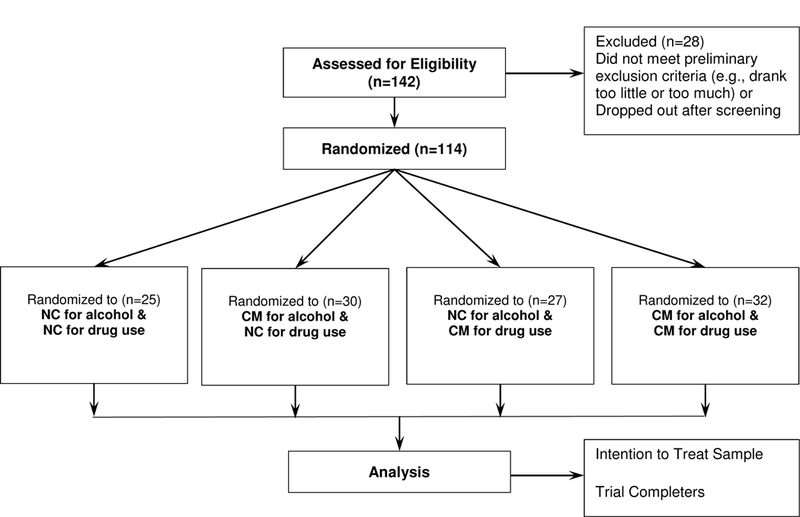
This 2 × 2 factorial, randomized controlled trial currently includes 114 American Indian adults with alcohol and/or drug dependence who are seeking treatment. Participants were randomized into one of four groups that received (1) contingency management for alcohol, (2) contingency management for other drug, (3) contingency management for both substances, or (4) no contingency management for either substance. We present descriptive, baseline data to characterize the sample and describe the modified contingency management approach that is specific to the community wherein this trial was being conducted.
The sample is 49.1% male, with an average age of 35.8 years (standard deviation = 10.4 years). At baseline, 43.0% of the sample tested positive for ethyl glucuronide, 50.9% of participants self-reported methamphetamine as their most used drug, 36.8% self-reported cannabis, and 12.3% self-reported prescription opiates as their most used drug. Among randomized participants, 47.4% tested positive for cannabis, 28.1% tested positive for methamphetamine, 16.7% tested positive for amphetamines, and 2.1% tested positive for opiates.
This is the first study to examine a culturally tailored contingency management intervention targeting co-addiction of two substances among American Indian adults. By establishing a tribal-university partnership to adapt, implement, and evaluate contingency management, we will increase the literature on evidence-based addiction treatments and research, while improving trust for addiction interventions among American Indian communities through ongoing collaboration. Moreover, results have implications for the use of contingency management as an intervention for co-addiction in any population.
背景/目的:与美国总人口相比,美国印第安成年人的酒精禁欲率最高。尽管如此,与美国总人口相比,许多美国印第安人更有可能同时使用酒精和非法药物,并且更不可能参加和留在门诊治疗酒精和其他药物使用。针对美国印第安成年人的酒精和药物双重成瘾,有效干预措施的知识有限。条件管理是一种行为干预措施,旨在通过提供金钱奖励来增加药物禁欲,以换取药物和酒精阴性尿液样本。我们的目标是评估和描述一种针对居住在北平原保留地的美国印第安成年人的文化适应条件管理干预措施,以增加他们的酒精和其他药物禁欲。
这是一项 2×2 因子随机对照试验,目前包括 114 名寻求治疗的酒精和/或药物依赖的美国印第安成年人。参与者被随机分配到四个组中的一个,分别接受(1)酒精的条件管理,(2)其他药物的条件管理,(3)两种物质的条件管理,或(4)两种物质都不接受条件管理。我们呈现描述性的基线数据,以描述样本并描述特定于进行该试验的社区的修改后的条件管理方法。
该样本中 49.1%为男性,平均年龄为 35.8 岁(标准差=10.4 岁)。在基线时,样本中 43.0%的人乙基葡萄糖醛酸检测呈阳性,50.9%的参与者报告甲基苯丙胺是他们最常使用的药物,36.8%的人报告大麻,12.3%的人报告处方阿片类药物是他们最常使用的药物。在随机分组的参与者中,47.4%的人检测出大麻阳性,28.1%的人检测出甲基苯丙胺阳性,16.7%的人检测出安非他命阳性,2.1%的人检测出阿片类药物阳性。
这是第一项研究,旨在检验一种针对美国印第安成年人两种物质共同成瘾的文化适应条件管理干预措施。通过建立部落-大学伙伴关系来适应、实施和评估条件管理,我们将增加有关循证成瘾治疗和研究的文献,同时通过持续合作增强美洲印第安社区对成瘾干预措施的信任。此外,结果对将条件管理作为任何人群中共同成瘾的干预措施具有启示意义。