Institute of Occupational Therapy, School of Health Professions, Zurich University of Applied Sciences, Winterthur, Switzerland.
Department of Family Medicine, CAPHRI School for Public Health and Primary Care, Maastricht University, Maastricht, The Netherlands.
PLoS One. 2018 Aug 29;13(8):e0202071. doi: 10.1371/journal.pone.0202071. eCollection 2018.
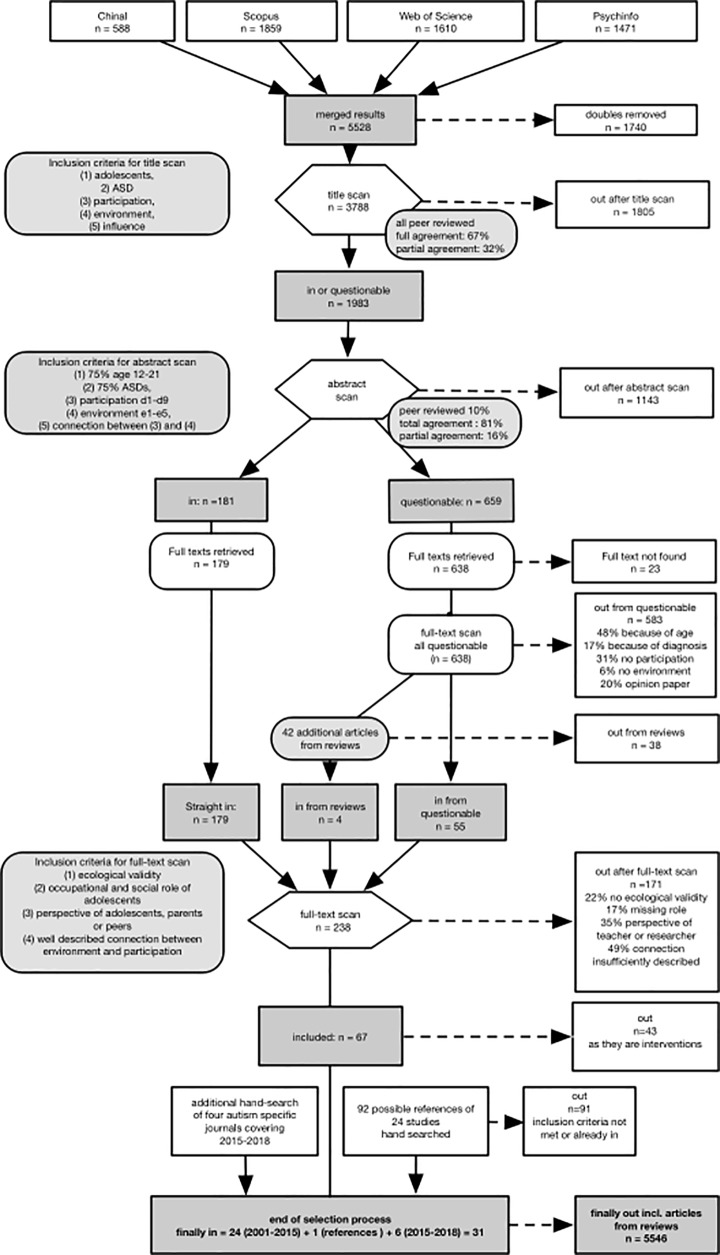
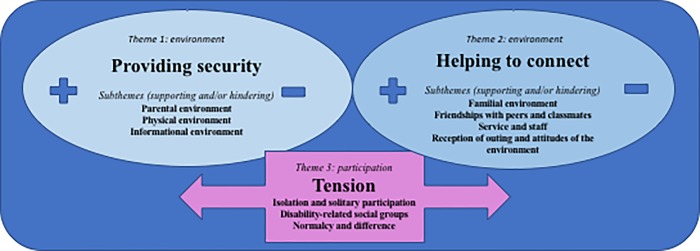
The influence of a person's environment and its modifying potential on participation is well recognized for most childhood disabilities, but scarcely studied for adolescents with autism spectrum disorder (ASD). A scoping review was conducted, the aim of which was to map the existing literature about supporting and hindering environments for the participation of adolescents with ASD. Sources of scientific evidence were searched for in four databases. Inclusion criteria were the perspectives of adolescents between 12 and 21, families, peers, or significant others; ecologic validity; and a clear connection between environment and participation. The publication dates ranged from 2001 to 2014 and partly up to 2018. The International Classification of Functioning, Disability and Health (ICF) served as the guiding framework for inclusion/exclusion during the selection process. Thematic analysis was performed by five independent reviewers. Results were additionally validated by stakeholders. This scoping review identified 5528 articles, and finally included 31 studies. Two main themes were found: "providing security" indicates how the environment, and specifically the parental, physical, and informational environments, have a securing or intimidating effect. The second theme, "helping to connect", indicates which environments support or hinder social relationships or social activities, and hence participation. An additional third main theme, "tension in participation", relates to ambiguities that seem essential to understand participation or isolation of adolescents with ASD. Results show that participation is a value-laden concept. This research widens the field of dealing with adolescents with ASD, as it directs attention towards the responsibility of the environment regarding participation.
环境及其修饰潜力对大多数儿童残疾者的参与有很大影响,但对自闭症谱系障碍(ASD)青少年的参与几乎没有研究。为此进行了范围界定审查,目的是绘制关于支持和阻碍自闭症青少年参与的环境的现有文献图。在四个数据库中搜索了科学证据来源。纳入标准为 12 至 21 岁的青少年、家庭、同龄人或重要他人的观点;生态效度;以及环境与参与之间的明确联系。出版日期从 2001 年到 2014 年,部分直到 2018 年。国际功能、残疾和健康分类(ICF)作为纳入/排除标准的指导框架在选择过程中。五位独立评审员进行了主题分析。结果由利益相关者进一步验证。这项范围界定审查确定了 5528 篇文章,最终纳入了 31 项研究。发现了两个主要主题:“提供安全”表明环境,特别是父母、物理和信息环境,具有安全或恐吓的影响。第二个主题是“帮助连接”,表明哪些环境支持或阻碍社会关系或社会活动,从而参与。第三个主要主题是“参与的紧张”,涉及到一些似乎对理解自闭症青少年的参与或孤立至关重要的模糊性。结果表明,参与是一个价值观念。这项研究拓宽了处理 ASD 青少年的领域,因为它关注环境对参与的责任。