Laboratory for Genome Engineering, Biological and Environmental Sciences and Engineering Division, King Abdullah University of Science and Technology, Thuwal, 23955-6900, Saudi Arabia.
The Bioactives Lab, Biological and Environmental Sciences and Engineering Division, King Abdullah University of Science and Technology, Thuwal, 23955-6900, Saudi Arabia.
BMC Plant Biol. 2018 Aug 29;18(1):174. doi: 10.1186/s12870-018-1387-1.
Precision plant genome engineering holds much promise for targeted improvement of crop traits via unprecedented single-base level control over the genetic material. Strigolactones (SLs) are a key determinant of plant architecture, known for their role in inhibiting shoot branching (tillering).
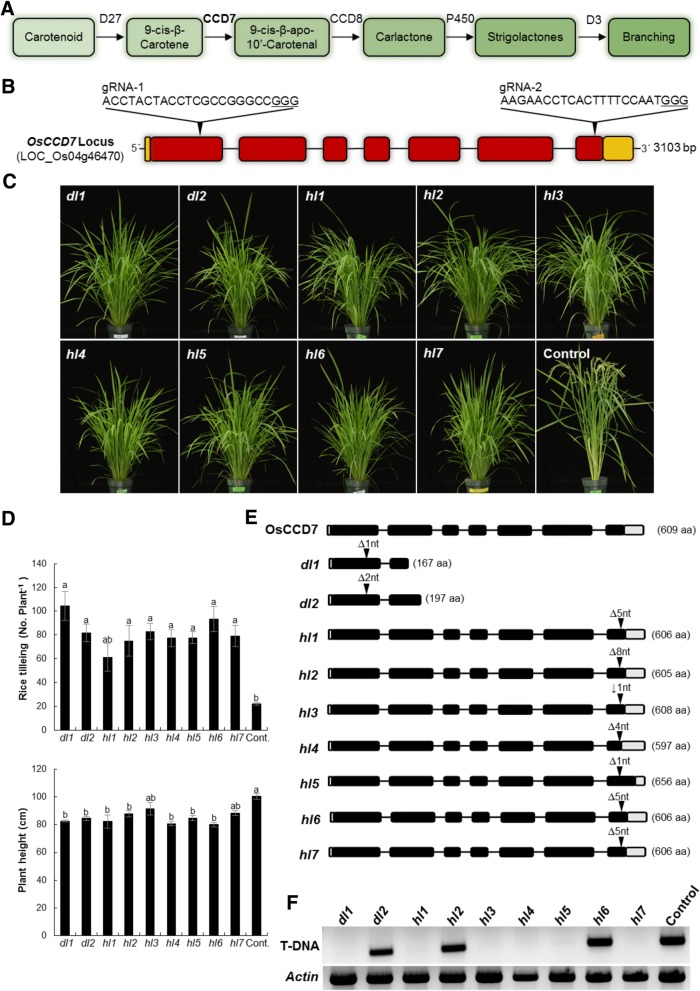
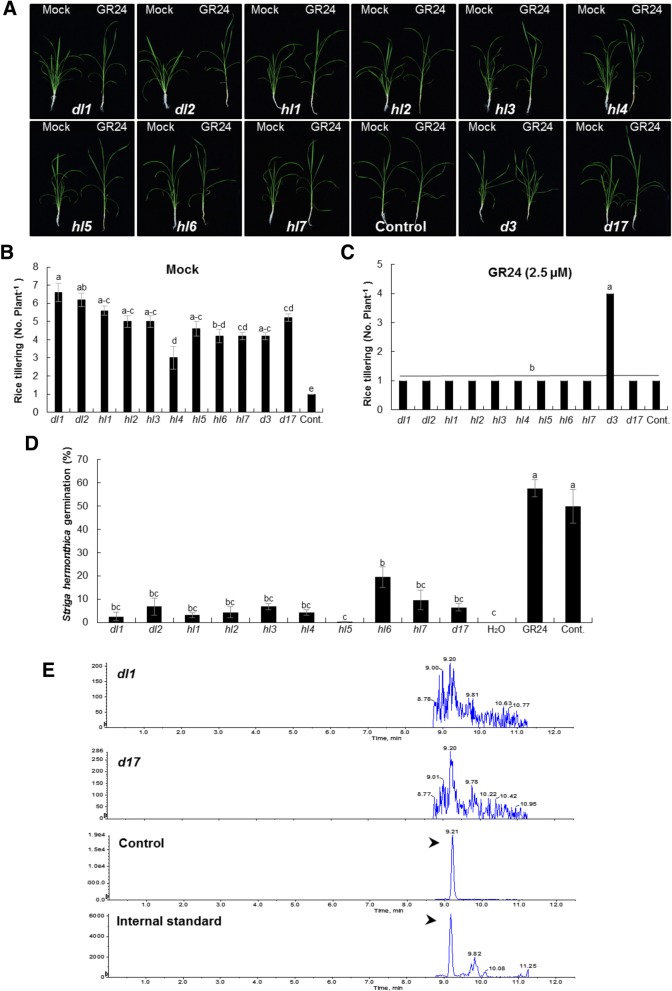
We used CRISPR/Cas9 in rice (Oryza sativa) for targeted disruption of CAROTENOID CLEAVAGE DIOXYGENASE 7 (CCD7), which controls a key step in SL biosynthesis. The ccd7 mutants exhibited a striking increase in tillering, combined with a reduced height, which could be rescued by application of the synthetic SL analog GR24. Striga germination assays and liquid chromatography-mass spectrometry analysis showed that root exudates of ccd7 mutants were also SL deficient.
Taken together, our results show the potential and feasibility of the use of the CRISPR/Cas9 system for targeted engineering of plant architecture and for elucidating the molecular underpinnings of architecture-related traits.
精准的植物基因组工程有望通过对遗传物质进行前所未有的单碱基水平控制,实现对作物性状的有针对性改良。独脚金内酯(SLs)是植物结构的一个关键决定因素,其在抑制 shoot branching(分蘖)方面的作用已广为人知。
我们在水稻(Oryza sativa)中使用 CRISPR/Cas9 对控制 SL 生物合成关键步骤的 CAROTENOID CLEAVAGE DIOXYGENASE 7(CCD7)进行靶向破坏。ccd7 突变体表现出分蘖显著增加,同时高度降低,这可以通过施用合成 SL 类似物 GR24 来挽救。Striga 萌发测定和液相色谱-质谱分析表明,ccd7 突变体的根分泌物也缺乏 SL。
总之,我们的研究结果表明,CRISPR/Cas9 系统在植物结构的靶向工程以及阐明与结构相关的性状的分子基础方面具有潜在的应用价值和可行性。