Watanabe H, Nakamura A
Infect Immun. 1986 Aug;53(2):352-8. doi: 10.1128/iai.53.2.352-358.1986.
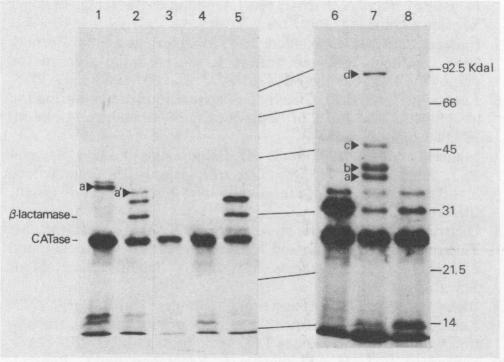
A series of Tn1 insertions in pSS120, the 120-megadalton form I plasmid of Shigella sonnei, were constructed by a Tn1-mediated conduction system previously described (H. Watanabe and A. Nakamura, Infect. Immun. 48:260-262, 1985, and screened for cell invasion in a tissue culture assay. The analysis of Tn1 insertion sites of seven noninvasive mutants suggested that four separate HindIII fragments were necessary for cell invasion. HindIII fragments including Tn1 of mutant plasmids were cloned into a vector plasmid, pACYC184. The DNA was used as a DNA probe to identify the corresponding, parental HindIII fragments. We identified one contiguous molecule of 2.6- and 4.1-kilobase pair (kb) HindIII fragments as being responsible for restoring cell invasiveness to the three mutant plasmids, pHW505, pHW510, and pHW511. Polypeptide analysis in minicells demonstrated that the contiguous HindIII fragments of 2.6 and 4.1 kb coded for at least four polypeptides, of 38, 41, 47, and 80 kilodaltons (kDa). A comparison of polypeptides synthesized by parental and mutant plasmids strongly suggested that the 38-kDa protein was essential for cell invasion. The 4.1-kb DNA which encoded the 38-kDa protein was conserved among plasmids of Shigella species and enteroinvasive Escherichia coli.
利用先前描述的Tn1介导的转导系统(H. 渡边和A. 中村,《感染与免疫》48:260 - 262, 1985)构建了一系列宋内志贺氏菌120兆道尔顿I型质粒pSS120中的Tn1插入突变体,并通过组织培养试验筛选细胞侵袭能力。对七个非侵袭性突变体的Tn1插入位点分析表明,细胞侵袭需要四个独立的HindIII片段。将包含突变体质粒Tn1的HindIII片段克隆到载体质粒pACYC184中。该DNA用作DNA探针来鉴定相应的亲本HindIII片段。我们鉴定出一个由2.6和4.1千碱基对(kb)的HindIII片段组成的连续分子,它负责恢复三个突变质粒pHW505、pHW510和pHW511的细胞侵袭性。在小细胞中的多肽分析表明,2.6和4.1 kb的连续HindIII片段编码至少四种多肽,分子量分别为38、41、47和80千道尔顿(kDa)。亲本质粒和突变体质粒合成的多肽比较强烈表明,38-kDa蛋白对细胞侵袭至关重要。编码38-kDa蛋白的4.1-kb DNA在志贺氏菌属质粒和肠侵袭性大肠杆菌中是保守的。