Downer Mary K, Martínez-González Miguel A, Gea Alfredo, Stampfer Meir, Warnberg Julia, Ruiz-Canela Miguel, Salas-Salvadó Jordi, Corella Dolores, Ros Emilio, Fitó Montse, Estruch Ramon, Arós Fernando, Fiol Miquel, Lapetra José, Serra-Majem Lluís, Bullo Monica, Sorli Jose V, Muñoz Miguel A, García-Rodriguez Antonio, Gutierrez-Bedmar Mario, Gómez-Gracia Enrique
Harvard T.H. Chan School of Public Health, Boston, USA.
Department of Preventive Medicine and Public Health, University of Navarra, Pamplona, Spain.
BMC Cardiovasc Disord. 2017 Jan 5;17(1):9. doi: 10.1186/s12872-016-0435-8.
Substantial evidence suggests that consuming 1-2 servings of fish per week, particularly oily fish (e.g., salmon, herring, sardines) is beneficial for cardiovascular health due to its high n-3 polyunsaturated fatty acid content. However, there is some concern that the mercury content in fish may increase cardiovascular disease risk, but this relationship remains unclear.
The PREDIMED trial included 7477 participants who were at high risk for cardiovascular disease at baseline. In this study, we evaluated associations between mercury exposure, fish consumption and cardiovascular disease. We randomly selected 147 of the 288 cases diagnosed with cardiovascular disease during follow-up and matched them on age and sex to 267 controls. Instrumental neutron activation analysis was used to assess toenail mercury concentration. In-person interviews, medical record reviews and validated questionnaires were used to assess fish consumption and other covariates. Information was collected at baseline and updated yearly during follow-up. We used conditional logistic regression to evaluate associations in the total nested case-control study, and unconditional logistic regression for population subsets.
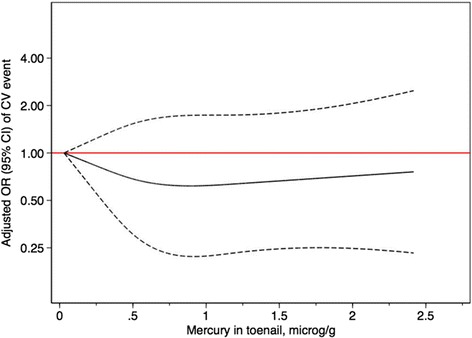
Mean (±SD) toenail mercury concentrations (μg per gram) did not significantly differ between cases (0.63 (±0.53)) and controls (0.67 (±0.49)). Mercury concentration was not associated with cardiovascular disease in any analysis, and neither was fish consumption or n-3 fatty acids. The fully-adjusted relative risks for the highest versus lowest quartile of mercury concentration were 0.71 (95% Confidence Interval [CI], 0.34, 1.14; p = 0.37) for the nested case-control study, 0.74 (95% CI, 0.32, 1.76; p = 0.43) within the Mediterranean diet intervention group, and 0.50 (95% CI, 0.13, 1.96; p = 0.41) within the control arm of the trial. Associations remained null when mercury was jointly assessed with fish consumption at baseline and during follow-up. Results were similar in different sensitivity analyses.
We found no evidence that mercury exposure from regular fish consumption increases cardiovascular disease risk in a population of Spanish adults with high cardiovascular disease risk and high fish consumption. This implies that the mercury content in fish does not detract from the already established cardiovascular benefits of fish consumption.
ISRCTN35739639 .
大量证据表明,每周食用1 - 2份鱼,尤其是油性鱼类(如鲑鱼、鲱鱼、沙丁鱼),因其富含n - 3多不饱和脂肪酸,对心血管健康有益。然而,有人担心鱼中的汞含量可能会增加心血管疾病风险,但这种关系仍不明确。
PREDIMED试验纳入了7477名基线时患有心血管疾病高风险的参与者。在本研究中,我们评估了汞暴露、鱼类消费与心血管疾病之间的关联。我们从随访期间确诊患有心血管疾病的288例病例中随机选取147例,并根据年龄和性别将其与267例对照进行匹配。采用仪器中子活化分析评估趾甲汞浓度。通过面对面访谈、病历审查和经过验证的问卷来评估鱼类消费及其他协变量。在基线时收集信息,并在随访期间每年更新。我们使用条件逻辑回归评估总巢式病例对照研究中的关联,对人群亚组使用无条件逻辑回归。
病例组(0.63(±0.53))和对照组(0.67(±0.49))的平均(±标准差)趾甲汞浓度(微克/克)无显著差异。在任何分析中,汞浓度均与心血管疾病无关,鱼类消费或n - 3脂肪酸也与心血管疾病无关。巢式病例对照研究中,汞浓度最高四分位数与最低四分位数相比,完全调整后的相对风险为0.71(95%置信区间[CI],0.34,1.14;p = 0.37);在地中海饮食干预组中为0.74(95% CI,0.32,1.76;p = 0.43);在试验对照组中为0.50(95% CI,0.13,1.96;p = 0.41)。在基线和随访期间将汞与鱼类消费联合评估时,关联仍为无效。不同敏感性分析的结果相似。
我们没有发现证据表明,在心血管疾病风险高且鱼类消费量高的西班牙成年人群中,经常食用鱼类导致的汞暴露会增加心血管疾病风险。这意味着鱼中的汞含量不会削弱鱼类消费已确定的心血管益处。
ISRCTN35739639 。