Faculty of Biophysics, Biochemistry and Biotechnology, Department of Cell Biology, Jagiellonian University, Gronostajowa 7, 30-378 Kraków, Poland.
Nencki Institute of Experimental Biology, Laboratory of Intracellular Ion Channels, 02-093 Warsaw, Poland.
Int J Mol Sci. 2018 Aug 29;19(9):2571. doi: 10.3390/ijms19092571.
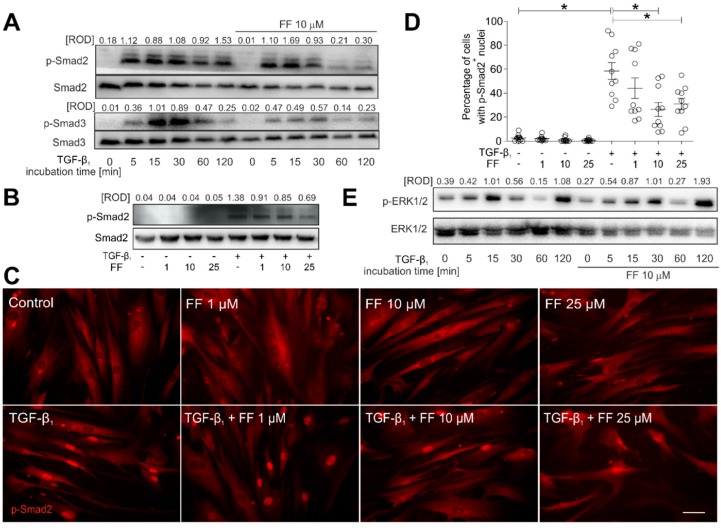
The activation of human bronchial fibroblasts by transforming growth factor-β₁ (TGF-β₁) leads to the formation of highly contractile myofibroblasts in the process of the fibroblast⁻myofibroblast transition (FMT). This process is crucial for subepithelial fibrosis and bronchial wall remodeling in asthma. However, this process evades current therapeutic asthma treatment strategies. Since our previous studies showed the attenuation of the TGF-β₁-induced FMT in response to lipid-lowering agents (e.g., statins), we were interested to see whether a corresponding effect could be obtained upon administration of hypolipidemic agents. In this study, we investigated the effect of fenofibrate on FMT efficiency in populations of bronchial fibroblasts derived from asthmatic patients. Fenofibrate exerted a dose-dependent inhibitory effect on the FMT, even though it did not efficiently affect the expression of α-smooth muscle actin (α-SMA; marker of myofibroblasts); however, it considerably reduced its incorporation into stress fibers through connexin 43 regulation. This effect was accompanied by disturbances in the actin cytoskeleton architecture, impairments in the maturation of focal adhesions, and the fenofibrate-induced deactivation of TGF-β₁/Smad2/3 signaling. These data suggest that fenofibrate interferes with myofibroblastic differentiation during asthma-related subepithelial fibrosis. The data indicate the potential application of fenofibrate in the therapy and prevention of bronchial remodeling during the asthmatic process.
人支气管成纤维细胞被转化生长因子-β₁(TGF-β₁)激活后,会在成纤维细胞-肌成纤维细胞转化(FMT)过程中形成高度收缩的肌成纤维细胞。这个过程对于哮喘患者的上皮下纤维化和支气管壁重塑至关重要。然而,这个过程避开了目前治疗哮喘的策略。由于我们之前的研究表明,降脂药(如他汀类药物)可以减弱 TGF-β₁诱导的 FMT,我们想知道给予降脂药是否能获得相应的效果。在这项研究中,我们研究了非诺贝特对哮喘患者来源的支气管成纤维细胞群体中 FMT 效率的影响。非诺贝特对 FMT 具有剂量依赖性的抑制作用,尽管它不能有效地影响α-平滑肌肌动蛋白(α-SMA;肌成纤维细胞的标志物)的表达;然而,它通过连接蛋白 43 的调节,显著减少了其整合到应激纤维中。这种作用伴随着细胞骨架结构的紊乱,焦点粘连的成熟受损,以及非诺贝特诱导的 TGF-β₁/Smad2/3 信号的失活。这些数据表明,非诺贝特在哮喘相关上皮下纤维化的肌成纤维细胞分化过程中发挥干扰作用。这些数据表明,非诺贝特在哮喘过程中具有在治疗和预防支气管重塑方面的应用潜力。