Haenfler Jill M, Skariah Geena, Rodriguez Caitlin M, Monteiro da Rocha Andre, Parent Jack M, Smith Gary D, Todd Peter K
Department of Neurology, University of Michigan, Ann Arbor, MI, United States.
Department of Molecular, Cellular and Developmental Biology, University of Michigan, Ann Arbor, MI, United States.
Front Mol Neurosci. 2018 Aug 15;11:282. doi: 10.3389/fnmol.2018.00282. eCollection 2018.
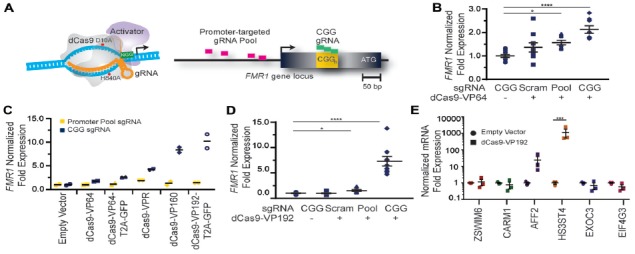
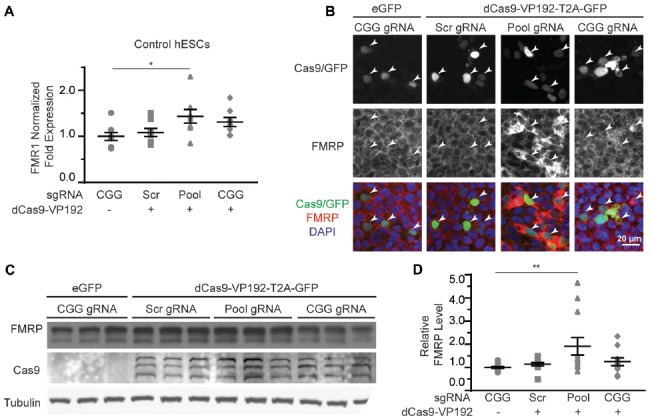
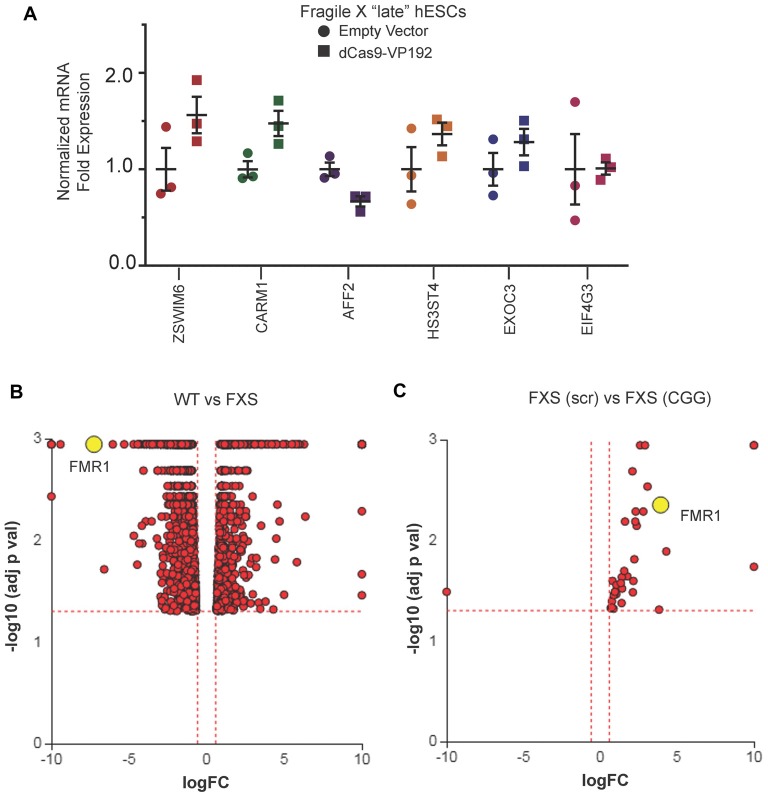
Fragile X Syndrome (FXS) is the most common inherited cause of intellectual disability and autism. It results from expansion of a CGG nucleotide repeat in the 5' untranslated region (UTR) of . Large expansions elicit repeat and promoter hyper-methylation, heterochromatin formation, transcriptional silencing and loss of the Fragile X protein, FMRP. Efforts aimed at correcting the sequelae resultant from FMRP loss have thus far proven insufficient, perhaps because of FMRP's pleiotropic functions. As the repeats do not disrupt the FMRP coding sequence, reactivation of endogenous gene expression could correct the proximal event in FXS pathogenesis. Here we utilize the Clustered Regularly Interspaced Palindromic Repeats/deficient CRISPR associated protein 9 (CRISPR/dCas9) system to selectively re-activate transcription from the silenced locus. Fusion of the transcriptional activator VP192 to dCas9 robustly enhances transcription and increases FMRP levels when targeted directly to the CGG repeat in human cells. Using a previously uncharacterized FXS human embryonic stem cell (hESC) line which acquires transcriptional silencing with serial passaging, we achieved locus-specific transcriptional re-activation of messenger RNA (mRNA) expression despite promoter and repeat methylation. However, these changes at the transcript level were not coupled with a significant elevation in FMRP protein expression in FXS cells. These studies demonstrate that directing a transcriptional activator to CGG repeats is sufficient to selectively reactivate mRNA expression in Fragile X patient stem cells.
脆性X综合征(FXS)是智力残疾和自闭症最常见的遗传性病因。它是由[具体基因名称]5'非翻译区(UTR)中CGG核苷酸重复序列的扩增引起的。大量扩增导致重复序列和启动子高甲基化、异染色质形成、转录沉默以及脆性X蛋白FMRP的缺失。迄今为止,旨在纠正FMRP缺失所导致后果的努力已被证明是不够的,这可能是由于FMRP具有多效性功能。由于这些重复序列不会破坏FMRP编码序列,内源性基因表达的重新激活可以纠正FXS发病机制中的近端事件。在这里,我们利用成簇规律间隔短回文重复序列/缺失CRISPR相关蛋白9(CRISPR/dCas9)系统来选择性地重新激活沉默的[具体基因名称]位点的转录。当将转录激活因子VP192与dCas9融合并直接靶向人类细胞中的CGG重复序列时,可有力地增强转录并提高FMRP水平。使用一种先前未被表征的FXS人类胚胎干细胞(hESC)系,该细胞系在连续传代过程中会发生转录沉默,尽管存在启动子和重复序列甲基化,我们仍实现了[具体基因名称]信使RNA(mRNA)表达的位点特异性转录重新激活。然而,FXS细胞中这些转录水平的变化并未伴随着FMRP蛋白表达的显著升高。这些研究表明,将转录激活因子导向CGG重复序列足以在脆性X综合征患者干细胞中选择性地重新激活[具体基因名称]mRNA表达。