Kou Shan Shan, Yuan Guanghui, Wang Qian, Du Luping, Balaur Eugeniu, Zhang Daohua, Tang Dingyuan, Abbey Brian, Yuan Xiao-Cong, Lin Jiao
Department of Chemistry and Physics, La Trobe Institute for Molecular Science (LIMS), La Trobe University, Melbourne, VIC 3086, Australia.
Australian Research Council Centre of Excellence for Advanced Molecular Imaging, Australia.
Light Sci Appl. 2016 Feb 26;5(2):e16034. doi: 10.1038/lsa.2016.34. eCollection 2016 Feb.
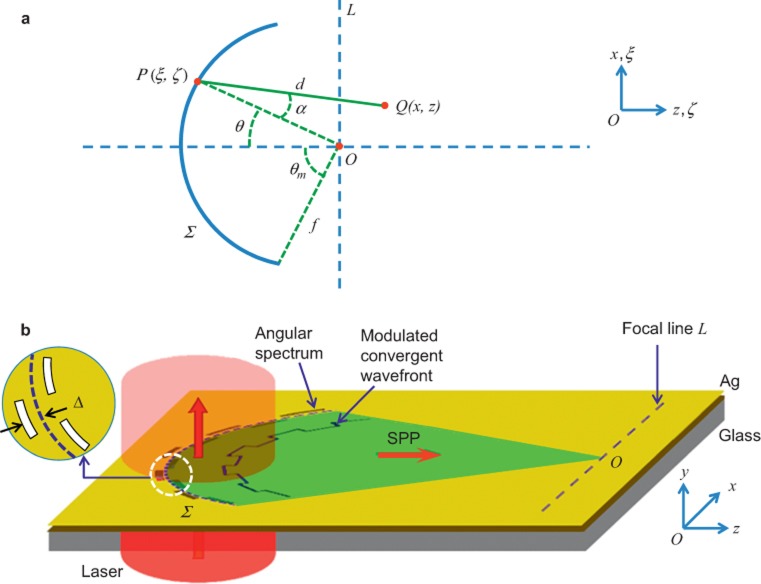
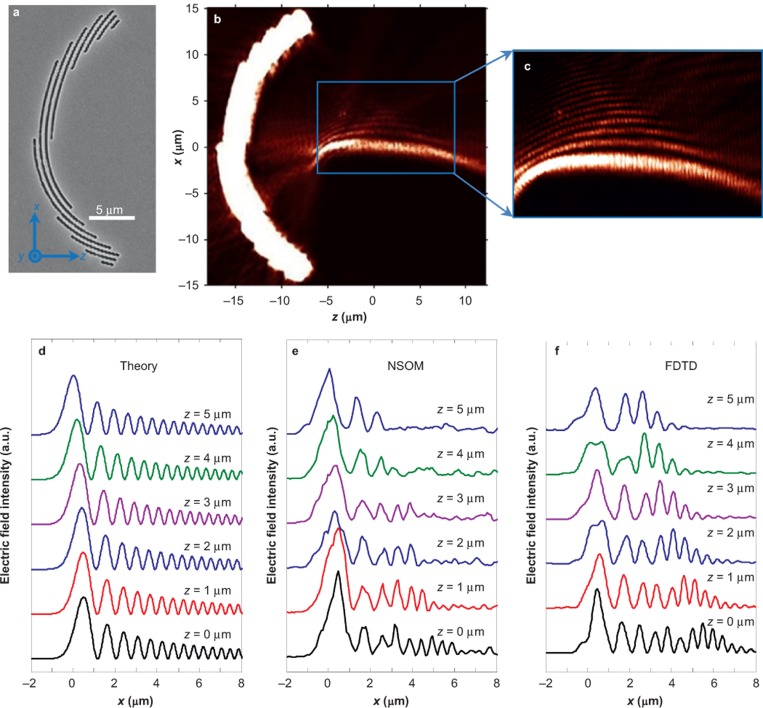
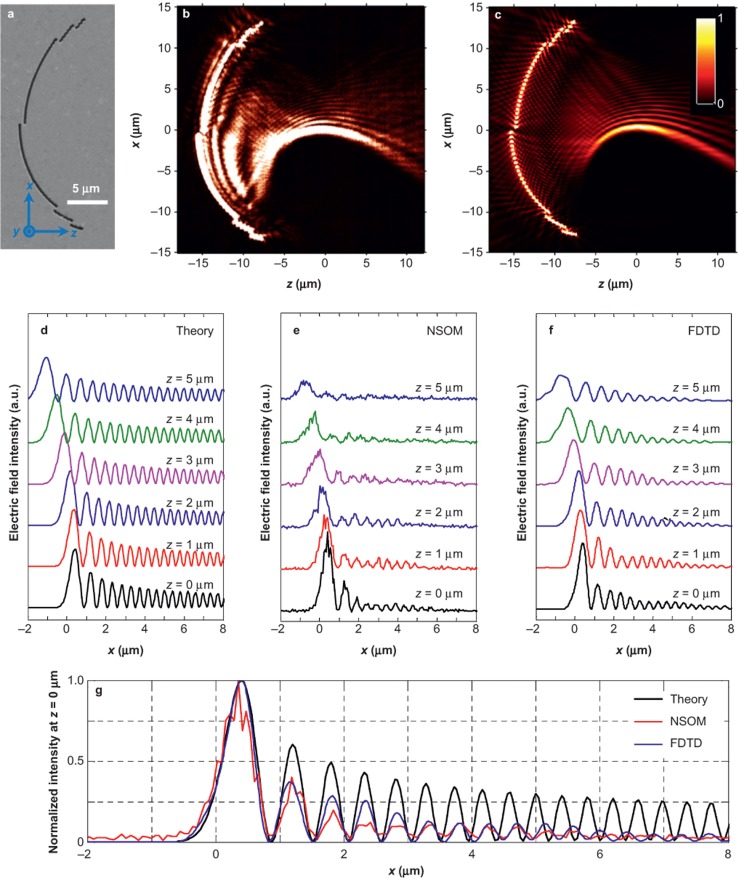
The Fourier transform (FT), a cornerstone of optical processing, enables rapid evaluation of fundamental mathematical operations, such as derivatives and integrals. Conventionally, a converging lens performs an optical FT in free space when light passes through it. The speed of the transformation is limited by the thickness and the focal length of the lens. By using the wave nature of surface plasmon polaritons (SPPs), here we demonstrate that the FT can be implemented in a planar configuration with a minimal propagation distance of around 10 μm, resulting in an increase of speed by four to five orders of magnitude. The photonic FT was tested by synthesizing intricate SPP waves with their Fourier components. The reduced dimensionality in the minuscule device allows the future development of an ultrafast on-chip photonic information processing platform for large-scale optical computing.
傅里叶变换(FT)是光学处理的基石,它能够快速评估诸如导数和积分等基本数学运算。传统上,当光穿过会聚透镜时,它会在自由空间中执行光学傅里叶变换。变换速度受透镜厚度和焦距的限制。通过利用表面等离激元极化子(SPP)的波动特性,我们在此证明傅里叶变换可以在平面配置中实现,传播距离最小约为10μm,从而使速度提高四到五个数量级。通过用其傅里叶分量合成复杂的表面等离激元极化子波,对光子傅里叶变换进行了测试。这种微型器件中维度的减小为大规模光学计算的超快片上光子信息处理平台的未来发展提供了可能。