Maruta Yuichi, Hasegawa Takeshi, Yamakoshi Etsuko, Nishiwaki Hiroki, Koiwa Fumihiko, Imai Enyu, Hishida Akira
Division of Nephrology (Fujigaoka Hospital), Department of Medicine, Showa University School of Medicine, Yokohama, Japan.
Office for Promoting Medical Research, Showa University, 1-5-8 Hatanodai, Shinagawa-ku, Tokyo, 142-8555, Japan.
Clin Exp Nephrol. 2019 Feb;23(2):215-222. doi: 10.1007/s10157-018-1631-x. Epub 2018 Aug 24.
Metabolic acidosis, which reduces serum bicarbonate levels, contributes to the progression of chronic kidney disease (CKD). The difference between sodium and chloride (Na-Cl) may theoretically predict serum bicarbonate levels. This study aimed to evaluate serum Na-Cl level as a risk factor for renal function decline among patients who participated in the chronic kidney disease Japan cohort (CKD-JAC) study.
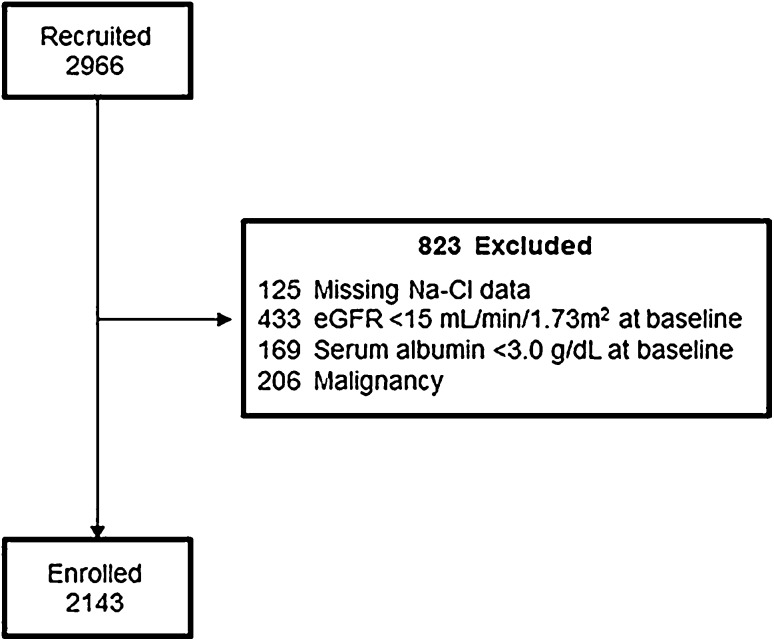
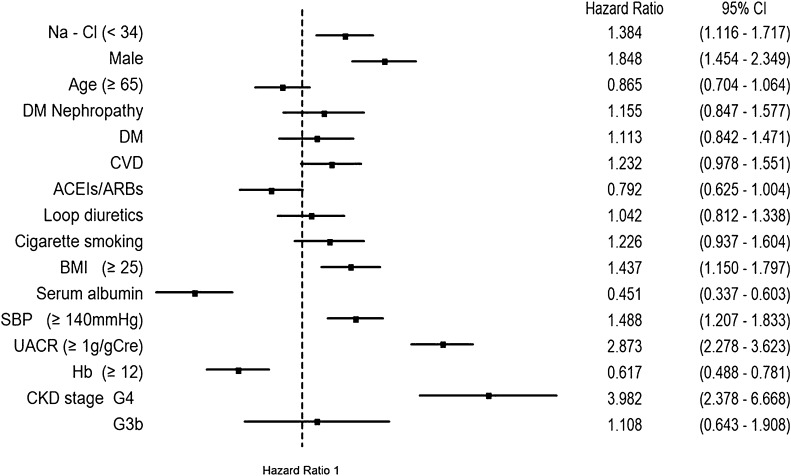
The association between low Na-Cl concentration (< 34 mmol/L) and composite renal function decline events (any initiation of renal replacement therapy or 50% decline in estimated glomerular filtration rate) was evaluated among 2143 patients with CKD stage G3a-4. Using Cox regression analysis, hazard ratios (HRs) were estimated after adjusting for the following covariates: age, sex, diabetes mellitus, diabetic nephropathy, cardiovascular disease, anemia, angiotensin-converting enzyme inhibitors and angiotensin II receptor antagonists, loop diuretics, cigarette smoking, body mass index, serum albumin, systolic blood pressure, urine albumin-to-creatinine ratio, and CKD stage.
Composite renal function decline events were observed in 405 patients (18.9%) over the 4-year follow-up period. Low serum Na-Cl level (< 34 mmol/L) was independently associated with a greater risk for composite renal function decline events (HR 1.384; 95% confidence interval [CI], 1.116-1.717). Subgroup analyses identified that the association between low Na-Cl level and composite renal function decline events was stronger among patients with CKD stage G4 and those with anemia.
Our investigation suggests that Na-Cl is an independent predictor of CKD progression, especially among patients with CKD stage G4 and those with anemia.
代谢性酸中毒会降低血清碳酸氢盐水平,促进慢性肾脏病(CKD)的进展。理论上,钠与氯的差值(Na-Cl)可能预测血清碳酸氢盐水平。本研究旨在评估血清Na-Cl水平作为参与日本慢性肾脏病队列(CKD-JAC)研究患者肾功能下降的危险因素。
在2143例G3a-4期CKD患者中,评估低Na-Cl浓度(<34 mmol/L)与复合肾功能下降事件(开始肾脏替代治疗或估算肾小球滤过率下降50%)之间的关联。采用Cox回归分析,在调整以下协变量后估计风险比(HR):年龄、性别、糖尿病、糖尿病肾病、心血管疾病、贫血、血管紧张素转换酶抑制剂和血管紧张素II受体拮抗剂、襻利尿剂、吸烟、体重指数、血清白蛋白、收缩压、尿白蛋白与肌酐比值以及CKD分期。
在4年随访期内,405例患者(18.9%)发生了复合肾功能下降事件。低血清Na-Cl水平(<34 mmol/L)与复合肾功能下降事件的风险增加独立相关(HR 1.384;95%置信区间[CI],1.116-1.717)。亚组分析发现,在G4期CKD患者和贫血患者中,低Na-Cl水平与复合肾功能下降事件之间的关联更强。
我们的研究表明,Na-Cl是CKD进展的独立预测因素,尤其是在G4期CKD患者和贫血患者中。