Division of Pediatric Nephrology, Children's National Hospital, Washington, DC.
Johns Hopkins Bloomberg School of Public Health, Baltimore, Maryland.
Clin J Am Soc Nephrol. 2020 Jun 8;15(6):755-765. doi: 10.2215/CJN.07060619. Epub 2020 May 28.
Studies of adults have demonstrated an association between metabolic acidosis, as measured by low serum bicarbonate levels, and CKD progression. We evaluated this relationship in children using data from the Chronic Kidney Disease in Children study.
DESIGN, SETTING, PARTICIPANTS, & MEASUREMENTS: The relationship between serum bicarbonate and a composite end point, defined as 50% decline in eGFR or KRT, was described using parametric and semiparametric survival methods. Analyses were stratified by underlying nonglomerular and glomerular diagnoses, and adjusted for demographic characteristics, eGFR, proteinuria, anemia, phosphate, hypertension, and alkali therapy.
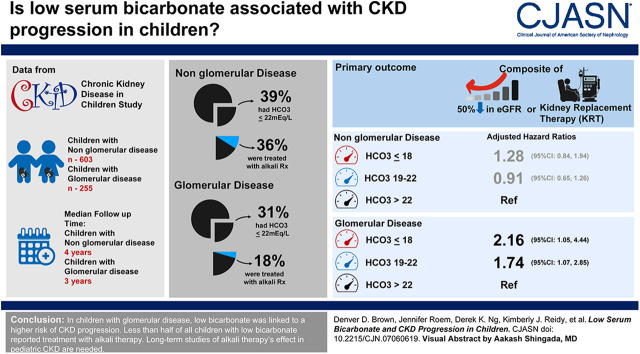
Six hundred and three participants with nonglomerular disease contributed 2673 person-years of follow-up, and 255 with a glomerular diagnosis contributed 808 person-years of follow-up. At baseline, 39% (237 of 603) of participants with nonglomerular disease had a bicarbonate level of ≤22 meq/L and 36% (85 of 237) of those participants reported alkali therapy treatment. In participants with glomerular disease, 31% (79 of 255) had a bicarbonate of ≤22 meq/L, 18% (14 of 79) of those participants reported alkali therapy treatment. In adjusted longitudinal analyses, compared with participants with a bicarbonate level >22 meq/L, hazard ratios associated with a bicarbonate level of <18 meq/L and 19-22 meq/L were 1.28 [95% confidence interval (95% CI), 0.84 to 1.94] and 0.91 (95% CI, 0.65 to 1.26), respectively, in children with nonglomerular disease. In children with glomerular disease, adjusted hazard ratios associated with bicarbonate level ≤18 meq/L and bicarbonate 19-22 meq/L were 2.16 (95% CI, 1.05 to 4.44) and 1.74 (95% CI, 1.07 to 2.85), respectively. Resolution of low bicarbonate was associated with a lower risk of CKD progression compared with persistently low bicarbonate (≤22 meq/L).
In children with glomerular disease, low bicarbonate was linked to a higher risk of CKD progression. Resolution of low bicarbonate was associated with a lower risk of CKD progression. Fewer than one half of all children with low bicarbonate reported treatment with alkali therapy. Long-term studies of alkali therapy's effect in patients with pediatric CKD are needed.
成人研究表明,血清碳酸氢盐水平低(代谢性酸中毒的衡量标准)与 CKD 进展之间存在关联。我们使用慢性肾脏病儿童研究的数据评估了儿童中的这种关系。
设计、设置、参与者和测量:使用参数和半参数生存方法描述了血清碳酸氢盐与复合终点(定义为 eGFR 下降 50%或 KRT)之间的关系。分析按非肾小球和肾小球基础诊断分层,并根据人口统计学特征、eGFR、蛋白尿、贫血、磷酸盐、高血压和碱治疗进行调整。
2673 人年的随访中,39%(603 名参与者中的 237 名)患有非肾小球疾病,808 人年的随访中,255 名参与者患有肾小球疾病。基线时,39%(603 名参与者中的 237 名)患有非肾小球疾病的患者碳酸氢盐水平≤22meq/L,其中 36%(237 名患者中的 85 名)报告接受碱治疗。在患有肾小球疾病的参与者中,31%(255 名参与者中的 79 名)碳酸氢盐水平≤22meq/L,其中 18%(79 名患者中的 14 名)报告接受碱治疗。在调整后的纵向分析中,与碳酸氢盐水平>22meq/L 的参与者相比,碳酸氢盐水平<18meq/L 和 19-22 meq/L 的参与者的危险比分别为 1.28[95%置信区间(95%CI)为 0.84-1.94]和 0.91(95%CI 为 0.65-1.26)。在患有肾小球疾病的儿童中,碳酸氢盐水平≤18meq/L 和碳酸氢盐 19-22 meq/L 与较低的 CKD 进展风险相关的调整后的危险比分别为 2.16(95%CI 为 1.05-4.44)和 1.74(95%CI 为 1.07-2.85)。与持续低碳酸氢盐(≤22meq/L)相比,低碳酸氢盐的缓解与 CKD 进展的风险较低相关。
在患有肾小球疾病的儿童中,低碳酸氢盐与 CKD 进展风险增加有关。低碳酸氢盐的缓解与 CKD 进展的风险降低有关。报告接受碱治疗的低碳酸氢盐患儿不足一半。需要对碱治疗对小儿 CKD 患者的影响进行长期研究。