• 文献检索
  • 文档翻译
  • 深度研究
  • 学术资讯
  • Suppr Zotero 插件Zotero 插件
  • 邀请有礼
  • 套餐&价格
  • 历史记录
应用&插件
Suppr Zotero 插件Zotero 插件浏览器插件Mac 客户端Windows 客户端微信小程序
定价
高级版会员购买积分包购买API积分包
服务
文献检索文档翻译深度研究API 文档MCP 服务
关于我们
关于 Suppr公司介绍联系我们用户协议隐私条款
关注我们

Suppr 超能文献

核心技术专利:CN118964589B侵权必究
粤ICP备2023148730 号-1Suppr @ 2026

文献检索

告别复杂PubMed语法,用中文像聊天一样搜索,搜遍4000万医学文献。AI智能推荐,让科研检索更轻松。

立即免费搜索

文件翻译

保留排版,准确专业,支持PDF/Word/PPT等文件格式,支持 12+语言互译。

免费翻译文档

深度研究

AI帮你快速写综述,25分钟生成高质量综述,智能提取关键信息,辅助科研写作。

立即免费体验

德国早发性和晚发性痴呆晚期和终末期患者姑息治疗中的问题(EPYLOGE):研究方案。

IssuEs in Palliative care for people in advanced and terminal stages of Young-onset and Late-Onset dementia in GErmany (EPYLOGE): the study protocol.

机构信息

Department of Psychiatry and Psychotherapy, Technical University of Munich, Ismaninger Str.22, 81675, Munich, Germany.

Münchner Studienzentrum, Technical University of Munich, Munich, Germany.

出版信息

BMC Psychiatry. 2018 Aug 31;18(1):271. doi: 10.1186/s12888-018-1846-0.

DOI:10.1186/s12888-018-1846-0
PMID:30170575
原文链接:https://pmc.ncbi.nlm.nih.gov/articles/PMC6119330/
Abstract

BACKGROUND

Scientific research on palliative care in dementia is still underdeveloped. In particular, there are no research studies at all on palliative care issues in young onset dementia (YOD), although significant differences compared to late onset dementia (LOD) are expected. Most studies have focused on persons with dementia in long term care (LTC) facilities but have neglected persons that are cared for at home. We hypothesize that unmet care needs exist in advanced and terminal stages of YOD and LOD and that they differ between YOD and LOD.

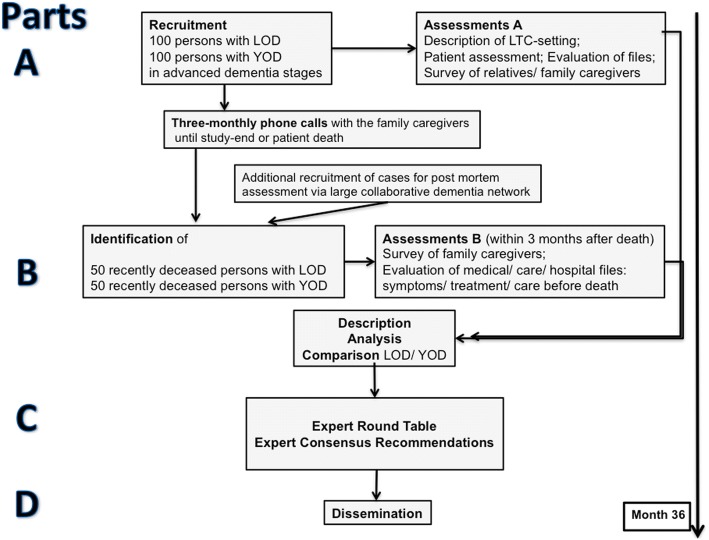
METHODS/DESIGN: The EPYLOGE-study (IssuEs in Palliative care for people in advanced and terminal stages of Young-onset and Late-Onset dementia in GErmany) aims to prospectively assess and survey 200 persons with YOD and LOD in advanced stages who are cared for in LTC facilities and at home. Furthermore, EPYLOGE aims to investigate the circumstances of death of 100 persons with YOD and LOD. This includes 1) describing symptoms and management, health care utilization, palliative care provision, quality of life and death, elements of advance care planning, family caregivers' needs and satisfaction; 2) comparing YOD and LOD regarding these factors; 3) developing expert-consensus recommendations derived from the study results for the improvement and implementation of strategies and interventions for palliative care provision; 4) and communicating the recommendations nationally and internationally in order to improve and adapt guidelines, to change current practice and to give a basis and perspectives for future research projects. The results will also be communicated to patients and their families in order to counsel and support them in their decision making processes and their dialogue with professional caregivers and physicians.

DISCUSSION

EPYLOGE is the first study in Germany that assesses palliative care and end-of-life issues in dementia. Furthermore, it is the first study internationally that focuses on the specific palliative care situation of persons with YOD and their families. EPYLOGE serves as a basis for the improvement of palliative care in dementia.

TRIAL REGISTRATION

The study is registered in ClinicalTrials.gov ( NCT03364179 ; Registered: 6. December 2017.

摘要

背景

痴呆症的姑息治疗科学研究仍不发达。特别是,在早发性痴呆症(YOD)中,没有关于姑息治疗问题的研究,尽管与晚发性痴呆症(LOD)相比,预计会有明显的差异。大多数研究都集中在长期护理(LTC)机构中的痴呆症患者身上,但忽视了在家中接受护理的患者。我们假设,在 YOD 和 LOD 的晚期和终末期存在未满足的护理需求,并且这些需求在 YOD 和 LOD 之间存在差异。

方法/设计:EPYLOGE 研究(德国早发性和晚发性痴呆症晚期和终末期姑息治疗问题)旨在前瞻性评估和调查 200 名在 LTC 机构和家中接受护理的晚期 YOD 和 LOD 患者。此外,EPYLOGE 旨在调查 100 名 YOD 和 LOD 患者的死亡情况。这包括 1)描述症状和管理、医疗保健利用、姑息治疗提供、生活质量和死亡、预先护理计划要素、家庭照顾者的需求和满意度;2)比较 YOD 和 LOD 在这些因素方面的差异;3)从研究结果中为姑息治疗提供策略和干预措施的改进和实施制定专家共识建议;4)在国家和国际上宣传这些建议,以改善和调整指南,改变当前实践,并为未来的研究项目提供基础和观点。研究结果也将传达给患者及其家属,以便在他们的决策过程中为他们提供咨询和支持,并与专业护理人员和医生进行对话。

讨论

EPYLOGE 是德国第一项评估痴呆症姑息治疗和临终问题的研究。此外,它是国际上第一项关注 YOD 患者及其家属特定姑息治疗情况的研究。EPYLOGE 为改善痴呆症姑息治疗提供了基础。

试验注册

该研究在 ClinicalTrials.gov 注册(NCT03364179;注册日期:2017 年 12 月 6 日)。
https://cdn.ncbi.nlm.nih.gov/pmc/blobs/50fd/6119330/068c6f267347/12888_2018_1846_Fig1_HTML.jpg

相似文献

1
IssuEs in Palliative care for people in advanced and terminal stages of Young-onset and Late-Onset dementia in GErmany (EPYLOGE): the study protocol.德国早发性和晚发性痴呆晚期和终末期患者姑息治疗中的问题(EPYLOGE):研究方案。
BMC Psychiatry. 2018 Aug 31;18(1):271. doi: 10.1186/s12888-018-1846-0.
2
Quality of Life in Advanced Dementia with Late Onset, Young Onset, and Very Young Onset.晚期发病、早发性和极早发性痴呆患者的生活质量。
J Alzheimers Dis. 2021;80(1):283-297. doi: 10.3233/JAD-201302.
3
How Do Persons with Young and Late Onset Dementia Die?早发性和晚发性痴呆患者的死亡方式有哪些?
J Alzheimers Dis. 2021;81(2):843-852. doi: 10.3233/JAD-210046.
4
Predictors of the time to institutionalization in young- versus late-onset dementia: results from the Needs in Young Onset Dementia (NeedYD) study.早发性与晚发性痴呆患者入院时间的预测因素:来自早发性痴呆需求研究(NeedYD)的结果。
J Am Med Dir Assoc. 2013 Apr;14(4):248-53. doi: 10.1016/j.jamda.2012.09.011. Epub 2012 Nov 2.
5
A Systematic Review of Palliative Care Needs in Young-Onset Dementia.《青年期痴呆的姑息治疗需求的系统评价》。
J Am Med Dir Assoc. 2024 Oct;25(10):105219. doi: 10.1016/j.jamda.2024.105219. Epub 2024 Aug 15.
6
The Impact of Young Onset Dementia on Informal Caregivers Compared with Late Onset Dementia: Results from the NeedYD Study.早发性痴呆与晚发性痴呆对非正式照料者的影响比较:来自NeedYD研究的结果。
Am J Geriatr Psychiatry. 2016 Jun;24(6):467-74. doi: 10.1016/j.jagp.2015.07.005. Epub 2015 Jul 17.
7
Differences in Awareness of Disease Between Young-onset and Late-onset Dementia.早发性和晚发性痴呆的疾病认知差异。
Alzheimer Dis Assoc Disord. 2019 Apr-Jun;33(2):129-135. doi: 10.1097/WAD.0000000000000299.
8
Characteristics of Young-Onset and Late-Onset Dementia Patients at a Remote Memory Clinic.远程记忆诊所中青年发病和老年发病痴呆患者的特征。
Can J Neurol Sci. 2020 May;47(3):320-327. doi: 10.1017/cjn.2020.8.
9
Development and testing of an informative guide about palliative care for family caregivers of people with advanced dementia.发展和测试一份有关晚期痴呆患者家庭照顾者姑息治疗的信息指南。
BMC Palliat Care. 2020 Mar 12;19(1):30. doi: 10.1186/s12904-020-0533-3.
10
High Caregiver Burden in Young Onset Dementia: What Factors Need Attention?高 caregiver负担的早发性痴呆:需要注意哪些因素?
J Alzheimers Dis. 2018;61(2):537-543. doi: 10.3233/JAD-170409.

引用本文的文献

1
Home-based care for people living with dementia at the end of life: the perspective of experts.居家护理:终末期老年痴呆患者的选择。
BMC Palliat Care. 2023 Sep 1;22(1):123. doi: 10.1186/s12904-023-01251-z.
2
A bitter pill to swallow - Polypharmacy and psychotropic treatment in people with advanced dementia.难以下咽的苦药——晚期痴呆患者的多种药物治疗和精神类药物治疗。
BMC Geriatr. 2022 Mar 16;22(1):214. doi: 10.1186/s12877-022-02914-x.
3
An Integrative Literature Review on the Nomenclature and Definition of Dementia at a Young Age.

本文引用的文献

1
The last phase of life with dementia in Swiss nursing homes: the study protocol of the longitudinal and prospective ZULIDAD study.瑞士养老院痴呆症患者生命的最后阶段:纵向和前瞻性ZULIDAD研究的研究方案
BMC Palliat Care. 2016 Aug 24;15(1):80. doi: 10.1186/s12904-016-0151-2.
2
Tools to Assess Pain or Lack of Comfort in Dementia: A Content Analysis.评估痴呆症患者疼痛或不适的工具:一项内容分析
J Pain Symptom Manage. 2015 Nov;50(5):659-75.e3. doi: 10.1016/j.jpainsymman.2015.05.015. Epub 2015 Jul 23.
3
End-of-life issues in advanced dementia: Part 1: goals of care, decision-making process, and family education.
关于早发性痴呆的命名和定义的综合文献回顾。
J Alzheimers Dis. 2021;83(4):1891-1916. doi: 10.3233/JAD-210458.
4
Suicidal Ideations and Behavior in Patients With Young and Late Onset Dementia.早发型和晚发型痴呆患者的自杀观念与行为
Front Neurol. 2021 Jul 27;12:647396. doi: 10.3389/fneur.2021.647396. eCollection 2021.
5
How Do Persons with Young and Late Onset Dementia Die?早发性和晚发性痴呆患者的死亡方式有哪些?
J Alzheimers Dis. 2021;81(2):843-852. doi: 10.3233/JAD-210046.
6
Quality of Life in Advanced Dementia with Late Onset, Young Onset, and Very Young Onset.晚期发病、早发性和极早发性痴呆患者的生活质量。
J Alzheimers Dis. 2021;80(1):283-297. doi: 10.3233/JAD-201302.
晚期痴呆患者的临终问题:第1部分:护理目标、决策过程及家属教育
Can Fam Physician. 2015 Apr;61(4):330-4.
4
From admission to death: prevalence and course of pain, agitation, and shortness of breath, and treatment of these symptoms in nursing home residents with dementia.从入院到死亡:痴呆症疗养院居民疼痛、激越和呼吸急促的患病率及病程,以及这些症状的治疗情况
J Am Med Dir Assoc. 2015 Jun 1;16(6):475-81. doi: 10.1016/j.jamda.2014.12.016. Epub 2015 Feb 23.
5
Hospitalizations of nursing home residents with dementia in the last month of life: results from a nationwide survey.痴呆症疗养院居民生命最后一个月的住院情况:一项全国性调查结果
Palliat Med. 2014 Oct;28(9):1110-7. doi: 10.1177/0269216314535962. Epub 2014 May 27.
6
When do people with dementia die peacefully? An analysis of data collected prospectively in long-term care settings.痴呆症患者何时能安详离世?对长期护理机构前瞻性收集数据的分析。
Palliat Med. 2014 Mar;28(3):210-9. doi: 10.1177/0269216313509128. Epub 2013 Nov 29.
7
Modelling the landscape of palliative care for people with dementia: a European mixed methods study.对痴呆症患者进行姑息治疗的景观建模:一项欧洲混合方法研究。
BMC Palliat Care. 2013 Aug 12;12(1):30. doi: 10.1186/1472-684X-12-30.
8
Dying with dementia: symptoms, treatment, and quality of life in the last week of life.痴呆症患者临终关怀:生命最后一周的症状、治疗及生活质量
J Pain Symptom Manage. 2014 Apr;47(4):710-20. doi: 10.1016/j.jpainsymman.2013.05.015. Epub 2013 Jul 31.
9
White paper defining optimal palliative care in older people with dementia: a Delphi study and recommendations from the European Association for Palliative Care.定义老年痴呆症患者最佳姑息治疗的白皮书:来自欧洲姑息治疗协会的德尔菲研究和建议。
Palliat Med. 2014 Mar;28(3):197-209. doi: 10.1177/0269216313493685. Epub 2013 Jul 4.
10
Retrospective and prospective data collection compared in the Dutch End Of Life in Dementia (DEOLD) study.回顾性和前瞻性数据收集在荷兰痴呆症末期研究(DEOLD)中进行了比较。
Alzheimer Dis Assoc Disord. 2014 Jan-Mar;28(1):88-94. doi: 10.1097/WAD.0b013e318293b380.