Leukemia Research Institute, The Catholic University of Korea, Seoul, Korea.
Department of Pharmacy, College of Pharmacy, Yonsei University, Incheon, Korea.
Cancer Med. 2018 Oct;7(10):5107-5117. doi: 10.1002/cam4.1753. Epub 2018 Aug 31.
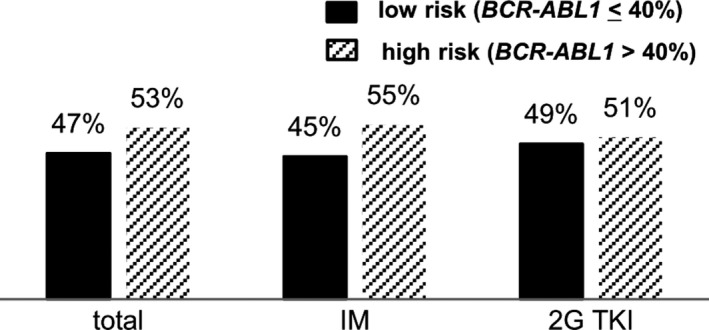
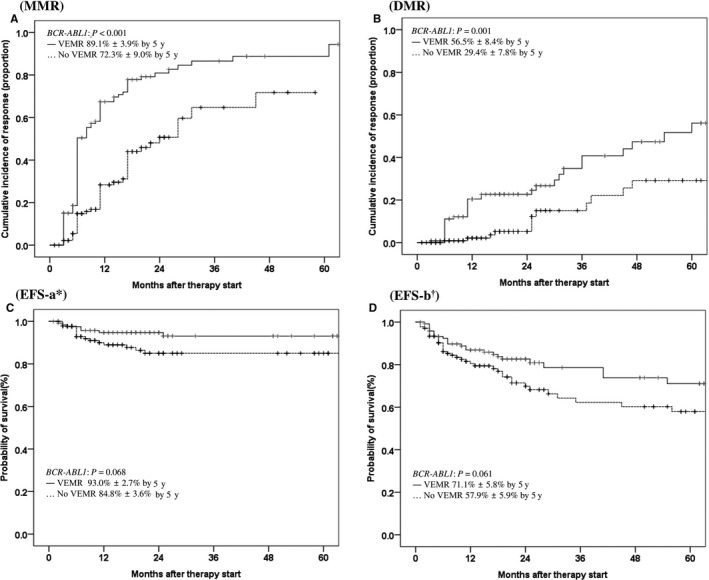
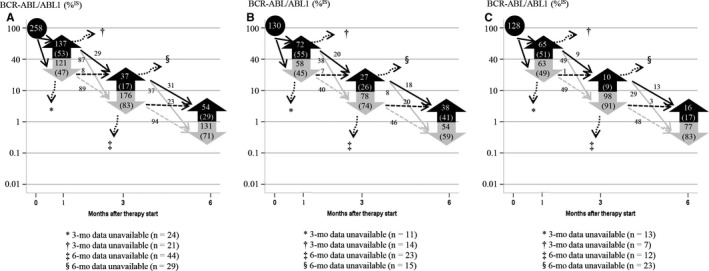
The present study aimed to assess the clinical impact of BCR-ABL1 transcript levels determined at an earlier time point than the 3-month early molecular response (EMR) in chronic-phase chronic myeloid leukemia (CML-CP) patients. BCR-ABL1 transcript levels of CML-CP patients (n = 258; median age, 43 [range, 18-81] years) treated with various tyrosine kinase inhibitors (TKIs) were determined at 4 weeks (28 ± 3 days) and at every 3 months of treatment initiation. At 4 weeks, receiver operating characteristic curves revealed that cutoff values of BCR-ABL1 transcripts for achieving major molecular responses (MMRs) by 12 and 60 months were 40.89% and 39.16%, respectively (95% CI, 0.658-0.772 and 95% CI, 0.643-0.758; P < 0.0001). With 40% of BCR-ABL1 transcripts at 4 weeks (very early MR; VEMR), patients with VEMR achieved higher 3-month EMR and 4-week VEMR significantly associated with higher cumulative incidences of 5-year MMR (89.1% vs 72.3%; P < 0.001) and 5-year deep molecular response (DMR) (56.5% vs 29.4%; P = 0.001). Furthermore, event-free survival (EFS)-a (93.0% vs 84.8%; P = 0.068) and EFS-b (71.1% vs 57.9%; P = 0.061) by 5 years were also marginally significant. VEMR and 3-month EMR were achieved in 89 patients, with significantly superior outcomes. In multivariate analyses, lower leukocyte count (P = 0.008) and frontline second-generation TKI therapy size (P < 0.001) were significantly associated with VEMR achievement, but not baseline BCR-ABL1 level and CML duration. In conclusion, the 4-week BCR-ABL1 transcript levels including VEMR could be important to predict long-term outcomes and may provide additional information about innate intrinsic sensitivity to CML among individuals.
本研究旨在评估慢性期慢性髓系白血病(CML-CP)患者在获得 3 个月早期分子反应(EMR)之前更早时间点的 BCR-ABL1 转录本水平的临床影响。对接受各种酪氨酸激酶抑制剂(TKI)治疗的 258 例 CML-CP 患者(中位年龄 43 岁[范围 18-81 岁])的 BCR-ABL1 转录本水平在 4 周(28 ± 3 天)和治疗开始后每 3 个月进行检测。在 4 周时,接受者操作特征曲线显示,获得 12 和 60 个月时主要分子反应(MMR)的 BCR-ABL1 转录本的截断值分别为 40.89%和 39.16%(95%CI,0.658-0.772 和 95%CI,0.643-0.758;P < 0.0001)。在 4 周时达到 BCR-ABL1 转录本的 40%(非常早期 MR;VEMR),VEMR 患者获得更高的 3 个月 EMR,4 周 VEMR 与更高的 5 年 MMR(89.1% vs 72.3%;P < 0.001)和 5 年深度分子反应(DMR)(56.5% vs 29.4%;P = 0.001)的累积发生率显著相关。此外,5 年时无事件生存(EFS)-a(93.0% vs 84.8%;P = 0.068)和 EFS-b(71.1% vs 57.9%;P = 0.061)也略有显著差异。在 89 例患者中达到了 VEMR 和 3 个月 EMR,结果明显更好。多变量分析显示,白细胞计数较低(P = 0.008)和一线第二代 TKI 治疗剂量较小(P < 0.001)与 VEMR 的实现显著相关,但与基线 BCR-ABL1 水平和 CML 持续时间无关。总之,包括 VEMR 在内的 4 周 BCR-ABL1 转录本水平可能对预测长期结果很重要,并可能为个体对 CML 的固有内在敏感性提供额外信息。