Department of Respiratory and Critical Care Medicine, the First Affiliated Hospital of Guangzhou Medical University, Guangzhou Institute of Respiratory Health, Guangzhou, 510120, China.
Department of Respiratory, The affiliated hospital of Guangdong medical University, Zhanjiang, 524023, China.
Lipids Health Dis. 2018 Sep 1;17(1):206. doi: 10.1186/s12944-018-0853-y.
To investigate the changes of polyunsaturated fatty acids (PUFAs) and their downstream eicosanoids in patients with asthma, the levels of erythrocyte membrane lipids and plasma lipid metabolites were examined.
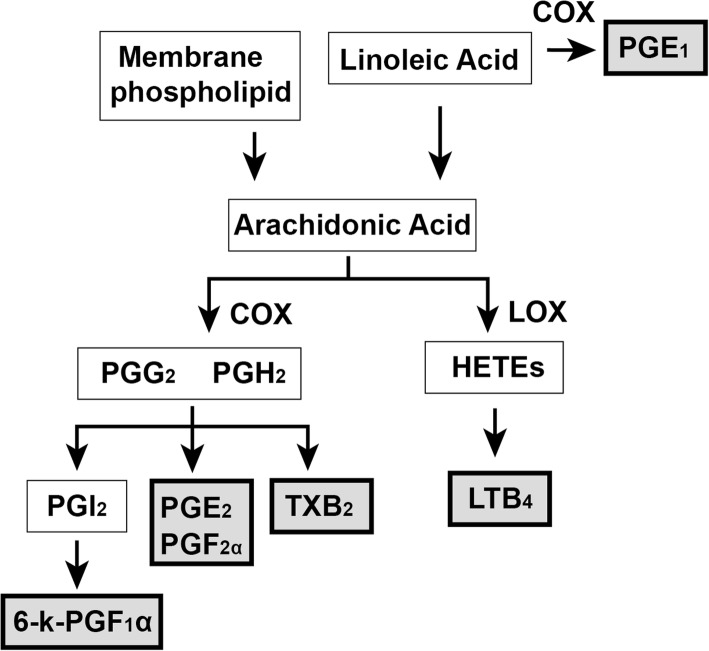
Erythrocyte membrane lipids were extracted and esterificated, and then fatty acid compositions were determined by gas chromatography. The concentrations of six eicosanoids of PGE, TXA, LTB, PGE, 6-k-PGF and PGF in plasma were measured by ELISA.
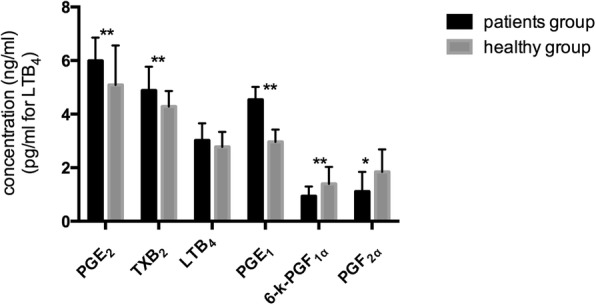
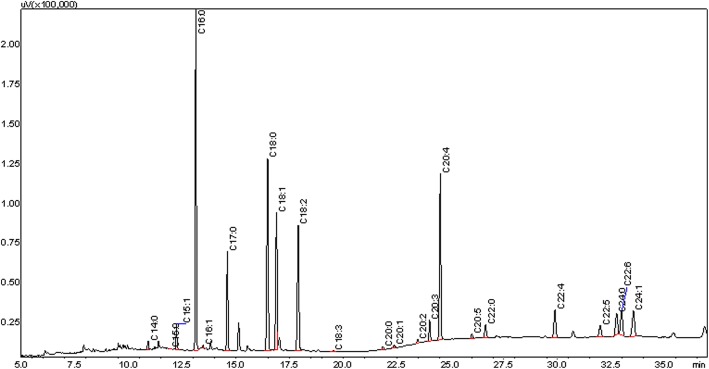
The results showed that the contents of erythrocyte membrane fatty acids in patients with asthma were mainly composed of C16:0, C18:0, C18:1, C18:2(n-6), and C20:4(n-6). The ratio n-6/n-3 PUFAs in patients and health persons were (4.42 ± 1.33):1 and (3.21 ± 0.79):1 (p < 0.01), showing statistically significant differences. ELISA results showed that the levels of plasma PGE, TXB, and PGE in patients were higher than health persons; and the levels of eicosanoids of PGF and 6-k-PGF were significantly lower in patient group than healthy group (p < 0.05), but LTB was no obvious difference (p = 0.09). Increased ratio of n-6/n-3 PUFAs is consistent to the increased levels of pro-inflammatory PGE and TXB and anti-inflammatory PGE originated from C20:4(n-6) and C18:2(n-6), indicating that increased ratio of n-6/n-3 PUFAs and eicosanoids from n-6 PUFAs might promote the progress of airway inflammation of asthma.
Changes of erythrocyte fatty acids, n-6/n-3 PUFAs ratio and the levels of plasma PGE, TXB, and PGE in patients with asthma were relevant to airway inflammation in some extent. Therefore, it could be proposed that increase of n-3/n-6 PUFAs ratio by diet supplementation of n-3 PUFAs might effectively improve airway inflammation in asthma.
为了研究哮喘患者多不饱和脂肪酸(PUFAs)及其下游类二十烷酸的变化,检测了红细胞膜脂质和血浆脂类代谢物的水平。
提取红细胞膜脂质并酯化,然后通过气相色谱法测定脂肪酸组成。通过 ELISA 测定血浆中 PGE、TXA、LTB、PGE、6-k-PGF 和 PGF 六种前列腺素的浓度。
结果表明,哮喘患者红细胞膜脂肪酸的含量主要由 C16:0、C18:0、C18:1、C18:2(n-6)和 C20:4(n-6)组成。患者和健康人的 n-6/n-3 PUFA 比值分别为(4.42±1.33):1 和(3.21±0.79):1(p<0.01),差异有统计学意义。ELISA 结果显示,患者血浆 PGE、TXA 和 PGE 水平高于健康人;患者组 PGF 和 6-k-PGF 水平明显低于健康组(p<0.05),但 LTB 无明显差异(p=0.09)。n-6/n-3 PUFAs 比值增加与促炎 PGE 和 TXB 水平升高以及抗炎 PGE 来自 C20:4(n-6)和 C18:2(n-6)一致,表明 n-6/n-3 PUFAs 比值增加和 n-6 PUFAs 衍生的类二十烷酸可能促进哮喘气道炎症的进展。
哮喘患者红细胞脂肪酸、n-6/n-3 PUFAs 比值以及血浆 PGE、TXA 和 PGE 水平的变化与气道炎症在一定程度上相关。因此,可以提出通过饮食补充 n-3 PUFAs 增加 n-3/n-6 PUFAs 比值可能有效改善哮喘的气道炎症。