Heuberger Maria, Grill Eva, Saǧlam Murat, Ramaioli Cecilia, Müller Martin, Strobl Ralf, Holle Rolf, Peters Annette, Schneider Erich, Lehnen Nadine
Department of Neurology, University Hospital Munich, Ludwig-Maximilians Universität München, Munich, Germany.
German Center for Vertigo and Balance Disorders, University Hospital Munich, Ludwig-Maximilians Universität München, Munich, Germany.
Front Neurol. 2018 Aug 17;9:659. doi: 10.3389/fneur.2018.00659. eCollection 2018.
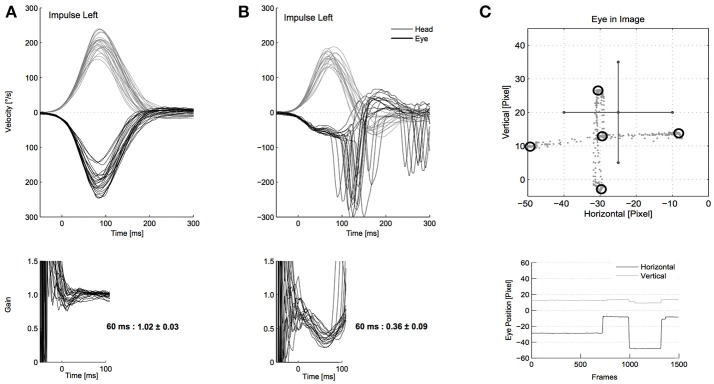
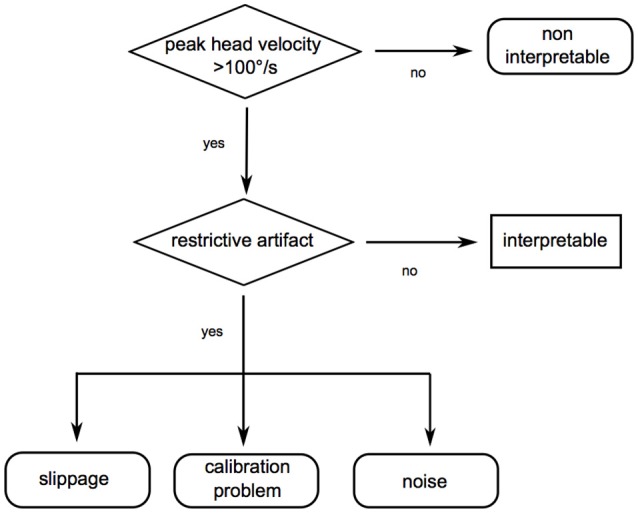
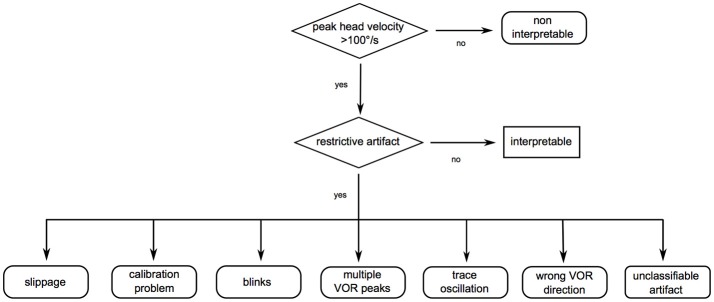
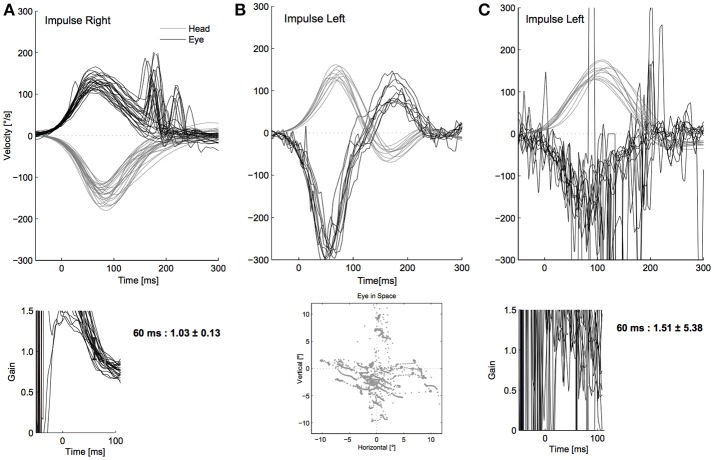
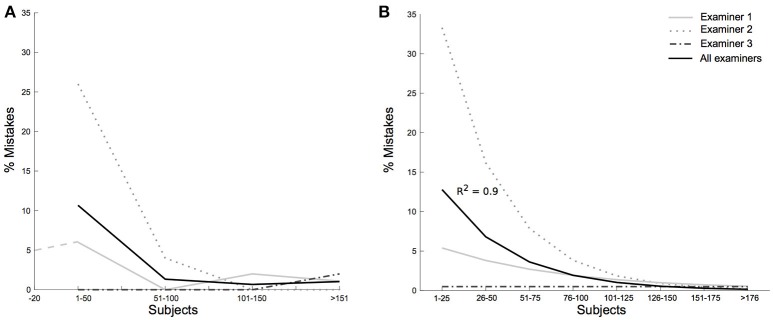
The video head impulse test (vHIT) has become a common examination in the work-up for dizziness and vertigo. However, recent studies suggest a number of pitfalls, which seem to reduce vHIT usability. Within the framework of a population-based prospective study with naïve examiners, we investigated the relevance of previously described technical mistakes in vHIT testing, and the effect of experience and training. Data originates from the KORA (Cooperative Health Research in the Region of Augsburg) FF4 study, the second follow-up of the KORA S4 population-based health survey. 681 participants were selected in a case-control design. Three examiners without any prior experience were trained in video head impulse testing. VHIT quality was assessed weekly by an experienced neuro-otologist. Restrictive mistakes (insufficient technical quality restricting interpretation) were noted. Based on these results, examiners received further individual training. Twenty-two of the 681 vHITs (3.2%) were not interpretable due to restrictive mistakes. Restrictive mistakes could be grouped into four categories: slippage, i.e., goggle movement relative to the head (63.6%), calibration problems (18.2%), noise (13.6%), and low velocity of the head impulse (4.6%). The overall rate of restrictive mistakes decreased significantly during the study (12% / examiner within the first 25 tested participants and 2.1% during the rest of the examinations, < 0.0001). Few categories suffice to explain restrictive mistakes in vHIT testing. With slippage being most important, trainers should emphasize the importance of tight goggles. Experience and training seem to be effective in improving vHIT quality, leading to high usability.
视频头脉冲试验(vHIT)已成为头晕和眩晕检查中的一项常见检查。然而,最近的研究表明存在一些缺陷,这似乎降低了vHIT的实用性。在一项针对新手检查人员的基于人群的前瞻性研究框架内,我们调查了vHIT测试中先前描述的技术错误的相关性以及经验和培训的效果。数据来源于KORA(奥格斯堡地区合作健康研究)FF4研究,这是KORA S4基于人群的健康调查的第二次随访。采用病例对照设计选取了681名参与者。三名没有任何先前经验的检查人员接受了视频头脉冲测试培训。由一名经验丰富的神经耳科医生每周评估vHIT质量。记录了限制性错误(技术质量不足限制了解读)。基于这些结果,检查人员接受了进一步的个性化培训。681次vHIT中有22次(3.2%)由于限制性错误而无法解读。限制性错误可分为四类:滑动,即护目镜相对于头部的移动(63.6%)、校准问题(18.2%)、噪声(13.6%)和头部脉冲速度低(4.6%)。在研究期间,限制性错误的总体发生率显著下降(在前25名测试参与者中,每位检查人员的发生率为12%,在其余检查中为2.1%,<0.0001)。少数几类足以解释vHIT测试中的限制性错误。由于滑动最为重要,培训人员应强调紧密佩戴护目镜的重要性。经验和培训似乎对提高vHIT质量有效,从而提高其可用性。