Quintana-Rodríguez Elizabeth, Ramírez-Rodríguez Alan Gamaliel, Ramírez-Chávez Enrique, Molina-Torres Jorge, Camacho-Coronel Xicotencatl, Esparza-Claudio José, Heil Martin, Orona-Tamayo Domancar
Departamento de Ingeniería Genética, Centro de Investigación y de Estudios Avanzados del Instituto Politécnico Nacional (CINVESTAV-IPN), Guanajuato, Mexico.
Departamento de Soluciones Tecnológicas, Centro de Innovación Aplicada en Tecnologías Competitivas (CIATEC), Guanajuato, Mexico.
Front Plant Sci. 2018 Jul 17;9:1031. doi: 10.3389/fpls.2018.01031. eCollection 2018.
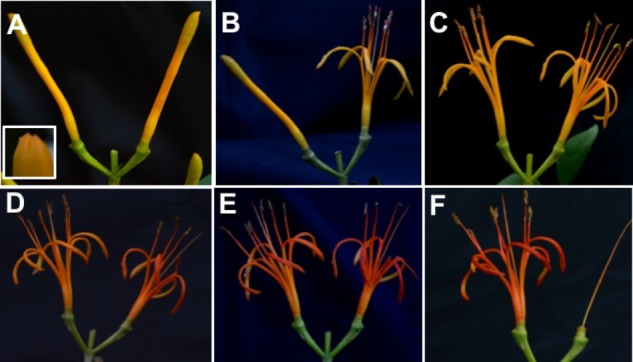
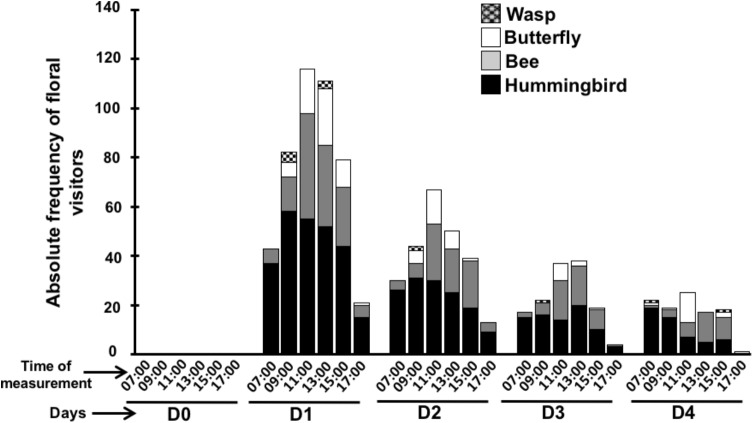
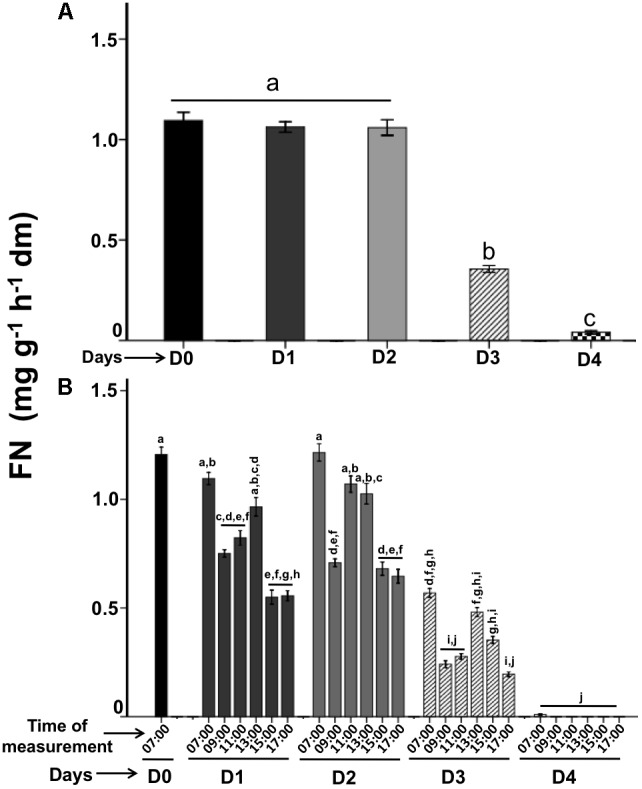
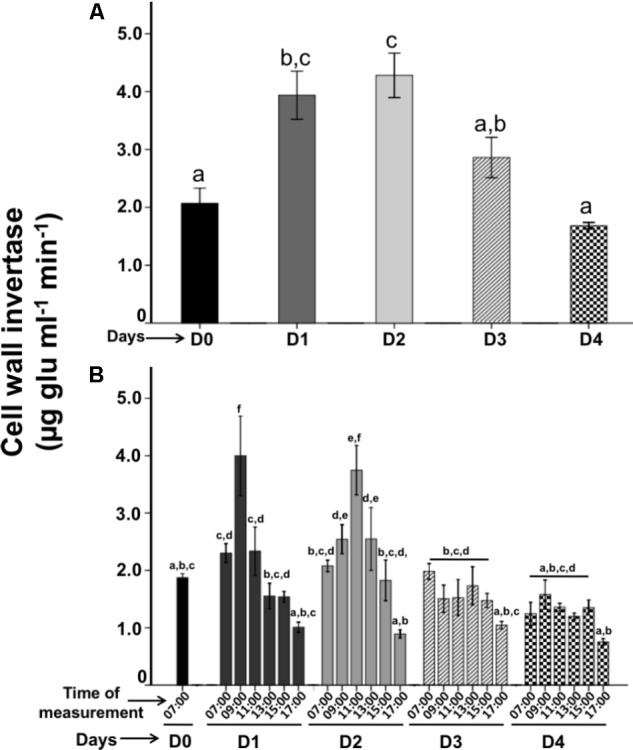
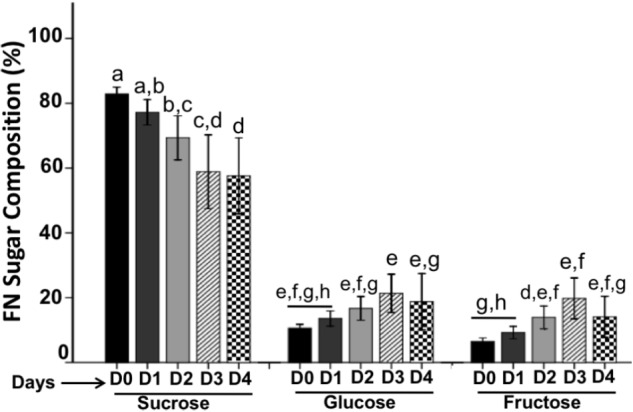
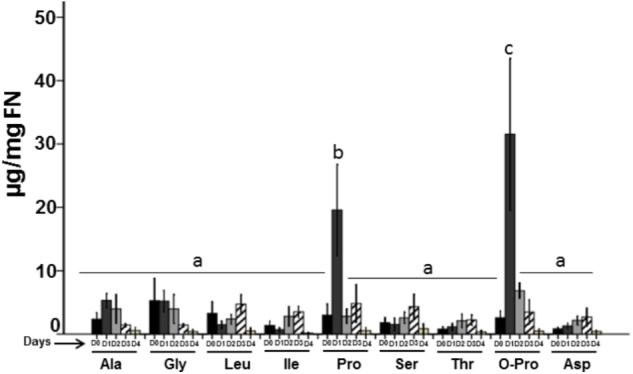
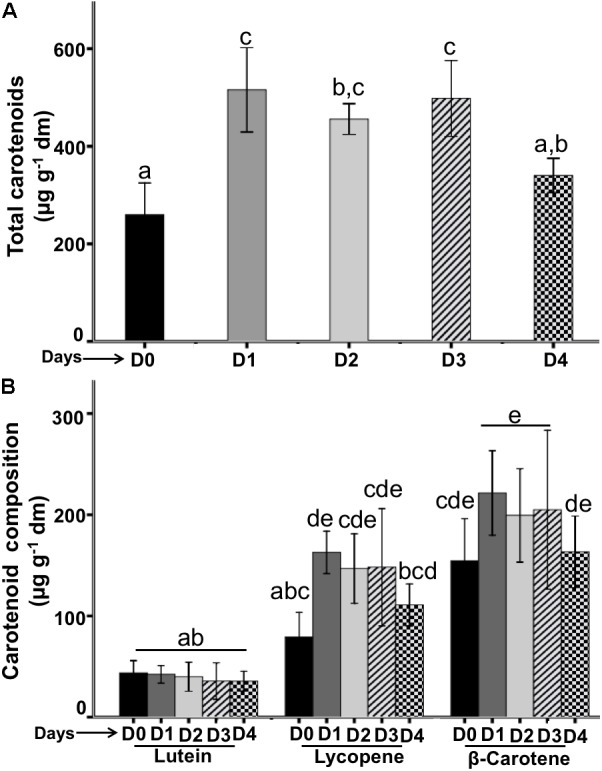
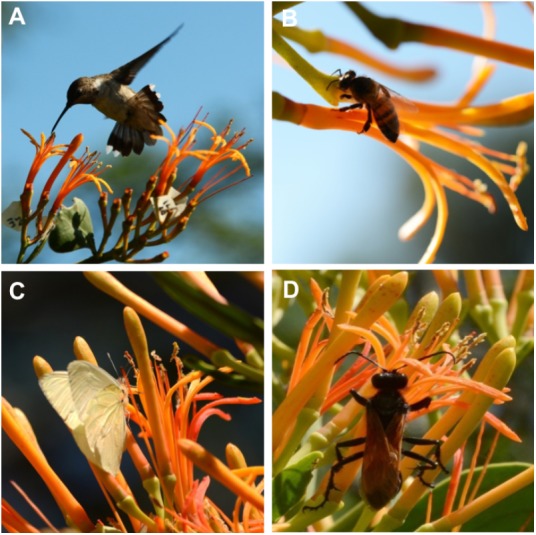
is a hemiparasitic plant that infects a wide range of trees. Mainly the biology reproduction of this mistletoe lies in bright colored flower development. Furthermore, it uses the nectar secretion as the only reward to engage different flower visitors. We investigated the physiological mechanisms of the flower phenology per hour and per day to analyze the spatial-temporal patterns of the nectar secretion, Cell Wall Invertase Activity (key enzyme in the quality of nectar), nectar chemistry, volatile organic compounds (VOCs) emission, synthesis of carotenoids and frequency of floral visitors. Flowers lasted 4 days, total nectar was loaded just before the anthesis and the secretion was maintained over day 1 and 2, decreased on day 3, and stopped on day 4. The diurnal nectar secretion dynamic per hour on day 1 and 2 showed similar patterns with high production on the morning and a decrease in the afternoon, the secretion declined on day 3 and ceased on day 4. On the other hand, CWIN activity per day was less before the anthesis and increased on day 1 and 2, this enzymatic activity decreased on the old flower phenology. Moreover, diurnal CWIN activities showed different patterns in the morning, noon, and lastly in the afternoon. Nectar chemistry varied significantly throughout of the flower lifetime, sucrose decreased along the flower phenology increasing glucose and fructose. Amino acids showed the prevalence of proline and oxo-proline, both increased on the day 1 and diminished in subsequent old flower stages. The spatial VOCs emission showed the presence of 11 compounds being β-ocimene the main volatile; its release increased on day 1 and remained constant in the flower lifetime. Lutein, lycopene, and β-carotene were concentrated in old stages of the flowers. In field, the most frequent flower visitors were the hummingbirds that usually foraging in all phenologic flower stage and their foraging events decreased with the phenological flower lifetimes. The results showed that these traits presented by flowers are able to engage and manipulate the behavior of flower visitors and contribute to the reproduction of the parasitic plant.
是一种半寄生植物,可感染多种树木。这种槲寄生的生物学繁殖主要在于鲜艳花朵的发育。此外,它利用花蜜分泌作为唯一的奖赏来吸引不同的访花者。我们研究了每小时和每天花朵物候的生理机制,以分析花蜜分泌、细胞壁转化酶活性(花蜜质量的关键酶)、花蜜化学成分、挥发性有机化合物(VOCs)排放、类胡萝卜素合成以及访花频率的时空模式。花朵持续4天,总花蜜在开花前刚刚分泌,在第1天和第2天持续分泌,第3天减少,第4天停止。第1天和第2天每小时的昼夜花蜜分泌动态呈现相似模式,上午分泌量高,下午减少,第3天分泌量下降,第4天停止。另一方面,每天的CWIN活性在开花前较低,在第1天和第2天增加,这种酶活性在花朵物候后期降低。此外,昼夜CWIN活性在上午、中午和下午呈现不同模式。花蜜化学成分在花朵的整个生命周期中变化显著,蔗糖随着花朵物候的推进而减少,葡萄糖和果糖增加。氨基酸中脯氨酸和氧代脯氨酸占主导,两者在第1天增加,在随后的花朵衰老阶段减少。空间VOCs排放显示存在11种化合物,其中β-罗勒烯是主要挥发性物质;其释放量在第1天增加,并在花朵生命周期中保持恒定。叶黄素、番茄红素和β-胡萝卜素集中在花朵的衰老阶段。在野外,最常见的访花者是蜂鸟,它们通常在花朵的所有物候阶段觅食,并且它们的觅食活动随着花朵物候寿命的延长而减少。结果表明,花朵呈现的这些特征能够吸引和操纵访花者的行为,并有助于寄生植物的繁殖。