Department of Medicine II, Molecular Hepatology Section, Medical Faculty Mannheim, Heidelberg University, Theodor-Kutzer-Ufer 1-3 (H42, Floor 4), 68167, Mannheim, Germany.
Molecular Hepatology Section, Medical Faculty Mannheim, Heidelberg University, Theodor-Kutzer-Ufer 1-3 (H42, Floor 4), 68167, Mannheim, Germany.
J Exp Clin Cancer Res. 2018 Sep 3;37(1):211. doi: 10.1186/s13046-018-0872-6.
Although metabolism is profoundly altered in human liver cancer, the extent to which experimental models, e.g. cell lines, mimic those alterations is unresolved. Here, we aimed to determine the resemblance of hepatocellular carcinoma (HCC) cell lines to human liver tumours, specifically in the expression of deregulated metabolic targets in clinical tissue samples.
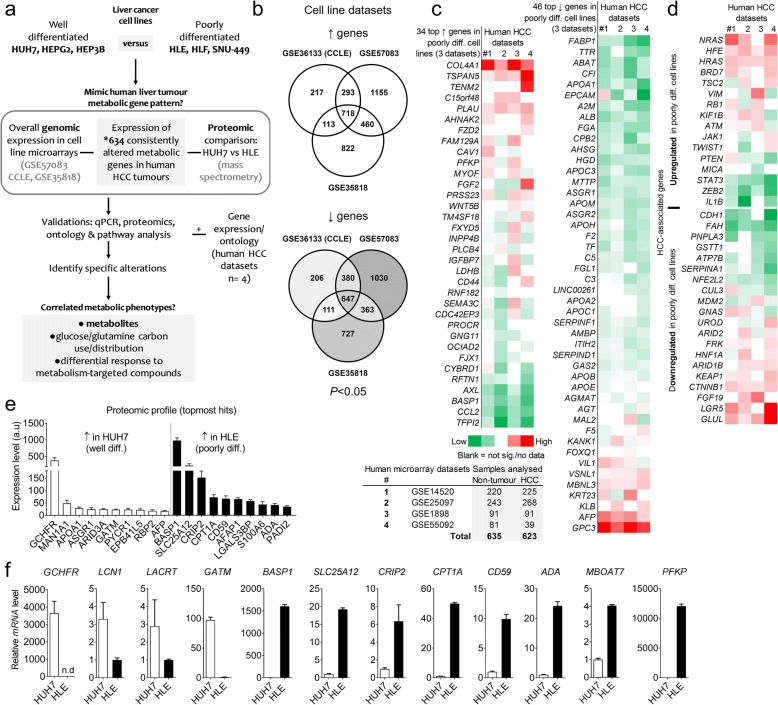
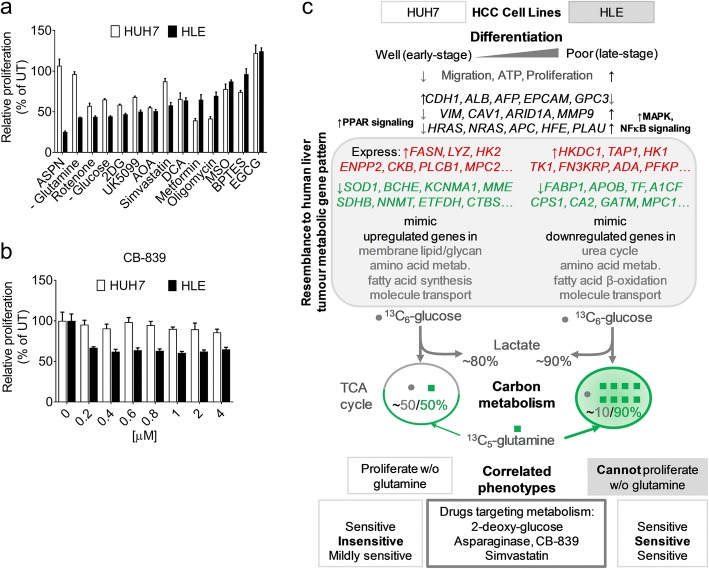
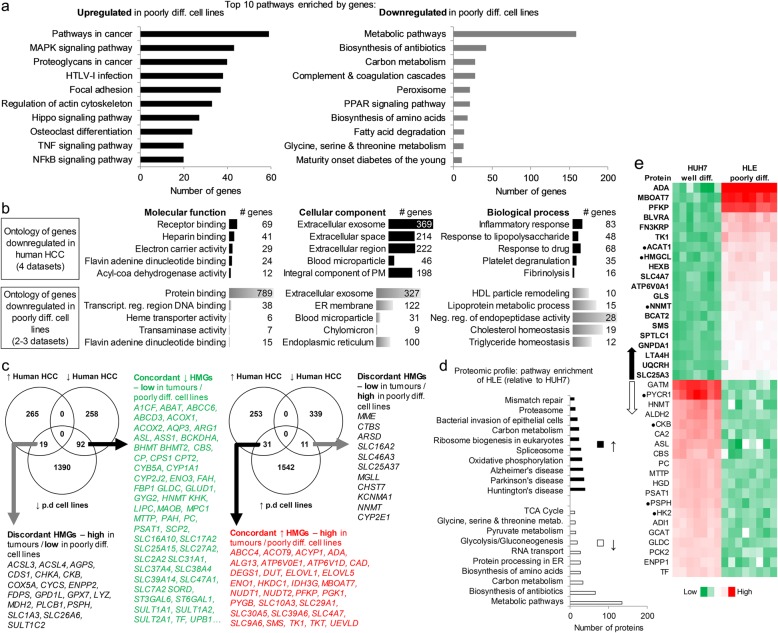
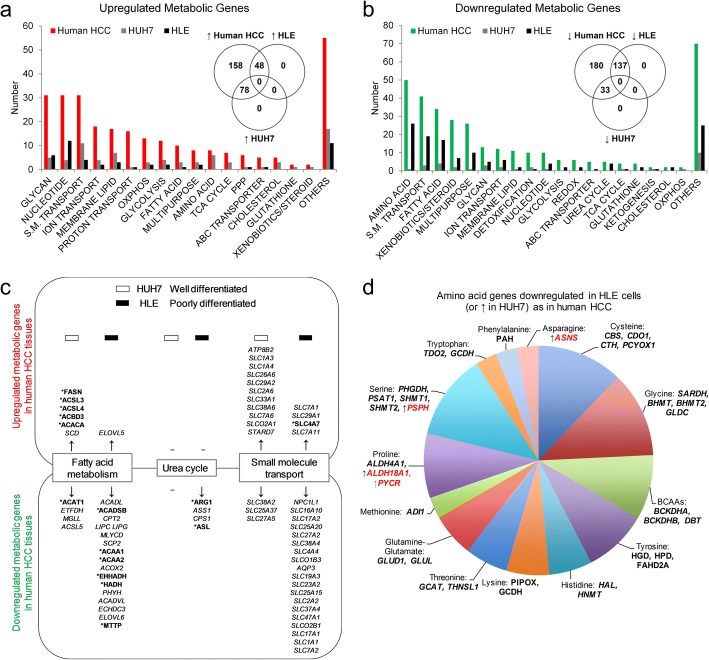
We compared the overall gene expression profile of poorly-differentiated (HLE, HLF, SNU-449) to well-differentiated (HUH7, HEPG2, HEP3B) HCC cell lines in three publicly available microarray datasets. Three thousand and eighty-five differentially expressed genes in ≥2 datasets (P < 0.05) were used for pathway enrichment and gene ontology (GO) analyses. Further, we compared the topmost gene expression, pathways, and GO from poorly differentiated cell lines to the pattern from four human HCC datasets (623 tumour tissues). In well- versus poorly differentiated cell lines, and in representative models HLE and HUH7 cells, we specifically assessed the expression pattern of 634 consistently deregulated metabolic genes in human HCC. These data were complemented by quantitative PCR, proteomics, metabolomics and assessment of response to thirteen metabolism-targeting compounds in HLE versus HUH7 cells.
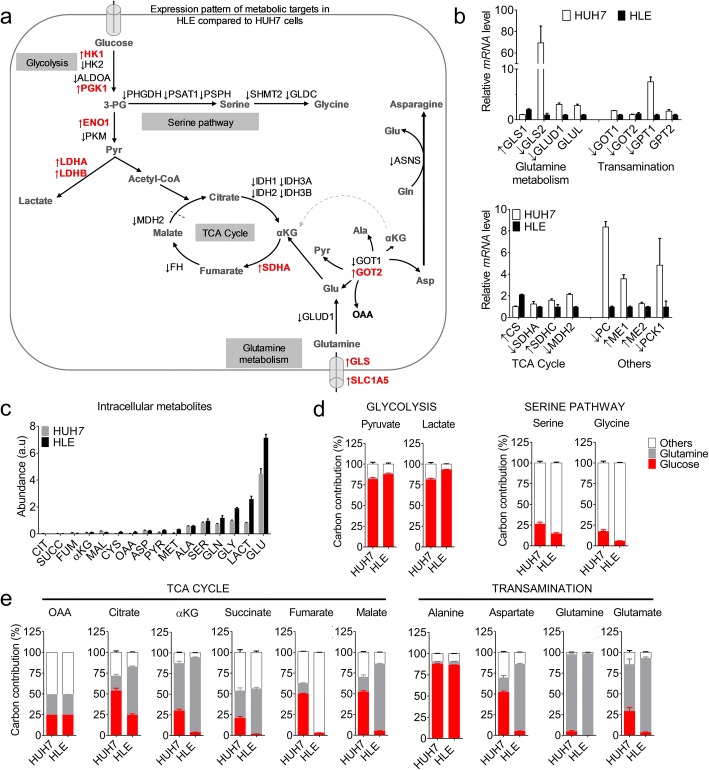
We found that poorly-differentiated HCC cells display upregulated MAPK/RAS/NFkB signaling, focal adhesion, and downregulated complement/coagulation cascade, PPAR-signaling, among pathway alterations seen in clinical tumour datasets. In HLE cells, 148 downregulated metabolic genes in liver tumours also showed low gene/protein expression - notably in fatty acid β-oxidation (e.g. ACAA1/2, ACADSB, HADH), urea cycle (e.g. CPS1, ARG1, ASL), molecule transport (e.g. SLC2A2, SLC7A1, SLC25A15/20), and amino acid metabolism (e.g. PHGDH, PSAT1, GOT1, GLUD1). In contrast, HUH7 cells showed a higher expression of 98 metabolic targets upregulated in tumours (e.g. HK2, PKM, PSPH, GLUL, ASNS, and fatty acid synthesis enzymes ACLY, FASN). Metabolomics revealed that the genomic portrait of HLE cells co-exist with profound reliance on glutamine to fuel tricarboxylic acid cycle, whereas HUH7 cells use both glucose and glutamine. Targeting glutamine pathway selectively suppressed the proliferation of HLE cells.
We report a yet unappreciated distinct expression pattern of clinically-relevant metabolic genes in HCC cell lines, which could enable the identification and therapeutic targeting of metabolic vulnerabilities at various liver cancer stages.
尽管人类肝癌的代谢发生了深刻的改变,但实验模型(例如细胞系)在多大程度上模拟了这些改变仍未得到解决。在这里,我们旨在确定肝细胞癌(HCC)细胞系与人肝肿瘤的相似性,特别是在临床组织样本中失调的代谢靶标表达方面。
我们在三个公开的微阵列数据集比较了低分化(HLE、HLF、SNU-449)和高分化(HUH7、HEPG2、HEP3B)HCC 细胞系的整体基因表达谱。使用三个数据集(P < 0.05)中≥2 个数据集差异表达的 3085 个基因进行途径富集和基因本体(GO)分析。此外,我们将低分化细胞系的最高基因表达、途径和 GO 与来自四个人类 HCC 数据集(623 个肿瘤组织)的模式进行了比较。在高分化和低分化细胞系中,以及在代表性模型 HLE 和 HUH7 细胞中,我们特别评估了 634 个在人类 HCC 中一致失调的代谢基因的表达模式。这些数据通过定量 PCR、蛋白质组学、代谢组学和对 HLE 与 HUH7 细胞中 13 种代谢靶向化合物的反应进行了补充。
我们发现,低分化 HCC 细胞显示 MAPK/RAS/NFkB 信号转导、焦点黏附上调,补体/凝血级联、PPAR 信号转导下调,这是临床肿瘤数据集中观察到的途径改变之一。在 HLE 细胞中,在肿瘤中下调的 148 个代谢基因也表现出低基因/蛋白表达-尤其是在脂肪酸β-氧化(例如 ACAA1/2、ACADSB、HADH)、尿素循环(例如 CPS1、ARG1、ASL)、分子转运(例如 SLC2A2、SLC7A1、SLC25A15/20)和氨基酸代谢(例如 PHGDH、PSAT1、GOT1、GLUD1)中。相比之下,HUH7 细胞显示出在肿瘤中上调的 98 个代谢靶标(例如 HK2、PKM、PSPH、GLUL、ASNS 和脂肪酸合成酶 ACLY、FASN)的更高表达。代谢组学表明,HLE 细胞的基因组特征与对谷氨酰胺的强烈依赖共存,以为三羧酸循环提供燃料,而 HUH7 细胞同时使用葡萄糖和谷氨酰胺。靶向谷氨酰胺途径选择性地抑制了 HLE 细胞的增殖。
我们报告了 HCC 细胞系中尚未被认识的临床相关代谢基因的独特表达模式,这可能使我们能够识别和治疗不同肝癌阶段的代谢脆弱性。