Department of Biomedicine, University of Basel, Pestalozzistr. 20, CH-4056, Basel, Switzerland.
Pharma Research and Early Development, Discovery Neuroscience Department, F. Hoffmann-La Roche Ltd, CH-4070, Basel, Switzerland.
Nat Commun. 2018 Sep 3;9(1):3576. doi: 10.1038/s41467-018-06004-8.
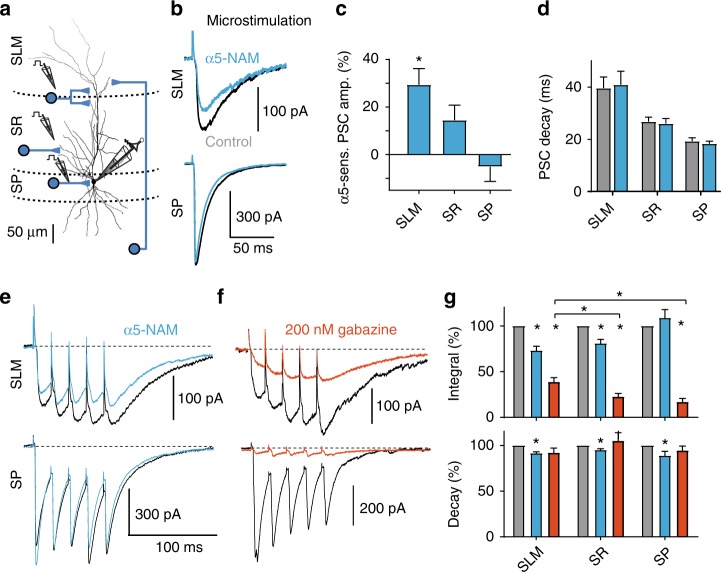
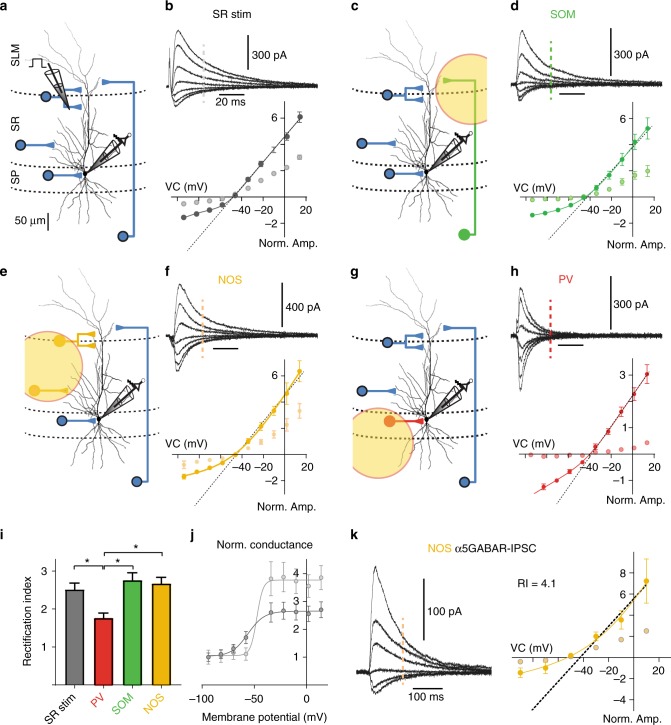
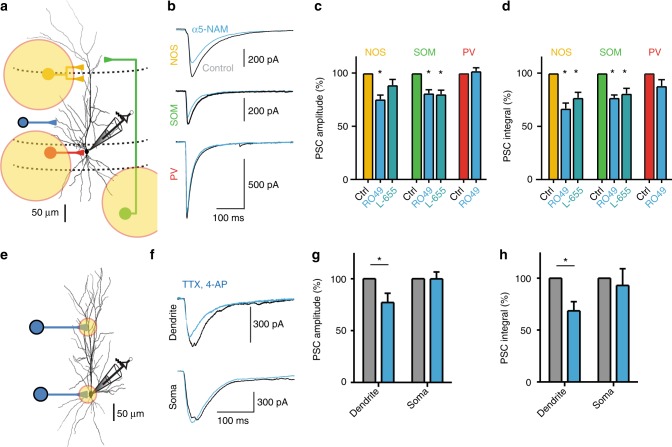
Dendrite-targeting GABAergic interneurons powerfully control postsynaptic integration, synaptic plasticity, and learning. However, the mechanisms underlying the efficient GABAergic control of dendritic electrogenesis are not well understood. Using subtype-selective blockers for GABA receptors, we show that dendrite-targeting somatostatin interneurons and NO-synthase-positive neurogliaform cells preferentially activate α5-subunit- containing GABA receptors (α5-GABARs), generating slow inhibitory postsynaptic currents (IPSCs) in hippocampal CA1 pyramidal cells. By contrast, only negligible contribution of these receptors could be found in perisomatic IPSCs, generated by fast-spiking parvalbumin interneurons. Remarkably, α5-GABAR-mediated IPSCs were strongly outward-rectifying generating 4-fold larger conductances above -50 mV than at rest. Experiments and modeling show that synaptic activation of these receptors can very effectively control voltage-dependent NMDA-receptor activation as well as Schaffer-collateral evoked burst firing in pyramidal cells. Taken together, nonlinear-rectifying α5-GABARs with slow kinetics match functional NMDA-receptor properties and thereby mediate powerful control of dendritic postsynaptic integration and action potential firing by dendrite-targeting interneurons.
树突靶向 GABA 能中间神经元强力控制突触后整合、突触可塑性和学习。然而,树突电发生的 GABA 能有效控制的基础机制仍不清楚。使用 GABA 受体的亚型选择性阻断剂,我们发现树突靶向生长抑素中间神经元和一氧化氮合酶阳性神经胶质细胞优先激活含有 α5 亚单位的 GABA 受体 (α5-GABARs),在海马 CA1 锥体神经元中产生慢抑制性突触后电流 (IPSCs)。相比之下,在由快速放电的 parvalbumin 中间神经元产生的体周 IPSC 中,这些受体的贡献可以忽略不计。值得注意的是,α5-GABAR 介导的 IPSC 具有强烈的外向整流特性,在 -50 mV 以上产生的电导比静息时大 4 倍。实验和建模表明,这些受体的突触激活可以非常有效地控制电压依赖性 NMDA 受体的激活以及锥体神经元中的 Schaffer 侧枝诱发的爆发式放电。总之,具有慢动力学的非线性整流 α5-GABAR 与功能性 NMDA 受体特性匹配,从而介导树突靶向中间神经元对树突突触后整合和动作电位放电的有力控制。