Ulm University, General Psychology, Ulm, 89081, Germany.
Sci Rep. 2018 Sep 3;8(1):13165. doi: 10.1038/s41598-018-31551-x.
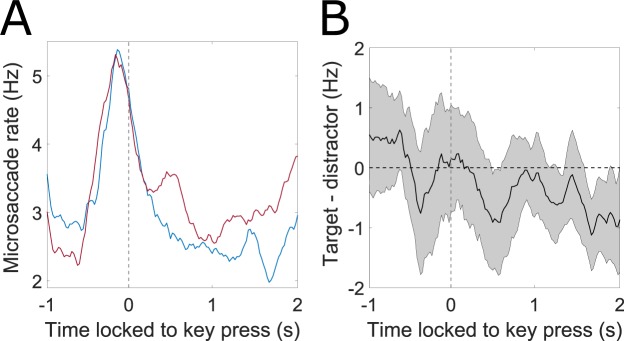
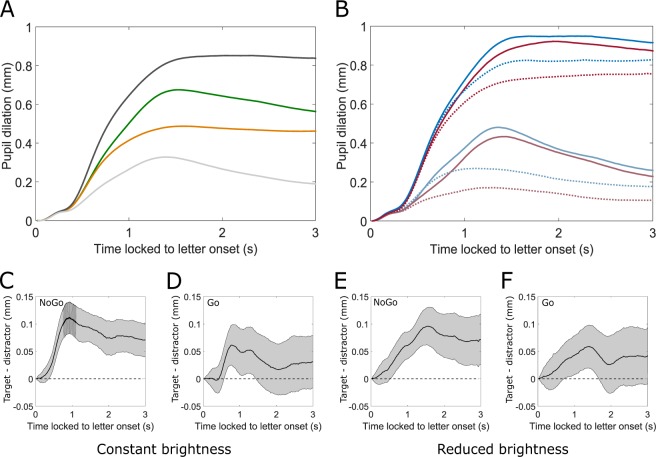
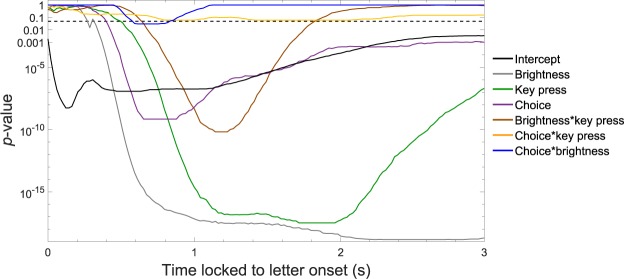
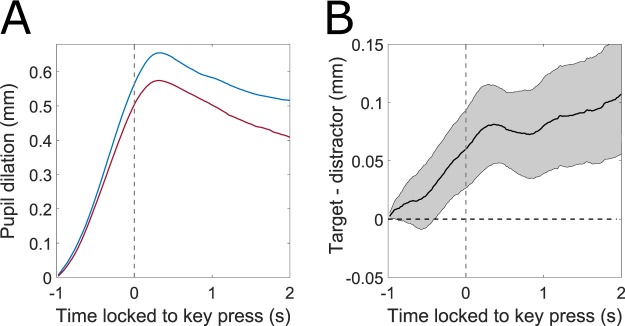
Pupil dilation, an indicator of arousal that is generally regarded as unspecific, amongst others reflects decision formation and reveals choice. Employing letter selection in a Go/NoGo task, we show that choice can robustly be predicted by the pupillary signal, even under the presence of strong interfering factors such as changes in brightness or motor execution. In addition, a larger difference in pupil dilation between target and distractor conditions for NoGo compared to Go was demonstrated, underlining the particular appropriateness of the paradigm for decision research. Incorporating microsaccades, a variable that is suggested to covary with pupil diameter, we show that decision formation can only be observed in pupil diameter. However, microsaccade rate and pupil size covaried for motor execution and both reflected choice after key press with smaller effect size for microsaccade rate. We argue that combining pupil dilation and microsaccade rate may help dissociating decision-related changes in pupil diameter from interfering factors. Considering the interlinked main neural correlates of pupil dilation and microsaccade generation, these findings point to a selective role of locus coeruleus compared to superior colliculus in decision formation.
瞳孔扩张是一种被普遍认为非特异性的觉醒指标,反映了决策形成并揭示了选择。我们在 Go/NoGo 任务中采用字母选择,表明即使在亮度变化或运动执行等强干扰因素的存在下,瞳孔信号也可以稳健地预测选择。此外,与 Go 相比,在 NoGo 条件下,瞳孔扩张在目标和干扰条件之间的差异更大,这强调了该范式特别适用于决策研究。纳入微扫视,这是一个被认为与瞳孔直径相关的变量,我们表明,只有在瞳孔直径中才能观察到决策形成。然而,微扫视率和瞳孔大小与运动执行相关,并且在按键后都反映了选择,微扫视率的影响较小。我们认为,结合瞳孔扩张和微扫视率可能有助于将与决策相关的瞳孔直径变化与干扰因素区分开来。考虑到瞳孔扩张和微扫视产生的主要神经关联,这些发现表明,在决策形成中,蓝斑相对于上丘具有选择性作用。