Institute of Lung and Molecular Therapy, Xinxiang Medical University, Xinxiang, China.
Department of Molecular and Cellular Biology, University of Texas Health Science Center at Tyler, Tyler, TX, United States.
Front Immunol. 2018 Aug 20;9:1898. doi: 10.3389/fimmu.2018.01898. eCollection 2018.
Acute lung injury (ALI) is characterized by suppressed fibrinolytic activity in bronchoalveolar lavage fluid (BALF) attributed to elevated plasminogen activator inhibitor-1 (PAI-1). Restoring pulmonary fibrinolysis by delivering tissue-type plasminogen activator (tPA), urokinase plasminogen activator (uPA), and plasmin could be a promising approach.
To systematically analyze the overall benefit of fibrinolytic therapy for ALI reported in preclinical studies.
We searched PubMed, Embase, Web of Science, and CNKI Chinese databases, and analyzed data retrieved from 22 studies for the beneficial effects of fibrinolytics on animal models of ALI.
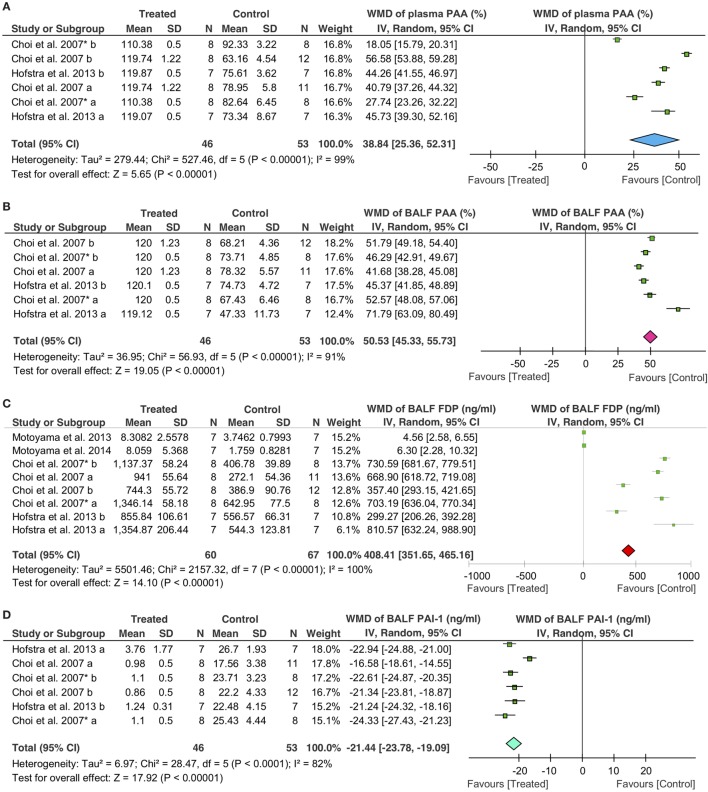
Both large and small animals were used with five routes for delivering tPA, uPA, and plasmin. Fibrinolytics significantly increased the fibrinolytic activity both in the plasma and BALF. Fibrin degradation products in BALF had a net increase of 408.41 ng/ml vs controls ( < 0.00001). In addition, plasma thrombin-antithrombin complexes increased 1.59 ng/ml over controls ( = 0.0001). In sharp contrast, PAI-1 level in BALF decreased 21.44 ng/ml compared with controls ( < 0.00001). Arterial oxygen tension was improved by a net increase of 15.16 mmHg, while carbon dioxide pressure was significantly reduced (11.66 mmHg, = 0.0001 vs controls). Additionally, fibrinolytics improved lung function and alleviated inflammation response: the lung wet/dry ratio was decreased 1.49 ( < 0.0001 vs controls), lung injury score was reduced 1.83 ( < 0.00001 vs controls), and BALF neutrophils were lesser (3 × 10/ml, < 0.00001 vs controls). The mortality decreased significantly within defined study periods (6 h to 30 days for mortality), as the risk ratio of death was 0.2-fold of controls ( = 0.0008).
We conclude that fibrinolytic therapy may be effective pharmaceutic strategy for ALI in animal models.
急性肺损伤(ALI)的特征是支气管肺泡灌洗液(BALF)中的纤维蛋白溶解活性受到抑制,这归因于纤溶酶原激活物抑制剂-1(PAI-1)水平升高。通过给予组织型纤溶酶原激活物(tPA)、尿激酶纤溶酶原激活物(uPA)和纤溶酶来恢复肺纤维蛋白溶解可能是一种很有前途的方法。
系统分析临床前研究中报告的纤维蛋白溶解疗法治疗 ALI 的总体益处。
我们检索了 PubMed、Embase、Web of Science 和中国知网(CNKI)数据库,并对 22 项研究中关于纤维蛋白溶解剂对 ALI 动物模型的有益作用的数据进行了分析。
研究使用了大、小动物,并采用了五种途径给予 tPA、uPA 和纤溶酶。纤维蛋白溶解剂可显著增加血浆和 BALF 中的纤维蛋白溶解活性。BALF 中的纤维蛋白降解产物净增加 408.41ng/ml(与对照组相比, < 0.00001)。此外,血浆凝血酶-抗凝血酶复合物增加 1.59ng/ml(与对照组相比, = 0.0001)。相比之下,BALF 中的 PAI-1 水平下降 21.44ng/ml(与对照组相比, < 0.00001)。动脉血氧分压通过净增加 15.16mmHg 得到改善,而二氧化碳分压显著降低(11.66mmHg,与对照组相比, = 0.0001)。此外,纤维蛋白溶解剂改善了肺功能并减轻了炎症反应:肺湿/干重比降低了 1.49(与对照组相比, < 0.0001),肺损伤评分降低了 1.83(与对照组相比, < 0.00001),BALF 中性粒细胞减少了(3×10/ml,与对照组相比, < 0.00001)。在定义的研究期间内,死亡率显著降低(死亡的风险比为 0.2 倍)。
我们的结论是,纤维蛋白溶解疗法可能是治疗动物模型中 ALI 的有效药物策略。