Jia Congjun, Zhao Fuping, Wang Xuemin, Han Jianlin, Zhao Haiming, Liu Guibo, Wang Zan
Institute of Animal Science, Chinese Academy of Agricultural Sciences, Beijing, China.
CAAS-ILRI Joint Laboratory on Livestock and Forage Genetic Resources, Institute of Animal Science, Chinese Academy of Agricultural Sciences, Beijing, China.
Front Plant Sci. 2018 Aug 20;9:1220. doi: 10.3389/fpls.2018.01220. eCollection 2018.
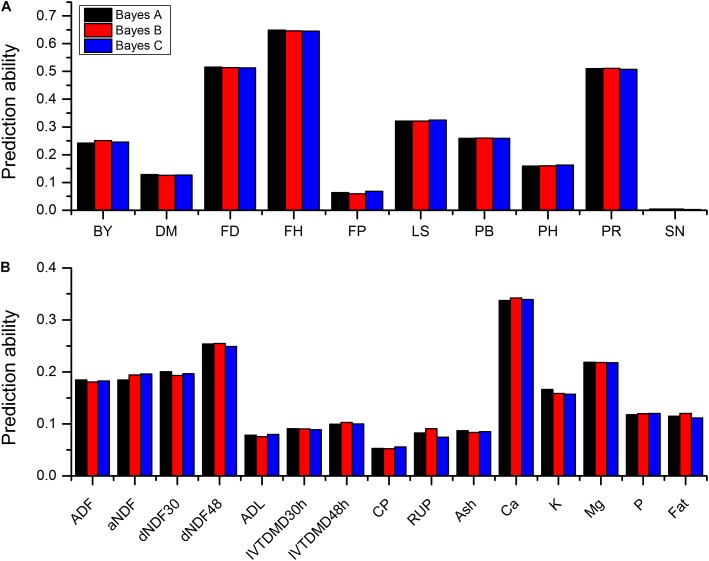
Agronomic and quality traits in alfalfa are very important to forage industry. Genomic prediction (GP) based on genotyping-by-sequencing (GBS) data could shorten the breeding cycles and accelerate the genetic gains of these complex traits, if they display moderate to high prediction accuracies. The aim of this study was to investigate the predictive potentials of these traits in alfalfa. A total of 322 genotypes from 75 alfalfa accessions were used for GP of the agronomic and quality traits, which were related to yield and nutrition value, respectively, using BayesA, BayesB, and BayesCπ methods. Ten-fold cross validation was used to evaluate the accuracy of GP represented by the correlation between genomic estimated breeding value (GEBV) and estimated breeding value (EBV). The accuracies ranged from 0.0021 to 0.6485 for different traits. For each trait, three GP methods displayed similar prediction accuracies. Among 15 quality traits, mineral element Ca had a moderate and the highest prediction accuracy (0.34). NDF digestibility after 48 h (NDFD 48 h) and 30 h (NDFD 30 h) and mineral element Mg had prediction accuracies varying from 0.20 to 0.25. Other traits, for example, fat and crude protein, showed low prediction accuracies (0.05 to 0.19). Among 10 agronomic traits, however, some displayed relatively high prediction accuracies. Plant height (PH) in fall (FH) had the highest prediction accuracy (0.65), followed by flowering date (FD) and plant regrowth (PR) with accuracies at 0.52 and 0.51, respectively. Leaf to stem ratio (LS), plant branch (PB), and biomass yield (BY) reached to moderate prediction accuracies ranging from 0.25 to 0.32. Our results revealed that a few agronomic traits, such as FH, FD, and PR, had relatively high prediction accuracies, therefore it is feasible to apply genomic selection (GS) for these traits in alfalfa breeding programs. Because of the limitations of population size and density of SNP markers, several traits displayed low accuracies which could be improved by a bigger reference population, higher density of SNP markers, and more powerful statistic tools.
苜蓿的农艺性状和品质性状对饲料产业非常重要。如果基于简化基因组测序(GBS)数据的基因组预测(GP)对这些复杂性状具有中等到较高的预测准确性,那么它可以缩短育种周期并加速这些性状的遗传进展。本研究的目的是探究苜蓿中这些性状的预测潜力。使用BayesA、BayesB和BayesCπ方法,对来自75份苜蓿种质的322个基因型进行了与产量和营养价值相关的农艺性状和品质性状的基因组预测。采用十折交叉验证法,以基因组估计育种值(GEBV)与估计育种值(EBV)之间的相关性来评估基因组预测的准确性。不同性状的准确性范围为0.0021至0.6485。对于每个性状,三种基因组预测方法显示出相似的预测准确性。在15个品质性状中,矿质元素钙具有中等且最高的预测准确性(0.34)。48小时(NDFD 48 h)和30小时(NDFD 30 h)的中性洗涤纤维消化率以及矿质元素镁的预测准确性在0.20至0.25之间。其他性状,例如脂肪和粗蛋白,显示出较低的预测准确性(0.05至0.19)。然而,在10个农艺性状中,一些性状显示出相对较高的预测准确性。秋季株高(FH)的预测准确性最高(0.65),其次是开花日期(FD)和植株再生(PR)分别为0.52和其准确性为0.51。叶茎比(LS)、植株分枝(PB)和生物量产量(BY)达到中等预测准确性,范围为0.25至0.32。我们的结果表明,一些农艺性状,如FH、FD和PR,具有相对较高的预测准确性,因此在苜蓿育种计划中对这些性状应用基因组选择(GS)是可行的。由于群体大小和单核苷酸多态性(SNP)标记密度的限制,一些性状显示出较低的准确性,可以通过更大的参考群体、更高密度的SNP标记和更强大的统计工具来提高。