Key Laboratory of Aquaculture Disease Control, Ministry of Agriculture, and State Key Laboratory of Freshwater Ecology and Biotechnology, Institute of Hydrobiology, Chinese Academy of Sciences, Wuhan, P. R. China.
Bio-Transduction Lab, Biolake, Wuhan, P. R. China.
PLoS One. 2018 Sep 4;13(9):e0203089. doi: 10.1371/journal.pone.0203089. eCollection 2018.
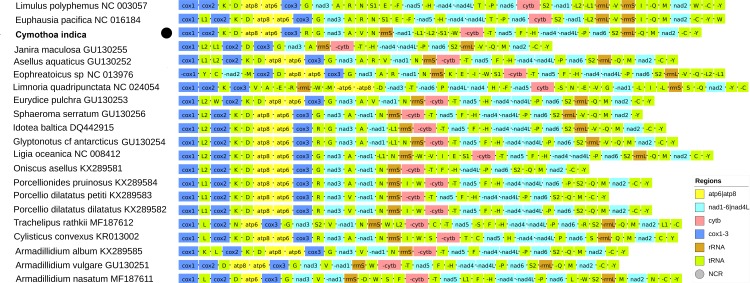
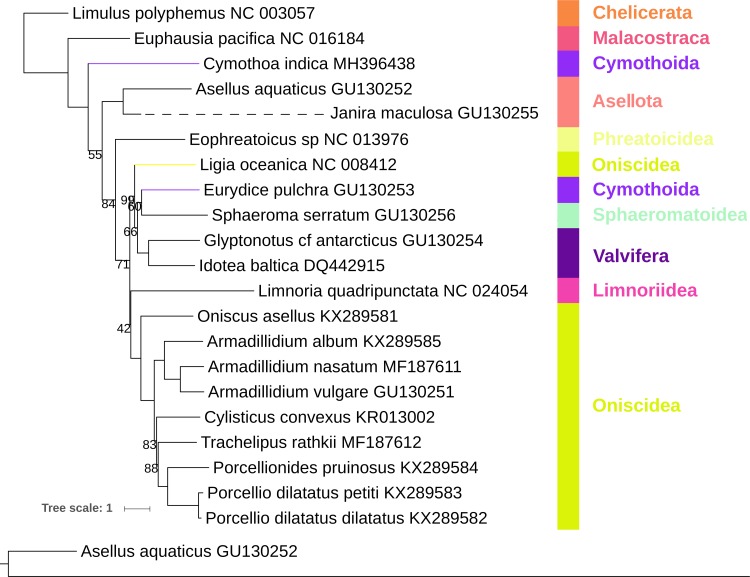
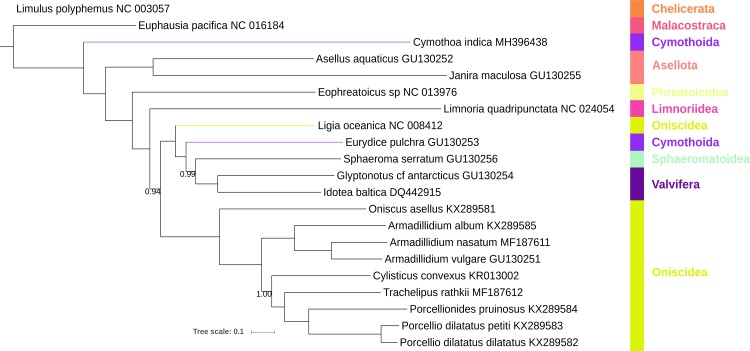
As a result of great diversity in life histories and a large number of described species, taxonomic and phylogenetic uncertainty permeates the entire crustacean order of Isopoda. Large molecular datasets capable of providing sufficiently high phylogenetic resolution, such as mitochondrial genomes (mitogenomes), are needed to infer their evolutionary history with confidence, but isopod mitogenomes remain remarkably poorly represented in public databases. We sequenced the complete mitogenome of Cymothoa indica, a species belonging to a family from which no mitochondrial genome was sequenced yet, Cymothoidae. The mitogenome (circular, 14484 bp, A+T = 63.8%) is highly compact, appears to be missing two tRNA genes (trnI and trnE), and exhibits a unique gene order with a large number of rearrangements. High compactness and the existence of palindromes indicate that the mechanism behind these rearrangements might be associated with linearization events in its evolutionary history, similar to those proposed for isopods from the Armadillidium genus (Oniscidea). Isopods might present an important model system to study the proposed discontinuity in the dynamics of mitochondrial genomic architecture evolution. Phylogenetic analyses (Bayesian Inference and Maximum Likelihood) conducted using nucleotide sequences of all mitochondrial genes resolved Oniscidea and Cymothoida suborders as paraphyletic. Cymothoa indica was resolved as a sister group (basal) to all remaining isopods, which challenges the accepted isopod phylogeny, where Cymothoida are the most derived, and Phreatoicidea the most basal isopod group. There is growing evidence that Cymothoida suborder might be split into two evolutionary distant clades, with parasitic species being the most basal split in the Isopoda clade, but a much larger amount of molecular resources carrying a high phylogenetic resolution will be needed to infer the remarkably complex evolutionary history of this group of animals with confidence.
由于生命史的巨大多样性和大量已描述的物种,分类和系统发育的不确定性渗透到整个等足目甲壳动物。需要具有足够高系统发育分辨率的大型分子数据集,如线粒体基因组(线粒体基因组),才能有信心推断其进化历史,但等足目线粒体基因组在公共数据库中的代表性仍然很差。我们对 Cymothoa indica 的完整线粒体基因组进行了测序,Cymothoa indica 是一个尚未测序线粒体基因组的 Cymothoidae 科的物种。线粒体基因组(圆形,14484 bp,A+T = 63.8%)非常紧凑,似乎缺少两个 tRNA 基因(trnI 和 trnE),并表现出独特的基因排列,存在大量重排。高紧凑性和回文序列的存在表明,这些重排背后的机制可能与线性化事件有关,类似于 Armadillidium 属(Oniscidea)等足目提出的那些事件。等足目可能是研究线粒体基因组结构进化动力学提出的不连续性的重要模型系统。使用所有线粒体基因的核苷酸序列进行的系统发育分析(贝叶斯推断和最大似然法)将 Oniscidea 和 Cymothoida 亚目解析为并系关系。Cymothoa indica 被解析为所有剩余等足目动物的姐妹群(基础),这对公认的等足目系统发育提出了挑战,在该系统发育中,Cymothoida 是最衍生的,而 Phreatoicidea 是最基础的等足目动物群。越来越多的证据表明,Cymothoida 亚目可能分裂为两个进化距离较远的分支,寄生物种是等足目动物中最基础的分支,但需要更多的分子资源,携带高分辨率的系统发育,才能有信心推断出这个动物群的复杂进化历史。