Int J Equity Health. 2018 Sep 5;17(1):136. doi: 10.1186/s12939-018-0836-7.
In the 2011 Rio Political Declaration on Social Determinants of Health, World Health Organization (WHO) Member States pledged action in five areas crucial for addressing health inequities. Their pledges referred to better governance for health and development, greater participation in policymaking and implementation, further reorientation of the health sector towards reducing health inequities, strengthening of global governance and collaboration, and monitoring progress and increasing accountability. WHO is developing a global system for monitoring governments' and international organizations' actions on the social determinants of health (SDH) to increase transparency and accountability, and to guide implementation, in alignment with broader health and development policy frameworks, including the universal health coverage and Sustainable Development Goals (SDG) agendas. We describe the selection of indicators proposed to be part of the initial WHO global system for monitoring action on the SDH.
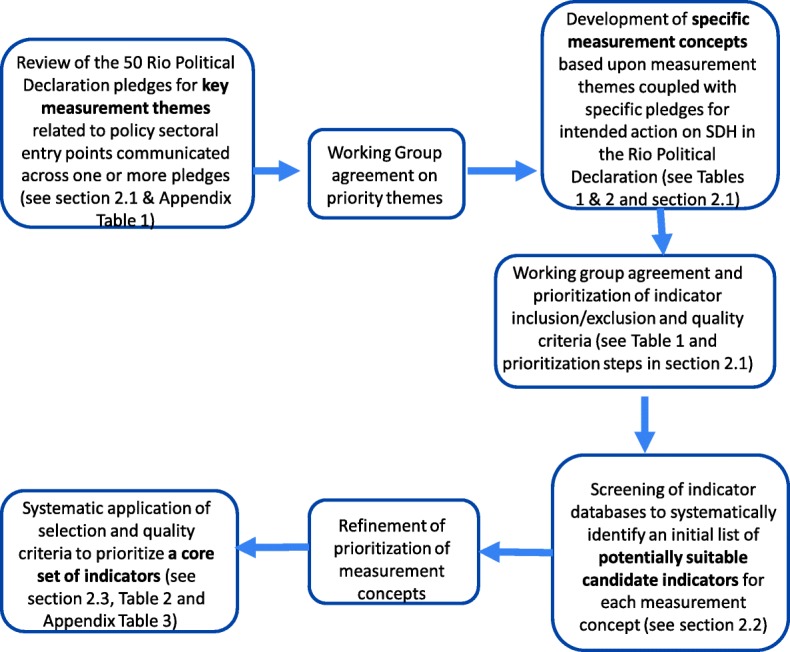
An interdisciplinary working group was established by WHO, the Public Health Agency of Canada, and the Canadian Institutes of Health Research-Institute of Population and Public Health. We describe the processes and criteria used for selecting SDH action indicators that were of high quality and the described the challenges encountered in creating a set of metrics for capturing government action on addressing the Rio Political Declaration's five Action Areas.
We developed 19 measurement concepts, identified and screened 20 indicator databases and systems, including the 223 SDG indicators, and applied strong criteria for selecting indicators for the core indicator set. We identified 36 suitable existing indicators, which were often SDG indicators.
Lessons learnt included the importance of ensuring diversity of the working group and always focusing on health equity; challenges included the relative dearth of data and indicators on some key interventions and capturing the context and level of implementation of indicator interventions.
在 2011 年里约政治宣言中,世界卫生组织(世卫组织)成员国承诺在五个对解决健康不平等至关重要的领域采取行动。这些承诺涉及改善卫生和发展治理、增强政策制定和实施中的参与度、进一步使卫生部门重新致力于减少健康不平等、加强全球治理与合作,以及监测进展和增强问责制。世卫组织正在制定一个监测各国政府和国际组织在社会决定因素健康方面行动的全球系统,以提高透明度和问责制,并根据更广泛的卫生和发展政策框架,包括全民健康覆盖和可持续发展目标议程,指导实施工作。我们介绍了拟作为世卫组织监测社会决定因素健康行动的全球系统的初始组成部分的指标选择情况。
世卫组织、加拿大公共卫生局和加拿大卫生研究院-人口与公共卫生研究所成立了一个跨学科工作组。我们介绍了选择高质量社会决定因素健康行动指标的流程和标准,并介绍了在为确定和衡量政府在解决《里约政治宣言》五个行动领域中的作用而创建一套指标方面遇到的挑战。
我们制定了 19 个度量概念,确定和筛选了 20 个指标数据库和系统,包括 223 项可持续发展目标指标,并应用了严格的标准,为核心指标集选择指标。我们确定了 36 个合适的现有指标,其中许多是可持续发展目标指标。
所吸取的经验教训包括确保工作组的多样性并始终关注健康公平的重要性;面临的挑战包括一些关键干预措施的数据和指标相对匮乏,以及难以捕捉指标干预措施的背景和实施程度。