Amri Michelle, Enright Theresa, O'Campo Patricia, Di Ruggiero Erica, Siddiqi Arjumand, Bump Jesse Boardman
School of Public Policy, Simon Fraser University, Harbour Center, 515 West Hastings Street, Vancouver, BC, V6B 4N6, Canada.
Takemi Program in International Health, Harvard T.H. Chan School of Public Health, Harvard University, 665 Huntington Avenue, Bldg. 1, Boston, MA, 02115-6021, USA.
BMC Glob Public Health. 2023 Dec 1;1(1):25. doi: 10.1186/s44263-023-00023-4.
The World Health Organization (WHO) has focused on health equity as part of its mandate and broader agenda-consider for example, the "health for all" slogan. However, a recent scoping review determined that there are no studies that investigate the WHO's approach to health equity. Therefore, this study is the first such empirical analysis examining discourses of health equity in WHO texts concerning health promotion, the social determinants of health, and urban health.
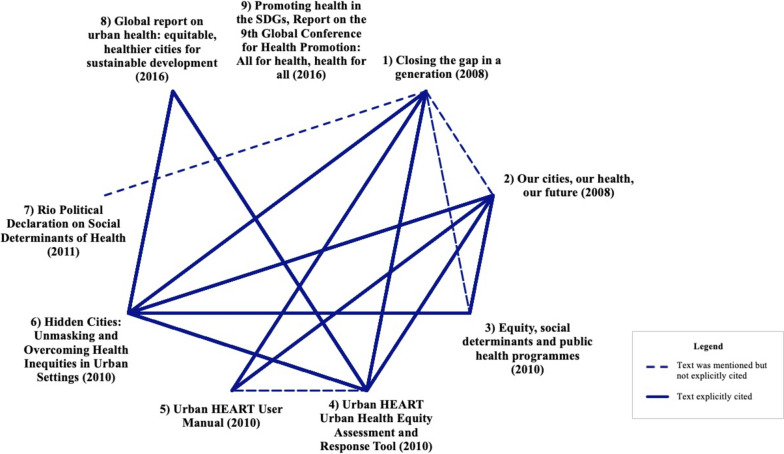
We undertook a critical discourse analysis of select texts that concern health promotion, the social determinants of health, and urban health.
The findings of this study suggest that (i) underpinning values are consistent in WHO texts' approach to health equity; (ii) WHO texts reiterate that health inequities are socially constructed and mitigatable but leave the 'causes of causes' vague; (iii) despite distinguishing between health "inequities" and "inequalities," there are several instances where these terms are used interchangeably across texts; (iv) WHO texts approach health equity broadly (covering a variety of areas); (v) health equity may be viewed as applicable either throughout the life-course or intergenerationally, which depends on the specific WHO text at hand; and (vi) WHO texts at times use vague or unclear language around how to improve health equity.
This study does not present one definition of health equity and action to be taken. Instead, this study uncovers discourses embedded in WHO texts to spur discussion and deliberate decision-making. This work can also pave the way for further inquiry on other complex key terms or those with embedded values.
世界卫生组织(WHO)已将健康公平作为其使命和更广泛议程的一部分——例如,想想“人人享有健康”这一口号。然而,最近一项范围界定综述确定,尚无研究调查WHO处理健康公平问题的方法。因此,本研究是第一项此类实证分析,考察WHO关于健康促进、健康的社会决定因素和城市健康的文本中有关健康公平的论述。
我们对涉及健康促进、健康的社会决定因素和城市健康的选定文本进行了批判性话语分析。
本研究结果表明:(i)WHO文本处理健康公平问题的方法中,其基础价值观是一致的;(ii)WHO文本重申健康不平等是社会建构的且可减轻,但对“根本原因”含糊不清;(iii)尽管区分了健康“不平等”和“不公平”,但在不同文本中有若干情况这些术语被交替使用;(iv)WHO文本广泛处理健康公平问题(涵盖多个领域);(v)健康公平可被视为适用于整个生命历程或代际之间,这取决于手头具体的WHO文本;(vi)WHO文本有时在如何改善健康公平方面使用模糊或不明确的语言。
本研究并未给出健康公平的单一定义及应采取的行动。相反,本研究揭示了WHO文本中所包含的论述,以激发讨论和审慎决策。这项工作还可为进一步探究其他复杂关键术语或具有内在价值观的术语铺平道路。