Innes Karen, Cotton Seonaidh, Campbell Marion K, Elliott Jim, Gillies Katie
Health Services Research Unit, Institute of Applied Health Sciences, School of Medicine, Medical Sciences and Nutrition, University of Aberdeen, Aberdeen, UK.
BMJ Open. 2018 Sep 5;8(9):e023303. doi: 10.1136/bmjopen-2018-023303.
To identify which information items potential participants and research nurses rank as the most important, and the reasons for this, when considering participation in a randomised controlled trial.
Q-methodology approach alongside a think-aloud process. Using a vignette outlining a hypothetical trial, participants were asked to rank statements about informational items usually included in a participant information leaflet (PIL) on a Q-grid, while undertaking a real-time think-aloud process to elicit the underpinning decision processes. Analysis of quantitative data was conducted using descriptive statistics and qualitative data was coded using content analysis.
20 participants (10 potential trial participants and 10 research nurses).
UK-based participants.
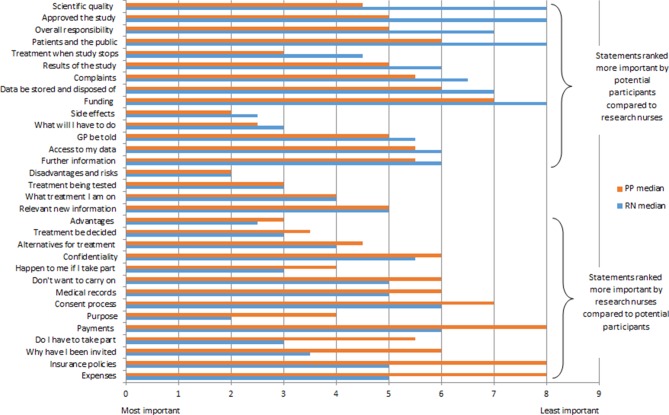
Ten research nurses and 10 potential trial participants provided data for the study. Both stakeholder groups ranked similar statements in their top three most important statements, with 'What are the possible disadvantages and risks of taking part?' featuring in both. However, considerable variability existed between the groups with regard to their ranking of statements of least importance. Participants identified that sufficient information to make a decision was secured using around 14 items. Participants also identified other items of importance not routinely included in PILs.
This study has provided a unique insight into how and why different trial stakeholder groups rank informational items currently contained within PILs. These results have implications for those developing future PILs and those who develop guidance on their content; PILs should focus most on the information items that potential trial participants want and need to make an informed choice about trial participation.
确定在考虑参与随机对照试验时,潜在参与者和研究护士将哪些信息项目列为最重要的项目以及原因。
Q方法与出声思考过程相结合。使用一个概述假设试验的 vignette,要求参与者在Q网格上对通常包含在参与者信息手册(PIL)中的信息项目陈述进行排序,同时进行实时出声思考过程以引出潜在的决策过程。定量数据使用描述性统计进行分析,定性数据使用内容分析进行编码。
20名参与者(10名潜在试验参与者和10名研究护士)。
英国参与者。
10名研究护士和10名潜在试验参与者为该研究提供了数据。两个利益相关者群体在其最重要的三项陈述中对类似的陈述进行了排序,“参与的可能缺点和风险是什么?”都在其中。然而,两组在对最不重要陈述的排序方面存在相当大的差异。参与者确定使用大约14个项目可以获得做出决定所需的足够信息。参与者还确定了其他重要项目,这些项目通常不包括在PIL中。
本研究对不同试验利益相关者群体如何以及为何对目前PIL中包含的信息项目进行排序提供了独特的见解。这些结果对那些制定未来PIL的人以及那些制定其内容指南的人具有启示意义;PIL应最关注潜在试验参与者想要和需要的信息项目,以便对试验参与做出明智的选择。