Mohammed Aminu, Islam Md Shahidul
Department of Biochemistry, Faculty of Life Sciences, Ahmadu Bello University, Zaria, Nigeria.
Department of Biochemistry, School of Life Sciences, University of KwaZulu-Natal, Durban, South Africa.
Front Pharmacol. 2018 Aug 22;9:893. doi: 10.3389/fphar.2018.00893. eCollection 2018.
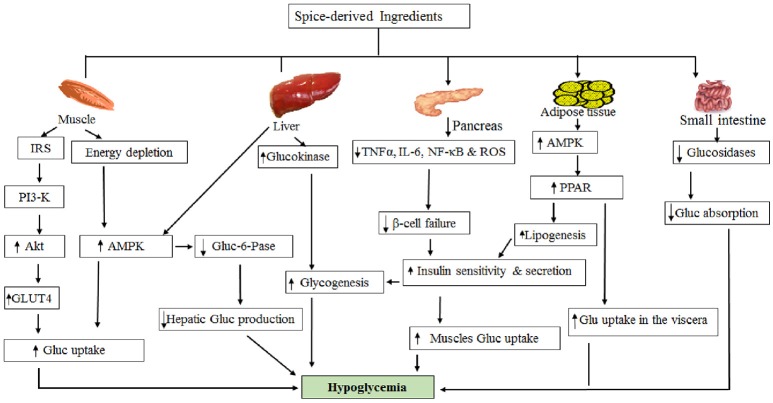
Spices possess tremendous therapeutic potential including hypoglycemic action, attributed to their bioactive ingredients. However, there is no study that critically reviewed the hypoglycemic potency, safety and the bioavailability of the spice-derived bioactive ingredients (SDBI). Therefore, the aim of the study was to comprehensively review all published studies regarding the hypoglycemic action of SDBI with the purpose to assess whether the ingredients are potential hypoglycemic agents or adjuvant. Factors considered were concentration/dosages used, the extent of blood glucose reduction, the IC values, and the safety concern of the SDBI. From the results, cinnamaldehyde, curcumin, diosgenin, thymoquinone (TQ), and trigonelline were showed the most promising effects and hold future potential as hypoglycemic agents. Conclusively, future studies should focus on improving the tissue and cellular bioavailability of the promising SDBI to achieve greater potency. Additionally, clinical trials and toxicity studies are with these SDBI are warranted.
香料具有巨大的治疗潜力,包括降血糖作用,这归因于它们的生物活性成分。然而,尚无研究对香料衍生生物活性成分(SDBI)的降血糖效力、安全性和生物利用度进行批判性综述。因此,本研究的目的是全面回顾所有已发表的关于SDBI降血糖作用的研究,以评估这些成分是否为潜在的降血糖药物或佐剂。考虑的因素包括所使用的浓度/剂量、血糖降低程度、IC值以及SDBI的安全性问题。结果显示,肉桂醛、姜黄素、薯蓣皂苷元、百里醌(TQ)和胡芦巴碱表现出最有前景的效果,有望成为未来的降血糖药物。总之,未来的研究应专注于提高有前景的SDBI的组织和细胞生物利用度,以实现更大的效力。此外,对这些SDBI进行临床试验和毒性研究是必要的。