Department of Diagnostic and Biological Sciences, University of Minnesota, Minneapolis, Minnesota, United States of America.
Department of Developmental and Surgical Sciences, Division of Orthodontics, University of Minnesota, Minneapolis, Minnesota, United States of America.
PLoS One. 2018 Sep 6;13(9):e0203404. doi: 10.1371/journal.pone.0203404. eCollection 2018.
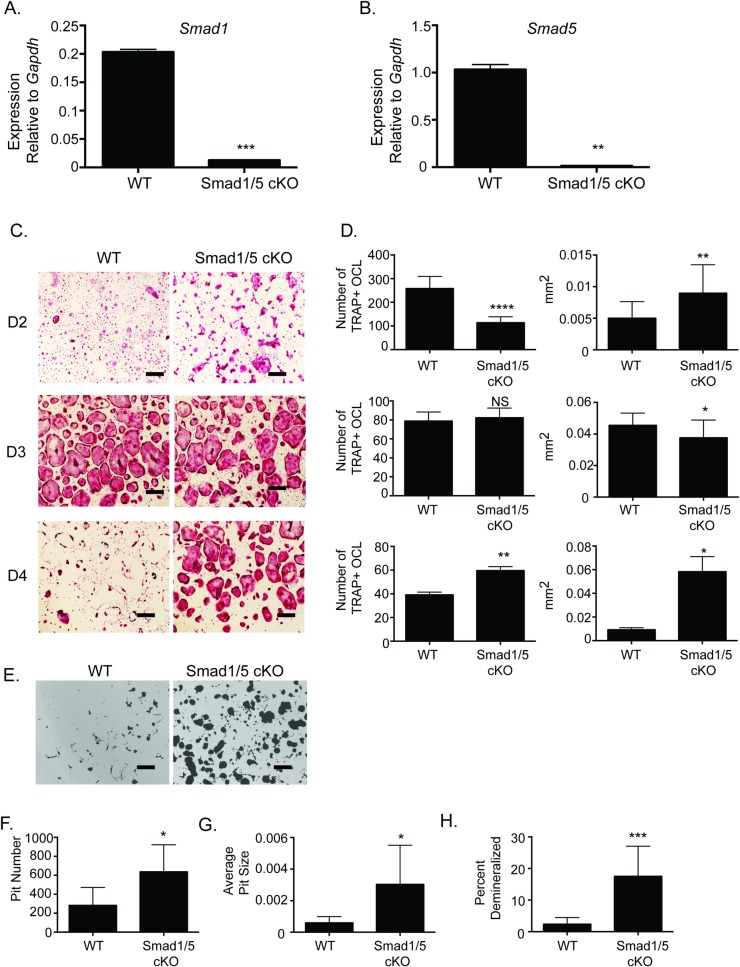
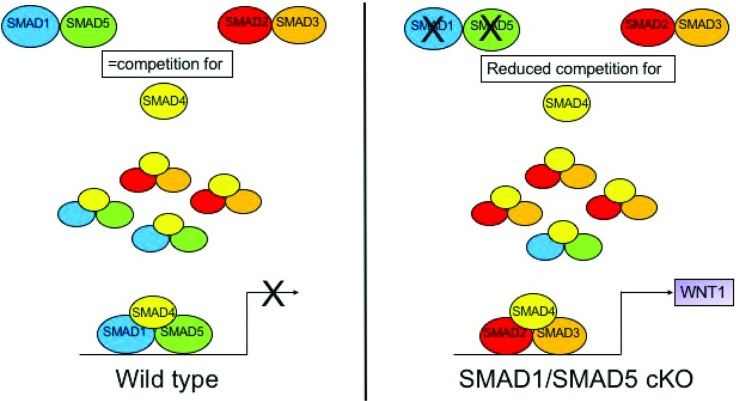
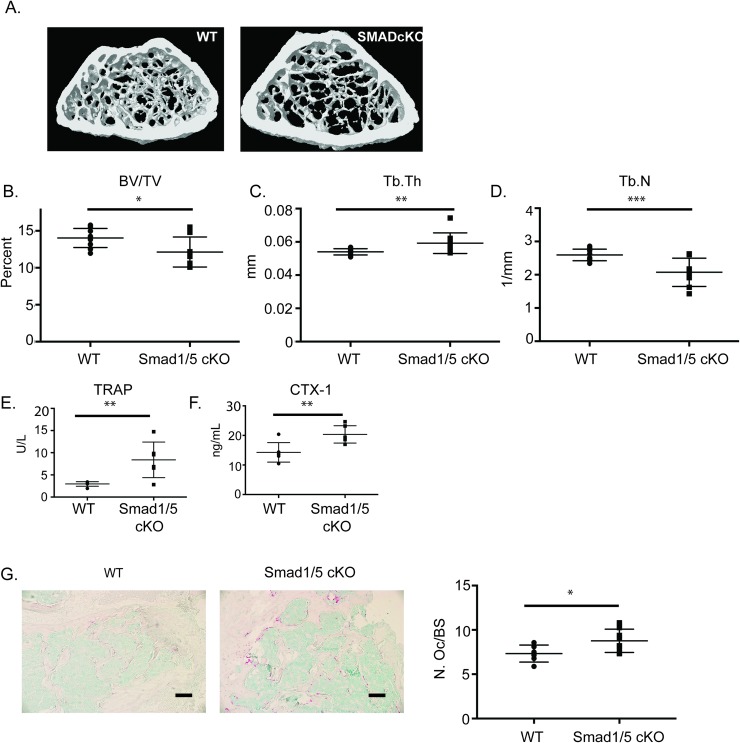
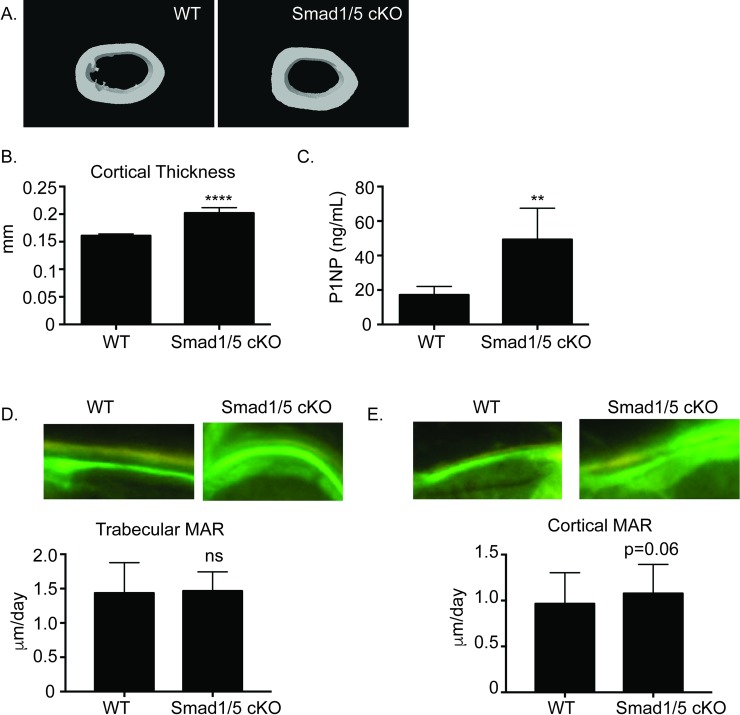
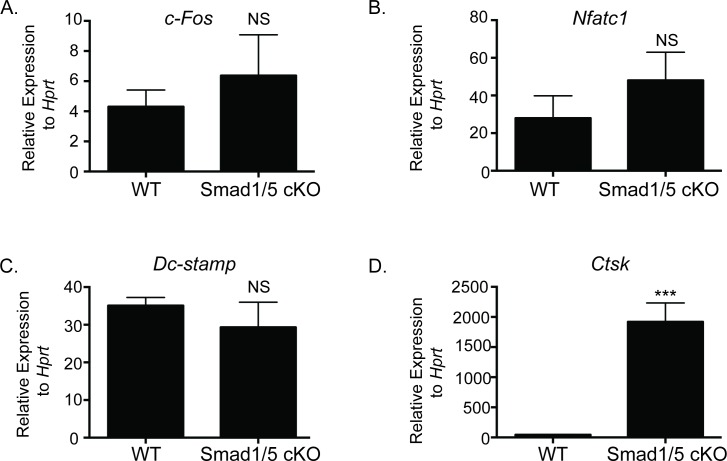
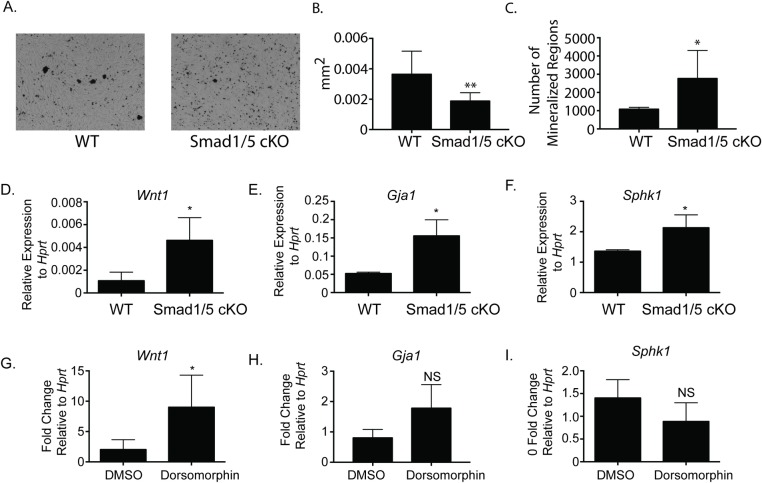
Bone remodeling occurs via coupling between bone resorption by osteoclasts and bone formation by osteoblasts. The mechanisms that regulate osteoclast signals to osteoblasts are not well understood. Published studies have reported that BMP signaling in osteoclasts regulate osteoclast coupling targets. To investigate the necessity of canonical BMP signaling on osteoclast differentiation and coupling, we mated Smad1fl/fl; Smad5fl/fl mice to c-Fms-Cre mice. We analyzed male mice at 3 months of age to determine the skeletal phenotype of the Smad1fl/fl; Smad5fl/fl;c-Fms-Cre (SMAD1/5 cKO) mice. There was a 1.2-fold decrease in trabecular BV/TV in SMAD1/5 cKO. Analyses of osteoclast serum markers in SMAD1/5 cKO mice, showed a significant increase in CTX-1 (1.5 fold) and TRAP ELISA (3 fold) compared to control mice. In these same mice, there was a 1.3-fold increase in cortical thickness. Consistent with the increase in cortical thickness, we found a 3-fold increase in osteoblast activity as measured by P1NIP ELISA assay from SMAD1/5 cKO mice. To explain the changes in cortical thickness and P1NP activity, we determined conditioned media from SMAD1/5 cKO osteoclast cultures enhanced mineralization of an osteoblast cell line and coupling factors expressed by osteoclasts that regulate osteoblast activity Wnt1 (4.5-fold increase), Gja1 (3-fold increase) and Sphk1 (1.5-fold increase) were all upregulated in osteoclasts from SMAD1/5 cKO compared to control osteoclasts. Lastly osteoclasts treated with dorsomorphin, a chemical inhibitor of SMAD1/5 signaling, demonstrates an increase in Wnt1 and Gja1 expression similar to the SMAD1/5 cKO mice. Previous studies demonstrated that TGF-β signaling in osteoclasts leads to increases in WNT1 expression by osteoclasts. Therefore, our data suggest that TGF-β and BMP signaling pathways in osteoclasts could act in an antagonistic fashion to regulate osteoblast activity through WNT1 and other coupling factors.
骨重建是通过破骨细胞的骨吸收和成骨细胞的骨形成之间的偶联来实现的。调节破骨细胞信号向成骨细胞的机制尚不清楚。已发表的研究报告称,破骨细胞中的 BMP 信号调节破骨细胞偶联靶标。为了研究经典 BMP 信号对破骨细胞分化和偶联的必要性,我们将 Smad1fl/fl;Smad5fl/fl 小鼠与 c-Fms-Cre 小鼠交配。我们分析了 3 月龄雄性小鼠,以确定 Smad1fl/fl;Smad5fl/fl;c-Fms-Cre(SMAD1/5 cKO)小鼠的骨骼表型。SMAD1/5 cKO 小鼠的小梁骨体积/骨体积(BV/TV)降低了 1.2 倍。SMAD1/5 cKO 小鼠的破骨细胞血清标志物分析显示,CTX-1(增加 1.5 倍)和 TRAP ELISA(增加 3 倍)与对照小鼠相比显著增加。在这些相同的小鼠中,皮质厚度增加了 1.3 倍。与皮质厚度增加一致,我们发现 P1NIP ELISA 测定法中 SMAD1/5 cKO 小鼠的成骨细胞活性增加了 1.3 倍。为了解释皮质厚度和 P1NP 活性的变化,我们确定了 SMAD1/5 cKO 破骨细胞培养物的条件培养基增强了成骨细胞系的矿化作用,并且调节成骨细胞活性的破骨细胞表达的偶联因子 Wnt1(增加 4.5 倍)、Gja1(增加 3 倍)和 Sphk1(增加 1.5 倍)在 SMAD1/5 cKO 破骨细胞中均上调与对照破骨细胞相比。最后,用 Dorsomorphin 处理破骨细胞,一种 SMAD1/5 信号的化学抑制剂,表明 Wnt1 和 Gja1 的表达增加,类似于 SMAD1/5 cKO 小鼠。先前的研究表明,破骨细胞中的 TGF-β 信号导致破骨细胞中 WNT1 表达增加。因此,我们的数据表明,破骨细胞中的 TGF-β 和 BMP 信号通路可能通过 WNT1 和其他偶联因子以拮抗方式发挥作用,从而调节成骨细胞活性。