Laboratory for Mineralized Tissues, Center for Translational and Clinical Research, University of Zagreb School of Medicine, Zagreb, Croatia.
Front Immunol. 2022 Apr 26;13:869422. doi: 10.3389/fimmu.2022.869422. eCollection 2022.
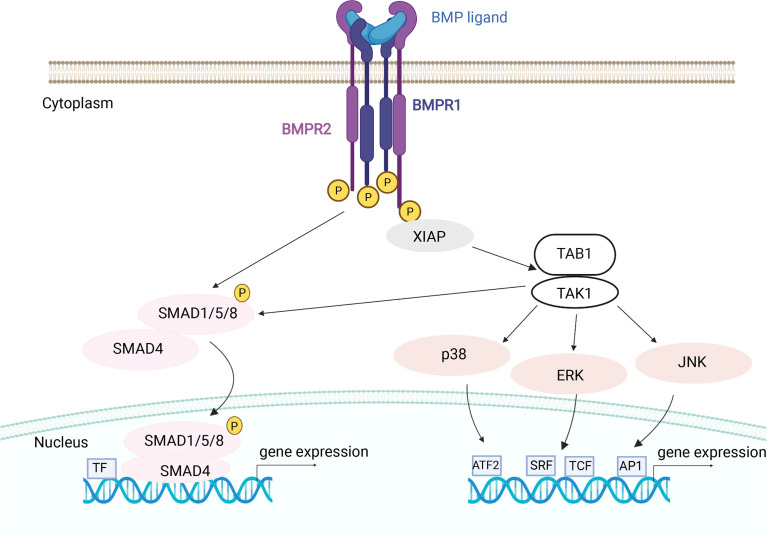
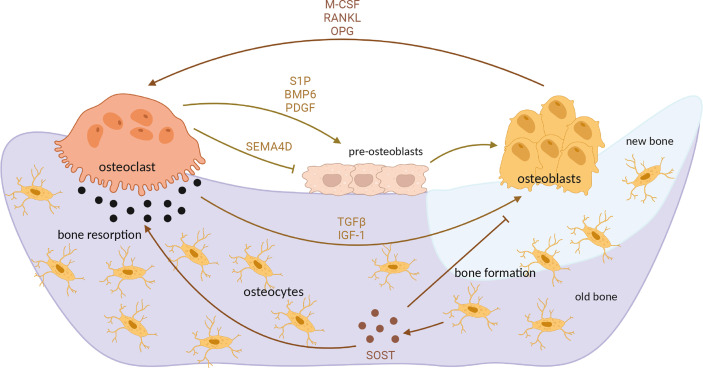
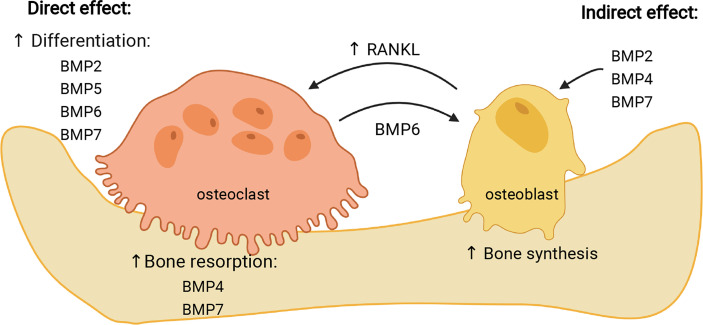
In response to mechanical forces and the aging process, bone in the adult skeleton is continuously remodeled by a process in which old and damaged bone is removed by bone-resorbing osteoclasts and subsequently is replaced by new bone by bone-forming cells, osteoblasts. During this essential process of bone remodeling, osteoclastic resorption is tightly coupled to osteoblastic bone formation. Bone-resorbing cells, multinuclear giant osteoclasts, derive from the monocyte/macrophage hematopoietic lineage and their differentiation is driven by distinct signaling molecules and transcription factors. Critical factors for this process are Macrophage Colony Stimulating Factor (M-CSF) and Receptor Activator Nuclear Factor-κB Ligand (RANKL). Besides their resorption activity, osteoclasts secrete coupling factors which promote recruitment of osteoblast precursors to the bone surface, regulating thus the whole process of bone remodeling. Bone morphogenetic proteins (BMPs), a family of multi-functional growth factors involved in numerous molecular and signaling pathways, have significant role in osteoblast-osteoclast communication and significantly impact bone remodeling. It is well known that BMPs help to maintain healthy bone by stimulating osteoblast mineralization, differentiation and survival. Recently, increasing evidence indicates that BMPs not only help in the anabolic part of bone remodeling process but also significantly influence bone catabolism. The deletion of the BMP receptor type 1A (BMPRIA) in osteoclasts increased osteoblastic bone formation, suggesting that BMPR1A signaling in osteoclasts regulates coupling to osteoblasts by reducing bone-formation activity during bone remodeling. The dual effect of BMPs on bone mineralization and resorption highlights the essential role of BMP signaling in bone homeostasis and they also appear to be involved in pathological processes in inflammatory disorders affecting bones and joints. Certain BMPs (BMP2 and -7) were approved for clinical use; however, increased bone resorption rather than formation were observed in clinical applications, suggesting the role BMPs have in osteoclast activation and subsequent osteolysis. Here, we summarize the current knowledge of BMP signaling in osteoclasts, its role in osteoclast resorption, bone remodeling, and osteoblast-osteoclast coupling. Furthermore, discussion of clinical application of recombinant BMP therapy is based on recent preclinical and clinical studies.
针对机械力和衰老过程,成人骨骼中的骨通过一个过程不断重塑,该过程中,旧的和受损的骨被破骨细胞(骨吸收细胞)吸收,随后由成骨细胞(骨形成细胞)替代新骨。在骨重塑的这个基本过程中,破骨细胞的吸收与成骨细胞的骨形成紧密偶联。破骨细胞来源于单核细胞/巨噬细胞造血谱系中的多核巨细胞,其分化由不同的信号分子和转录因子驱动。这个过程的关键因素是巨噬细胞集落刺激因子(M-CSF)和核因子-κB 受体激活剂配体(RANKL)。除了它们的吸收活性外,破骨细胞还分泌偶联因子,这些因子可将成骨细胞前体募集到骨表面,从而调节整个骨重塑过程。骨形态发生蛋白(BMPs)是一类多功能生长因子,参与许多分子和信号通路,在成骨细胞-破骨细胞通讯中具有重要作用,并显著影响骨重塑。众所周知,BMPs 通过刺激成骨细胞矿化、分化和存活来帮助维持健康的骨骼。最近,越来越多的证据表明,BMPs 不仅有助于骨重塑过程的合成部分,而且还显著影响骨分解代谢。破骨细胞中 BMP 受体 1A(BMPR1A)的缺失增加了成骨细胞的骨形成,这表明破骨细胞中的 BMPR1A 信号通过在骨重塑过程中降低成骨细胞的形成活性来调节与成骨细胞的偶联。BMPs 对骨矿化和吸收的双重作用突出了 BMP 信号在骨平衡中的重要作用,并且它们似乎也参与了影响骨骼和关节的炎症性疾病的病理过程。某些 BMPs(BMP2 和 -7)已获准用于临床应用;然而,在临床应用中观察到骨吸收增加而不是形成增加,这表明 BMPs 在破骨细胞激活和随后的骨溶解中起作用。在这里,我们总结了 BMP 信号在破骨细胞中的现有知识,及其在破骨细胞吸收、骨重塑和成骨细胞-破骨细胞偶联中的作用。此外,基于最近的临床前和临床研究,对重组 BMP 治疗的临床应用进行了讨论。