Balik Martin, Sander Michael, Trimmel Helmut, Heinz Gottfried
Department of Anaesthesia and Intensive Care, 1st Medical Faculty, Charles University, General University Hospital, U Nemocnice 2, Praha 2, Czechia.
Universitätsklinikum Gießen, Klinik für Anästhesiologie, Operative Intensivmedizin und Schmerztherapie, Rudolf-Buchheim-Straße 7, Gießen, Deutschland.
Eur Heart J Suppl. 2018 Jan;20(Suppl A):A10-A14. doi: 10.1093/eurheartj/sux036. Epub 2018 Jan 8.
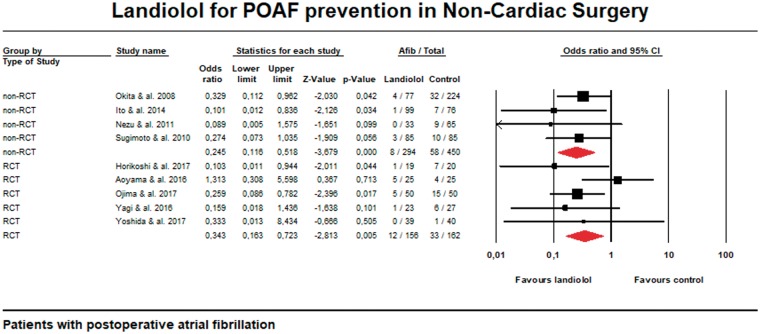
Beta-blockers are a potential option to manage peri-operative atrial fibrillation. Landiolol is a new ultra-short beta-blocker with a half-life of only 4 minutes and very high beta-1 selectivity which has been used for treatment and prevention of atrial fibrillation in pulmonary surgery and gastro-intestinal surgery. Due to its limited negative inotropic effect and high beta-1 selectivity landiolol allows for control of heart rate with minimal impact on blood pressure. Landiolol is well tolerated by the respiratory system. Additional benefits are related to the regulation of the inflammatory response and blunting of the adrenergic pathway. There is a limited number of trials with total of 61 patients undergoing lung resection or oesophagectomy who developed post-operative atrial fibrillation and were treated with landiolol. The experience with landiolol for prevention is more documented than landiolol application for treatment of post-operative atrial fibrillation. There are 9 comparative studies with a total of 450 patients administered landiolol for prevention of post-operative atrial fibrillation. The use of low dosage (5-10mcg/kg/min) is usually sufficient to rapidly control heart rate which is associated with earlier and higher rate of conversion to sinus rhythm as compared to the controls. The excellent tolerance of landiolol at lower dosage (3-5mcg/kg/min) allows to initiate prophylactic use during surgery and postoperatively. Landiolol prophylaxis is associated with reduced incidence of post-operative atrial fibrillation without triggering adverse events related to a beta-blockade.
β受体阻滞剂是围手术期房颤管理的一种潜在选择。兰地洛尔是一种新型超短效β受体阻滞剂,半衰期仅4分钟,具有很高的β1选择性,已用于肺手术和胃肠手术中房颤的治疗和预防。由于其有限的负性肌力作用和高β1选择性,兰地洛尔能在对血压影响最小的情况下控制心率。兰地洛尔在呼吸系统中耐受性良好。其他益处与炎症反应调节和肾上腺素能途径的减弱有关。共有61例接受肺切除或食管切除术的患者发生术后房颤并接受兰地洛尔治疗,相关试验数量有限。与兰地洛尔用于治疗术后房颤相比,其预防方面的经验记录更多。有9项比较研究,共450例患者使用兰地洛尔预防术后房颤。使用低剂量(5 - 10微克/千克/分钟)通常足以快速控制心率,与对照组相比,可使窦性心律转复的时间更早且转复率更高。兰地洛尔在较低剂量(3 - 5微克/千克/分钟)时耐受性良好,允许在手术期间和术后开始预防性使用。兰地洛尔预防与术后房颤发生率降低相关,且不会引发与β受体阻滞剂相关的不良事件。