Riccio Barbara, Fraschetto Claudia, Villanueva Justine, Cantatore Federica, Bertuglia Andrea
Private Practitioner, Turin, Italy.
Department of Veterinary Science, University of Turin, Grugliasco, Italy.
Front Vet Sci. 2018 Aug 23;5:195. doi: 10.3389/fvets.2018.00195. eCollection 2018.
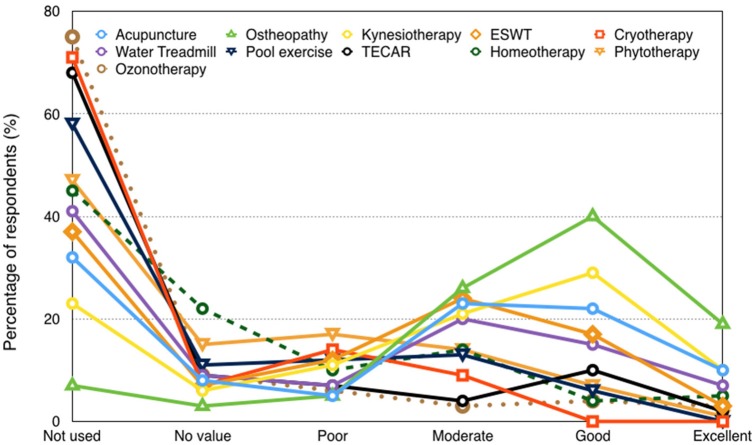
Despite back-pain being a common cause of poor performance in sport horses, a tailored diagnostic workflow and a consolidated therapeutic approach are currently lacking in equine medicine. The aim of the study was to assess the evolution in the veterinarian approach to diagnose and treat back-pain over a 10 years period. To investigate this topic, two surveys were addressed to equine veterinarians working in practice throughout Europe 10 years apart (2006 and 2016). The answers were organized in an Excel dataset and analyzed. There were 47 respondents in 2006 and 168 in 2016, from 8 European Countries. The main reasons for examining horses with back-pain were poor performance (76%), behavioral issues (68%), and lameness (50%). When assessing back pain, 97% of respondents applied careful digital pressure over paravertebral muscles, 90% of them used digital back mobilization, and 69% was detecting areas of localized heat. The use of diagnostic analgesia to confirm the source of pain was rarely employed. Radiography and ultrasonography were the most frequent diagnostic imaging modalities used to investigate the causes of back-pain in both surveys. Obtaining a definitive diagnosis in horses with back-pain is considered challenging due to the reduced accessibility of the area and the variability in the pain manifestations. Corticosteroids injections were used for local treatments by 80% of respondents in 2006 and 92% in 2016. Recently, ultrasonography has been extensively used during the injections of the vertebral articular facets and sacroiliac joints region. The use of complementary therapies was restricted to a low percentage of respondents in the first survey (20%) but it increased over the decade. In 2016, a wider percentage of respondents considered osteopathy (40%), kinesiotherapy (29%), and acupuncture (22%) when treating back disorders compared to 2006. The structural differences of the two surveys did not enable a direct data comparison. Based on the results of this surveys, however, veterinarians should be sensitized to the back-pain problems and seek to integrate findings from clinical research studies in their daily practice.
尽管背痛是运动马匹表现不佳的常见原因,但目前马医学中缺乏定制的诊断流程和统一的治疗方法。本研究的目的是评估兽医在10年期间诊断和治疗背痛方法的演变。为了调查这个主题,向欧洲各地从事临床工作的马兽医进行了两次相隔10年的调查(2006年和2016年)。答案整理在一个Excel数据集中并进行了分析。2006年有47名受访者,2016年有168名,来自8个欧洲国家。检查背痛马匹的主要原因是表现不佳(76%)、行为问题(68%)和跛行(50%)。在评估背痛时,97%的受访者对椎旁肌肉进行仔细的指压,90%的受访者进行背部手法松动,69%的受访者检测局部发热区域。很少使用诊断性镇痛来确定疼痛来源。在两项调查中,放射学和超声检查是用于调查背痛原因最常用的诊断成像方式。由于该区域难以触及且疼痛表现存在差异,因此对背痛马匹进行明确诊断具有挑战性。2006年80%的受访者和2016年92%的受访者使用皮质类固醇注射进行局部治疗。最近,超声检查已广泛应用于椎体关节面和骶髂关节区域的注射过程中。在第一次调查(2006年)中,使用辅助疗法的受访者比例较低(20%),但在这十年中有所增加。与2006年相比,2016年在治疗背部疾病时,更多受访者考虑整骨疗法(40%)、运动疗法(29%)和针灸(22%)。两项调查的结构差异无法进行直接数据比较。然而,根据本次调查结果,兽医应提高对背痛问题的认识,并寻求将临床研究结果纳入日常实践。