Plant Biotechnology, Institute of Molecular Plant Biology, ETH Zurich, 8092 Zurich, Switzerland.
Plant Biochemistry, Institute of Molecular Plant Biology, ETH Zurich, 8092 Zurich, Switzerland.
Sci Adv. 2018 Sep 5;4(9):eaat6086. doi: 10.1126/sciadv.aat6086. eCollection 2018 Sep.
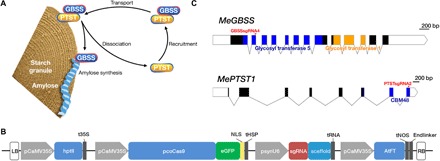
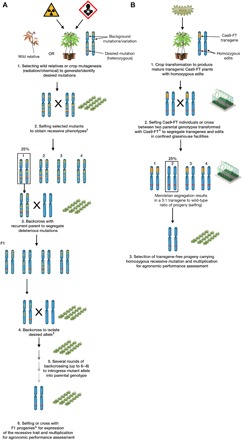
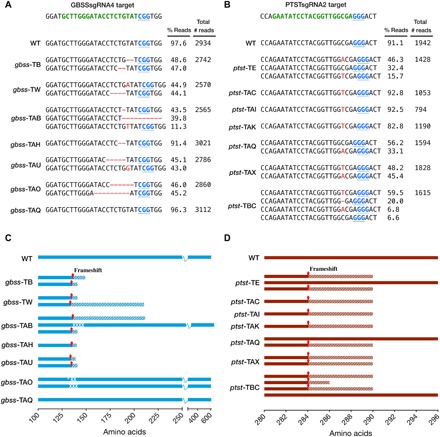
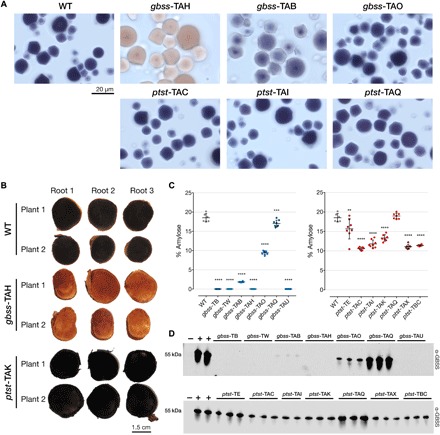
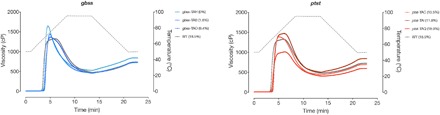
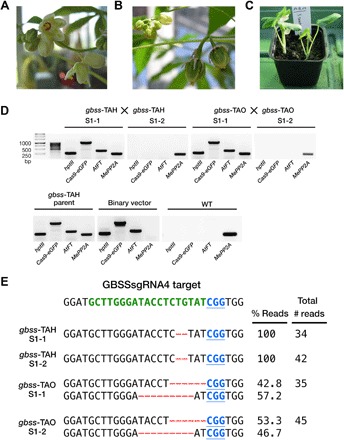
Crop diversification required to meet demands for food security and industrial use is often challenged by breeding time and amenability of varieties to genome modification. Cassava is one such crop. Grown for its large starch-rich storage roots, it serves as a staple food and a commodity in the multibillion-dollar starch industry. Starch is composed of the glucose polymers amylopectin and amylose, with the latter strongly influencing the physicochemical properties of starch during cooking and processing. We demonstrate that CRISPR-Cas9 (clustered regularly interspaced short palindromic repeats/CRISPR-associated protein 9)-mediated targeted mutagenesis of two genes involved in amylose biosynthesis, () or (), can reduce or eliminate amylose content in root starch. Integration of the gene in the genome-editing cassette allowed us to accelerate flowering-an event seldom seen under glasshouse conditions. Germinated seeds yielded S1, a transgene-free progeny that inherited edited genes. This attractive new plant breeding technique for modified cassava could be extended to other crops to provide a suite of novel varieties with useful traits for food and industrial applications.
为了满足食品安全和工业用途的需求,通常需要进行作物多样化种植,但这受到了育种时间和品种对基因组修饰的适应性的限制。木薯就是这样一种作物。木薯因其富含淀粉的大型块根而被种植,它既是主食,也是价值数十亿美元的淀粉工业的一种商品。淀粉由葡萄糖聚合物支链淀粉和直链淀粉组成,后者在烹饪和加工过程中强烈影响淀粉的物理化学性质。我们证明,CRISPR-Cas9(成簇规律间隔短回文重复/CRISPR 相关蛋白 9)介导的参与直链淀粉生物合成的两个基因()或()的靶向诱变,可以降低或消除根淀粉中的直链淀粉含量。基因在基因组编辑盒中的整合使我们能够加速开花——这是在温室条件下很少见的事件。萌发的种子产生了 S1,这是一种无转基因后代,遗传了编辑基因。这种用于修饰木薯的新型植物育种技术极具吸引力,可扩展到其他作物,为食品和工业应用提供一系列具有有用特性的新型品种。