Claes Annes J, Van de Heyning Paul, Gilles Annick, Hofkens-Van den Brandt Anouk, Van Rompaey Vincent, Mertens Griet
Department of Otorhinolaryngology, Head and Neck Surgery, Antwerp University Hospital, Antwerp, Belgium.
Experimental Lab of Translational Neurosciences and Dento-Otolaryngology, Faculty of Medicine and Health Sciences, University of Antwerp, Antwerp, Belgium.
Front Neurosci. 2018 Aug 24;12:580. doi: 10.3389/fnins.2018.00580. eCollection 2018.
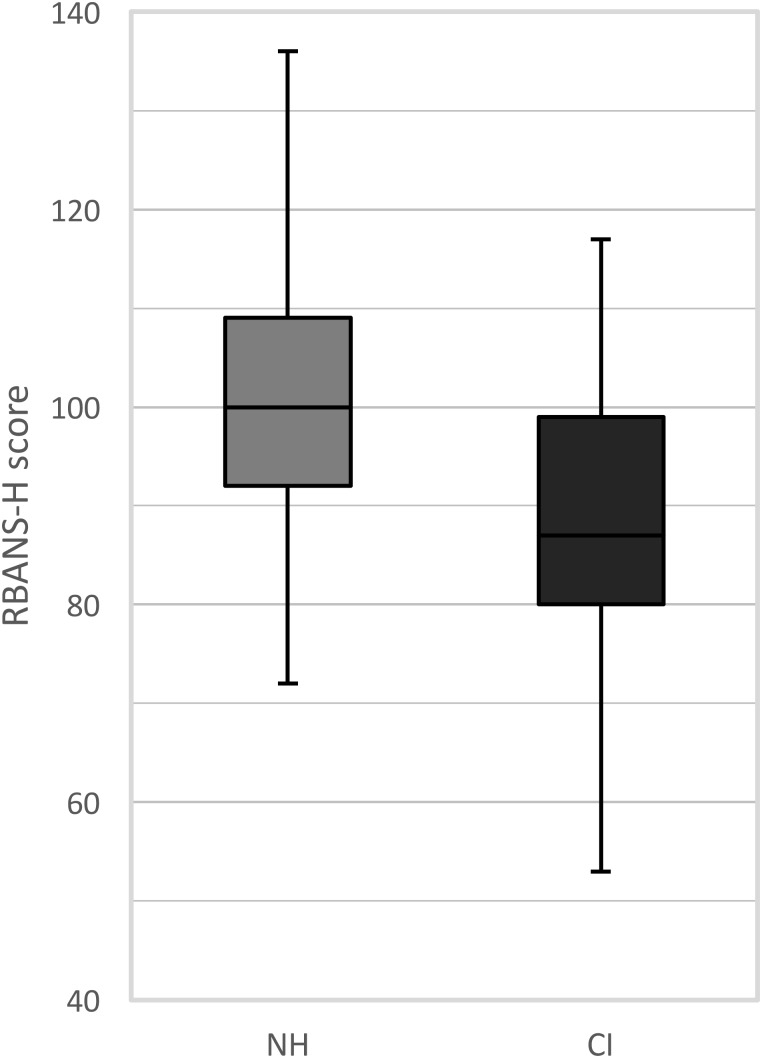
To compare cognitive functioning among experienced, unilateral cochlear implant (CI) recipients and normal-hearing (NH) controls by means of the Repeatable Battery for the Assessment of Neuropsychological Status for Hearing-impaired individuals (RBANS-H). Sixty-one post-lingually and bilaterally severely hearing-impaired CI recipients (median age: 71.0, range: 58.3 to 93.9 years) with at least 1 year of CI experience (median: 12.4, range: 1.1 to 18.6 years) and 81 NH control participants (median age: 69.9, range: 50.1 to 87.1 years) took part in this cross-sectional study. The RBANS-H was performed, as well as an audiometric assessment, including best-aided speech audiometry in quiet (monosyllabic words) and in noise (Leuven Intelligibility Sentences test). The RBANS-H performances of the CI recipients (mean: 88.1 ± 14.9) were significantly poorer than the those of the NH participants (mean: 100.5 ± 13.2), with correction of age, sex, and education differences (general linear model: = 0.001). The mean difference, corrected for the effects of these three demographic factors, was 8.8 (± 2.5) points. Additionally, in both groups, a significant correlation was established between overall cognition and speech perception, both in quiet and in noise, independently of age. Experienced, unilateral CI recipients present subnormal cognitive functioning, beyond the effect of age, sex and education. This has implications for auditory rehabilitation after CI and may highlight the need for additional cognitive rehabilitation in the long term after implantation. Long-term prospective and longitudinal investigations are imperative to improve our understanding of cognitive aging in severely hearing-impaired individuals receiving CIs and its association with CI outcomes.
通过用于听力受损个体的神经心理状态评估的可重复成套测验(RBANS-H),比较有经验的单侧人工耳蜗植入(CI)受者与正常听力(NH)对照者的认知功能。61名语后和双侧重度听力受损的CI受者(中位年龄:71.0岁,范围:58.3至93.9岁),至少有1年的CI使用经验(中位值:12.4年,范围:1.1至18.6年),以及81名NH对照参与者(中位年龄:69.9岁,范围:50.1至87.1岁)参与了这项横断面研究。进行了RBANS-H测试以及听力评估,包括安静环境下(单音节词)和噪声环境下(鲁汶清晰度句子测试)的最佳助听听阈测试。在对年龄、性别和教育差异进行校正后(一般线性模型:P = 0.001),CI受者的RBANS-H表现(均值:88.1±14.9)显著低于NH参与者(均值:100.5±13.2)。校正这三个人口统计学因素的影响后,平均差异为8.8(±2.5)分。此外,在两组中,无论年龄如何,安静和噪声环境下的整体认知与言语感知之间均建立了显著相关性。有经验的单侧CI受者存在低于正常的认知功能,超出了年龄、性别和教育的影响。这对CI后的听觉康复有影响,可能凸显了植入后长期进行额外认知康复的必要性。长期前瞻性和纵向研究对于增进我们对接受CI的重度听力受损个体的认知老化及其与CI结果的关联的理解至关重要。