Lin Shih Ping, Wu Chun-Ying, Wang Chang-Bi, Li Tsai-Chung, Ko Nai-Ying, Shi Zhi-Yuan
Department of Internal Medicine, Taichung Veterans General Hospital, Taichung National Cancer Institute, National Health Research Institute, Miaoli Graduate Institute of Clinical Medicine, National Yang-Ming University, Taipei Department of Life Sciences, National Chung Hsing University Department of Public Health, College of Public Health, China Medical University Department of Nursing, Central Taiwan University of Science and Technology Graduate Institute of Public Health, College of Public Health, China Medical University, Taichung Department of Nursing, College of Medicine, National Cheng Kung University and Hospital, Tainan, Taiwan.
Medicine (Baltimore). 2018 Sep;97(36):e12268. doi: 10.1097/MD.0000000000012268.
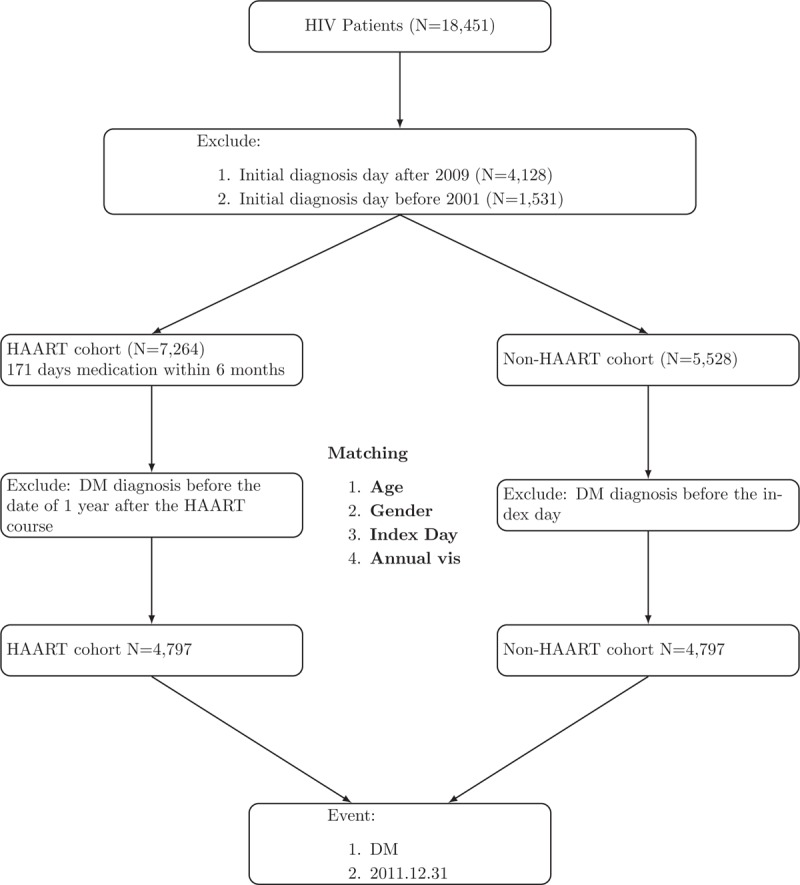
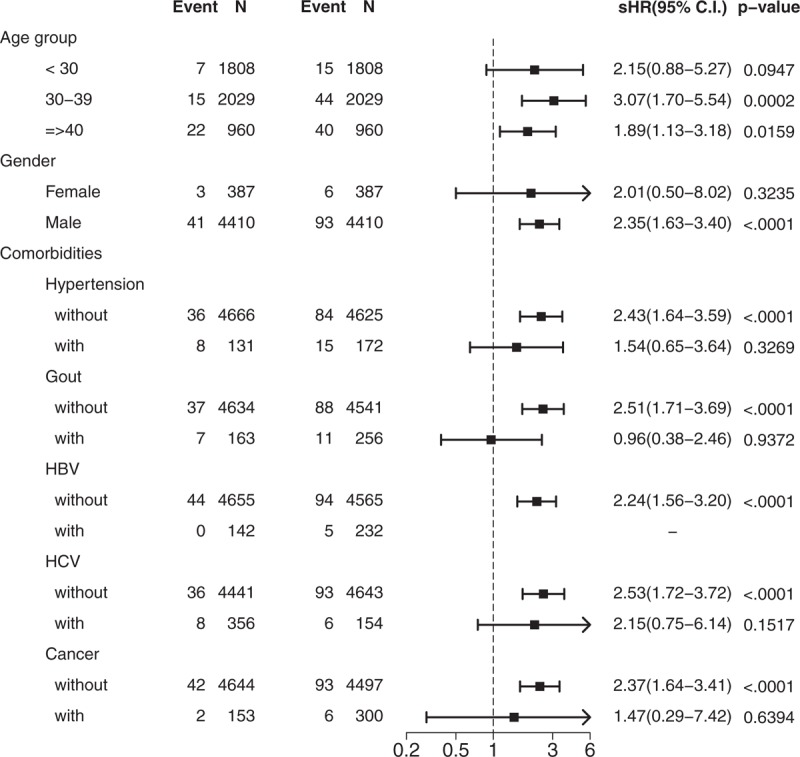
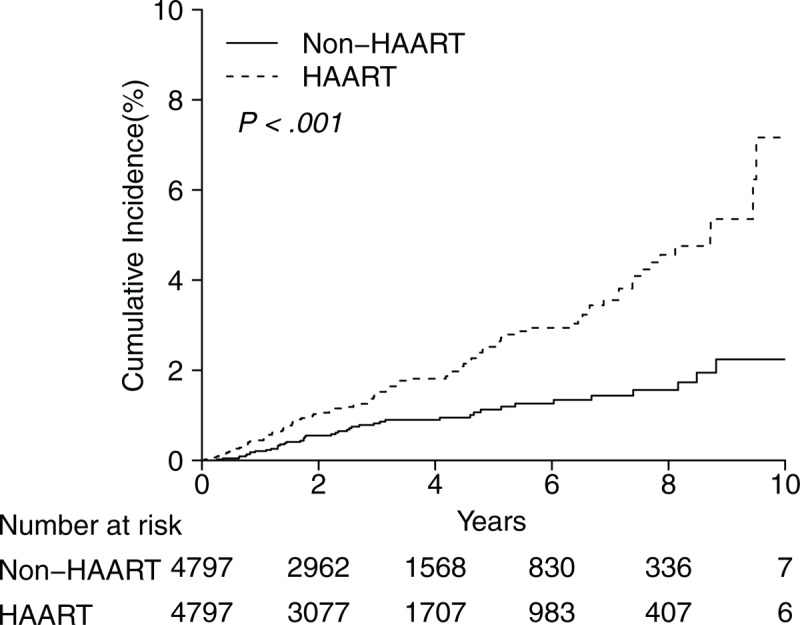
Previous studies have shown that the incidence of diabetes mellitus (DM) has increased in human immunodeficiency virus (HIV)-infected patients with long-term exposure to highly active antiretroviral therapy (HAART). However, the factors associated with DM among HIV-infected patients in Asia remain unclear in the HAART era.A nationwide cohort studyData from Taiwan's National Health Insurance Research Database (NHIRD) between 2000 and 2010 were used to investigate the incidence of and factors associated with DM among HIV-infected patients. Propensity score matching was conducted to match 4797 patients receiving HAART (HAART cohort) with 4797 patients not receiving HAART (non-HAART cohort). HAART use was treated as a time-dependent variable in a Cox regression model.HAART cohort had a significantly higher 10-year incidence of DM (7.16%; 95% confidence interval [CI], 4.30%-10.03%) than non-HAART cohort (2.24%; 95% CI, 1.28%-3.20%) (P < .001). After adjusting for age, gender, and comorbidities, receiving HAART was associated with an increased incidence of DM, with a subdistribution hazard ratio (sHR) of 2.39 (95% CI, 1.65-3.45). Hypertension (sHR = 5.27; 95% CI, 3.21-8.65), gout (sHR = 2.39; 95% CI, 1.38-4.16), and hepatitis C virus (HCV) infection (sHR = 2.43; 95% CI, 1.28-4.61) were significantly associated with a higher risk of DM. Sensitivity analyses showed exposure to HAART remained significantly associated with an increased risk of DM, particularly in those without pre-existing hypertension, gout, or HCV infection.Exposure to HAART increased the risk of DM in HIV-infected Taiwanese patients, particularly in those without pre-existing hypertension, gout, or HCV infection.
以往研究表明,长期接受高效抗逆转录病毒治疗(HAART)的人类免疫缺陷病毒(HIV)感染患者中,糖尿病(DM)的发病率有所上升。然而,在HAART时代,亚洲HIV感染患者中与DM相关的因素仍不明确。
一项全国性队列研究
利用台湾国民健康保险研究数据库(NHIRD)2000年至2010年的数据,调查HIV感染患者中DM的发病率及相关因素。进行倾向评分匹配,将4797例接受HAART的患者(HAART队列)与4797例未接受HAART的患者(非HAART队列)进行匹配。在Cox回归模型中,将HAART的使用视为时间依赖性变量。
HAART队列的DM 10年发病率(7.16%;95%置信区间[CI],4.30%-10.03%)显著高于非HAART队列(2.24%;95%CI,1.28%-3.20%)(P<0.001)。在调整年龄、性别和合并症后,接受HAART与DM发病率增加相关,亚分布风险比(sHR)为2.39(95%CI,1.65-3.45)。高血压(sHR=5.27;95%CI,3.21-8.65)、痛风(sHR=2.39;95%CI,1.38-4.16)和丙型肝炎病毒(HCV)感染(sHR=2.43;95%CI,1.28-4.61)与更高的DM风险显著相关。敏感性分析表明,暴露于HAART仍与DM风险增加显著相关,尤其是在那些无既往高血压、痛风或HCV感染的患者中。
暴露于HAART会增加台湾HIV感染患者患DM的风险,尤其是在那些无既往高血压、痛风或HCV感染的患者中。