Department of Pharmacy Administration and Clinical Pharmacy, School of pharmacy Xi'an Jiaotong University, Xi'an 710061, China.
Center for Drug Safety and Policy Research, Xian Jiaotong University, Xi'an 710061, China.
Int J Environ Res Public Health. 2018 Sep 2;15(9):1906. doi: 10.3390/ijerph15091906.
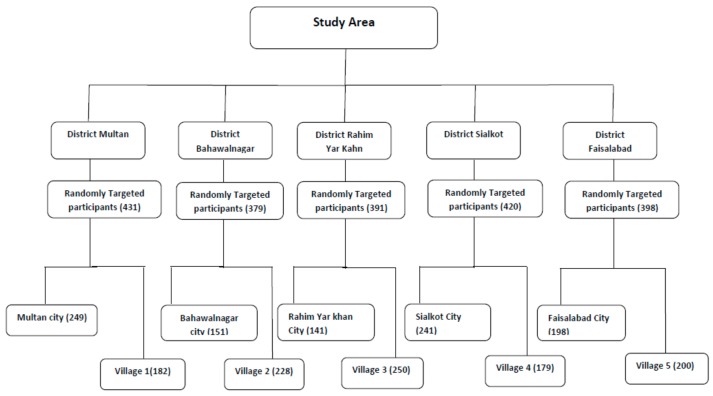
: Low knowledge about diabetes risk factors coupled with high disease prevalence is common in low-resource countries. This study evaluated diabetes-related knowledge, attitudes, and practices in the general population in Punjab (Pakistan). : A cross-sectional study was conducted in five districts in Punjab from January to March 2017. Data were collected from 2019 adults aged 18⁻90 years through face-to-face interviews using a semi-structured questionnaire. The total knowledge score ranged from 0⁻9; a score ≥6 was considered adequate diabetes awareness. Descriptive statistics, chi-square tests, and linear and binary logistic regression were used for the analyses. : Respondents' mean age was 32.92 ± 11.4 years. In total, 85.9% of respondents had heard of diabetes, and 30.1% knew about the glucose tolerance test. We found 2.3% of respondents scored zero for diabetes knowledge, 11.3% scored 9, and 47.4% scored ≥6 (adequate awareness). Being female (β = 0.37, 95% confidence interval [CI]: 0.16, 0.05; = 0.001), socioeconomic status (β = 0.24, 95% CI: 0.12, 0.36; < 0.001), being diabetic (β = 0.82, 95% CI: 0.53, 1.10; < 0.001), and higher education (β = 0.25, 95% CI: 0.17, 0.33; < 0.001) were significantly associated with knowledge score. Respondents with high socioeconomic status showed significantly higher positive attitudes compared with those with low socioeconomic status (adjusted odds ratio 1.57, 95% CI: 1.12, 2.24). Only 8.7% (30/343) of those diagnosed with diabetes had never undergone blood glucose screening since diagnosis. : Knowledge of diabetes risk factors, management, and care is low in Pakistan's general population. Targeted public education programs should be instigated at a national level to increase understanding of diabetes prevention and treatment.
在资源匮乏的国家,人们对糖尿病风险因素的了解程度较低,加上糖尿病的高患病率,这一情况十分常见。本研究评估了旁遮普省(巴基斯坦)普通人群中与糖尿病相关的知识、态度和实践。
2017 年 1 月至 3 月,在旁遮普省的五个地区进行了一项横断面研究。通过面对面访谈,使用半结构式问卷从 2019 名年龄在 18-90 岁的成年人中收集数据。知识总分为 0-9 分;得分≥6 分被认为是对糖尿病有足够的认识。采用描述性统计、卡方检验、线性和二元逻辑回归进行分析。
受访者的平均年龄为 32.92±11.4 岁。总的来说,85.9%的受访者听说过糖尿病,30.1%的人知道葡萄糖耐量试验。我们发现,2.3%的受访者糖尿病知识得分为 0,11.3%的人得分为 9,47.4%的人得分为≥6(有足够的认识)。女性(β=0.37,95%置信区间[CI]:0.16,0.05; = 0.001)、社会经济地位(β=0.24,95%CI:0.12,0.36; < 0.001)、糖尿病(β=0.82,95%CI:0.53,1.10; < 0.001)和较高的教育程度(β=0.25,95%CI:0.17,0.33; < 0.001)与知识得分显著相关。与社会经济地位较低的人相比,社会经济地位较高的人表现出更高的积极态度(调整后的优势比为 1.57,95%CI:1.12,2.24)。在已被诊断患有糖尿病的人群中,仅有 8.7%(30/343)的人自诊断以来从未进行过血糖筛查。
巴基斯坦普通人群对糖尿病风险因素、管理和护理的了解程度较低。应在国家层面启动有针对性的公众教育计划,以提高对糖尿病预防和治疗的认识。