Organic Chemistry Department, University of Cordoba, Campus de Rabanales, Edificio Marie Curie (C-3), Ctra. Nacional IV-A, Km 396, E14014 Cordoba, Spain.
Scientific Centre for Molecular Design and Synthesis of Innovative Compounds for Medicine, Peoples Friendship University of Russia (RUDN University), 6 Miklukho-Maklaya str., 117198 Moscow, Russia.
Molecules. 2018 Sep 6;23(9):2283. doi: 10.3390/molecules23092283.
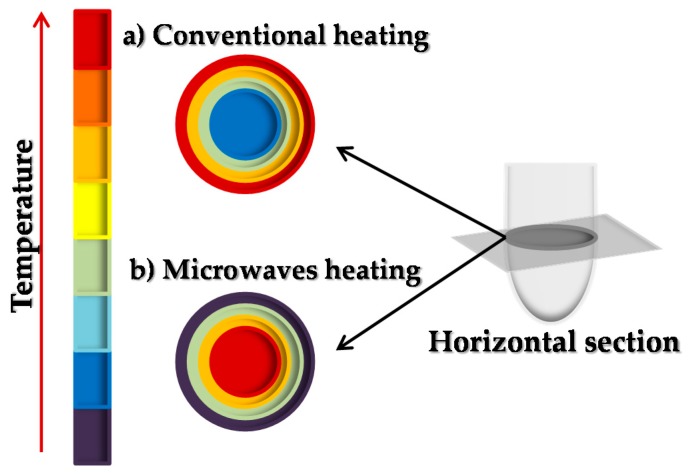
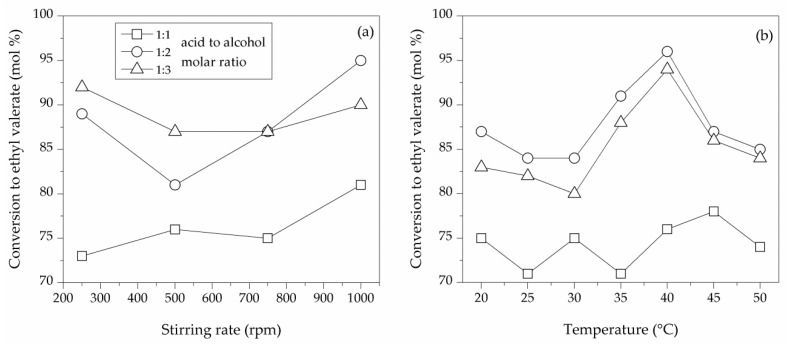
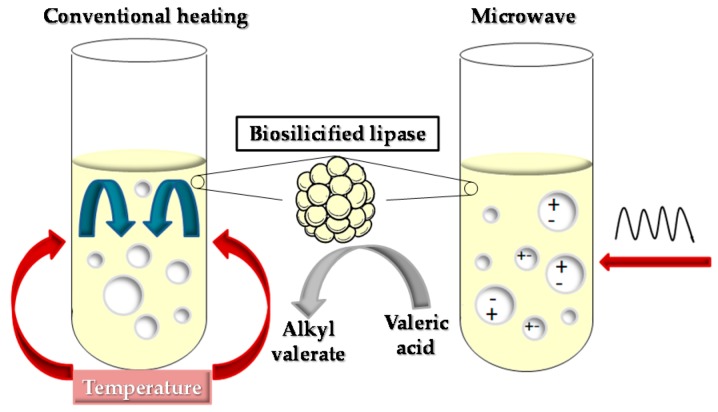
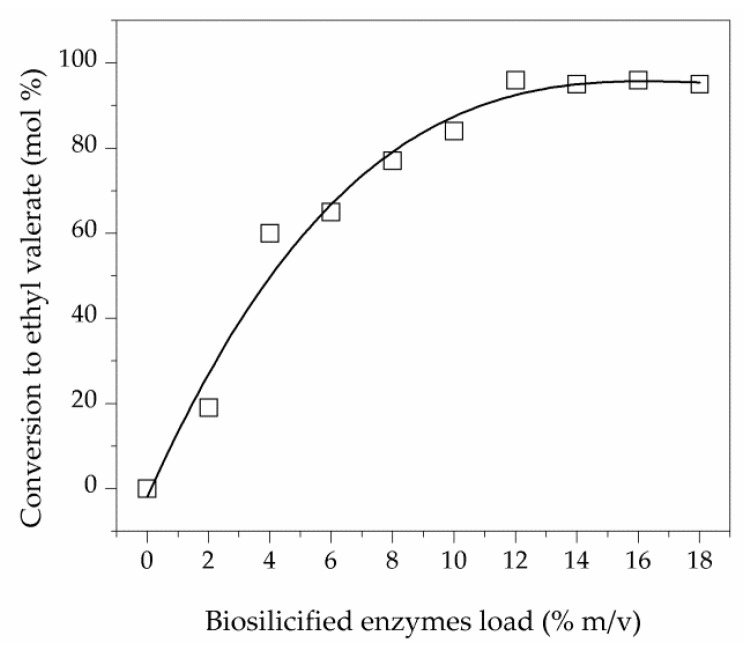
Alkyl esters are high added value products useful in a wide range of industrial sectors. A methodology based on a simple sol-gel approach (biosilicification) is herein proposed to encapsulate enzymes in order to design highly active and stable biocatalysts. Their performance was assessed through the optimization of valeric acid esterification evaluating the effect of different parameters (biocatalyst load, presence of water, reaction temperature and stirring rate) in different alcoholic media, and comparing two different methodologies: conventional heating and microwave irradiation. Ethyl valerate yields were in the 80⁻85% range under optimum conditions (15 min, 12% / biocatalyst, molar ratio 1:2 of valeric acid to alcohol). Comparatively, the biocatalysts were slightly deactivated under microwave irradiation due to enzyme denaturalisation. Biocatalyst reuse was attempted to prove that good reusability of these sol-gel immobilised enzymes could be achieved under conventional heating.
烷基酯是高附加值产品,广泛应用于多个工业领域。本研究提出了一种基于简单溶胶-凝胶方法(生物硅烷化)的封装酶的方法,以设计高活性和稳定的生物催化剂。通过优化戊酸酯化反应来评估它们的性能,考察了不同参数(生物催化剂负载量、水的存在、反应温度和搅拌速率)在不同醇介质中的影响,并比较了两种不同的方法:常规加热和微波辐射。在最佳条件下(15 分钟,12%/生物催化剂,戊酸与醇的摩尔比为 1:2),可获得 80-85%的戊酸乙酯产率。相比之下,由于酶变性,微波辐射下生物催化剂略有失活。尝试重复使用生物催化剂,以证明在常规加热下这些溶胶-凝胶固定化酶具有良好的可重复使用性。