1 College of Medicine, University of Kentucky, Lexington, Kentucky, USA.
2 Department of Otolaryngology-Head and Neck Surgery, University of Kentucky Medical Center, Lexington, Kentucky, USA.
Otolaryngol Head Neck Surg. 2019 Jan;160(1):36-48. doi: 10.1177/0194599818797598. Epub 2018 Sep 11.
There is evidence that children who are deaf and hard of hearing (DHH) have a higher incidence of behavioral disorders. Assessment of behavioral health in this population is often complicated by language developmental delays, which may result in unrecognized and untreated behavioral problems. The purpose of this study is to assess the association of behavioral disorders among children who are DHH and to explore behavioral interventions for children in this population.
PubMed, CINALH, PsychINFO, and Web of Science.
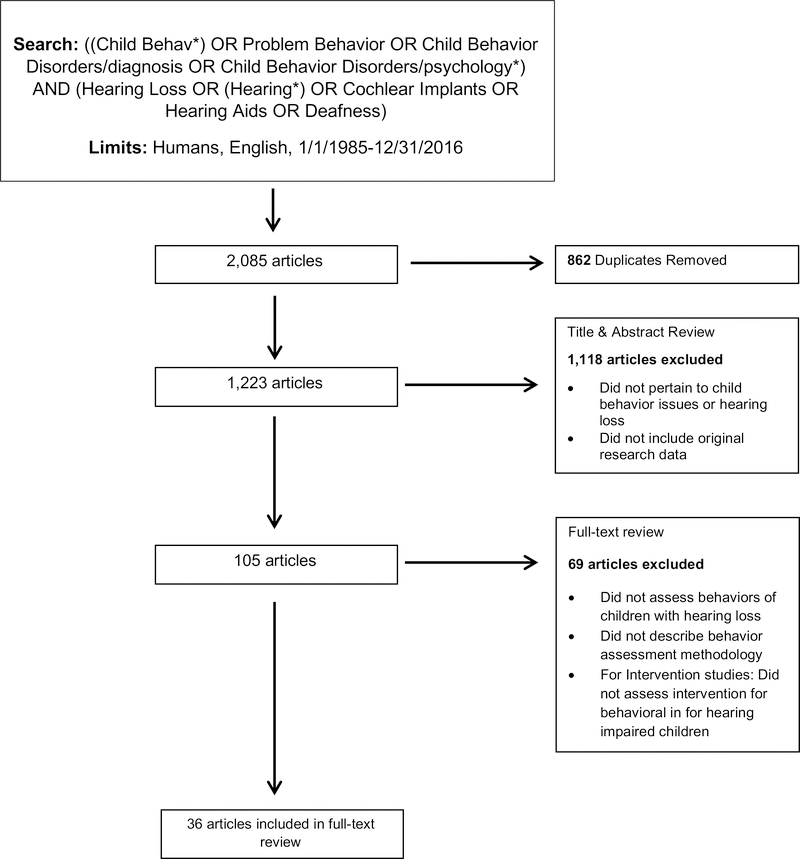
Search terms included the following: problem behavior, child behavior disorders/diagnosis, child behavior disorders/psychology coupled with hearing loss, cochlear implants, hearing aids, or deafness. Studies from the last 30 years (1985-2016) were included. The articles were reviewed independently by 3 reviewers.
Thirty-six articles met criteria. There was an association between internalizing behaviors and hearing loss among children, which may persist after cochlear implantation. These problems may be more pronounced for children with additional disabilities. Conduct and hyperactivity disorders as well as emotional and executive function problems among children who are DHH may be related to poor language development. There was limited evidence regarding interventions to address the behavioral disorders of DHH children.
There is a significant body of evidence demonstrating behavioral problems among DHH children but a lack of clear understanding of the mechanisms involved. There is limited evidence on interventions to address the behavioral problems of DHH children. Future research is warranted to mitigate the long-term effects of disruptive behavior among these children.
有证据表明,聋儿和重听儿童(DHH)的行为障碍发生率较高。由于语言发育迟缓,该人群的行为健康评估往往较为复杂,这可能导致行为问题未被识别和治疗。本研究旨在评估 DHH 儿童的行为障碍关联,并探讨针对该人群的行为干预措施。
PubMed、CINALH、PsychINFO 和 Web of Science。
搜索词包括以下内容:行为问题、儿童行为障碍/诊断、听力损失合并的儿童行为障碍/心理学、人工耳蜗、助听器或耳聋。纳入了过去 30 年(1985-2016 年)的研究。文章由 3 位审稿人独立进行了审查。
符合标准的文章有 36 篇。儿童的内在行为与听力损失之间存在关联,这种关联在人工耳蜗植入后仍可能持续存在。对于有其他残疾的儿童,这些问题可能更为明显。DHH 儿童的行为和多动障碍以及情绪和执行功能问题可能与语言发育不良有关。针对 DHH 儿童行为障碍的干预措施的证据有限。
有大量证据表明 DHH 儿童存在行为问题,但对相关机制的认识仍不明确。针对 DHH 儿童行为问题的干预措施的证据有限。需要进一步研究,以减轻这些儿童行为障碍的长期影响。