Department of Radiation Oncology, Fujian Medical University Cancer Hospital, Fujian Cancer Hospital, Fuzhou, 350014, China.
Department of Radiation Oncology, Xiamen Humanity Hospital, Xiamen, China.
Radiat Oncol. 2018 Sep 10;13(1):171. doi: 10.1186/s13014-018-1122-y.
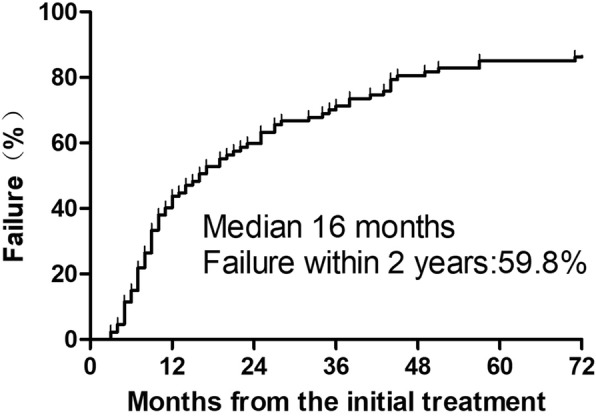
To investigate the treatment failure pattern and factors influencing locoregional recurrence of esophageal squamous cell carcinoma (ESCC) and examine patient survival with re-irradiation (re-RT) after primary radiotherapy.
We retrospectively analyzed 87 ESCC patients treated initially with radiotherapy. Failure patterns were classified into regional lymph node recurrence only (LN) and primary failure with/without regional lymph node recurrence (PF). Patients received either re-RT or other treatments (non-re-RT group). Baseline covariates were balanced by a propensity score model. Overall survival (OS) and toxicities were assessed as outcomes.
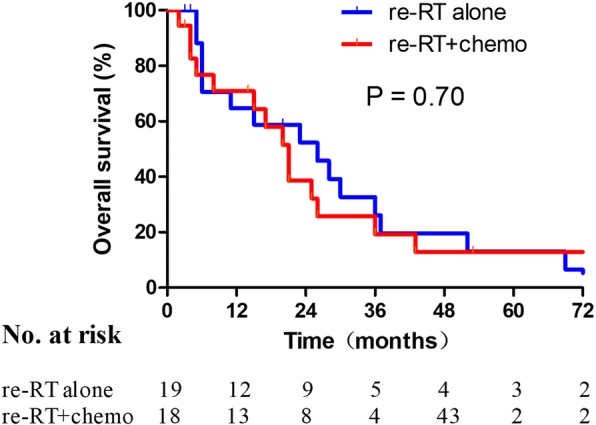
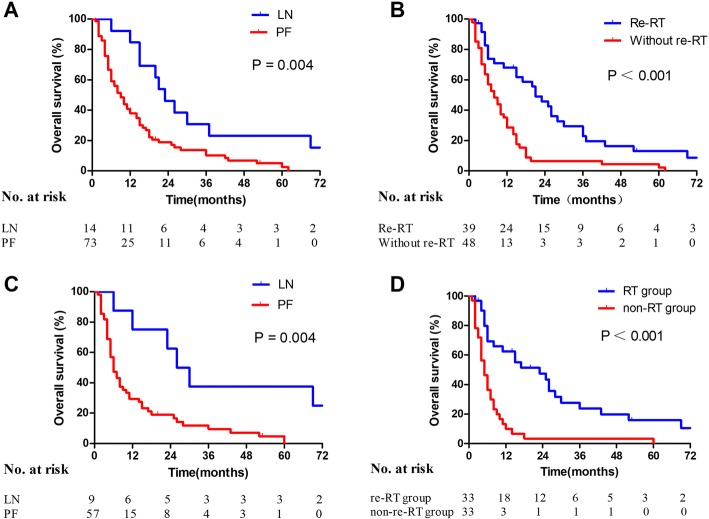
The median follow-up time was 87 months. Thirty-nine patients received re-RT. Failure pattern and re-RT were independent prognostic factors for OS (P = 0.040 and 0.015) by Cox multivariate analysis. Re-RT with concomitant chemotherapy showed no survival benefit over re-RT alone (P = 0.70). No differences in characteristics were found between the groups by Chi-square tests after propensity score matching. The Cox model showed that failure pattern and re-RT were prognostic factors with hazard ratios (HR) of 0.319 (P = 0.025) and 0.375 (P = 0.002), respectively, in the matched cohort. Significant differences in OS were observed according to failure pattern (P = 0.004) and re-RT (P < 0.001). In the re-RT and non-re-RT groups, 9.09% and 3.03% of patients experienced tracheoesophageal fistulas, and 15.15% and 3.03% of patients developed pericardial/pleural effusion, respectively (P > 0.05). The incidence of radiation pneumonitis was higher in the re-RT group (24.24% vs. 6.06%, P = 0.039), but no cases of pneumonia-related death occurred.
Re-RT improved long-term survival in patients with locoregional recurrent ESCC. Despite a high incidence of radiation pneumonitis, toxicities were tolerable.
本研究旨在探讨食管鳞癌(ESCC)放疗后局部区域复发的治疗失败模式和影响因素,并评估再放疗(re-RT)对初治放疗后局部区域复发患者的生存影响。
我们回顾性分析了 87 例初治接受放疗的 ESCC 患者。失败模式分为单纯区域淋巴结复发(LN)和原发灶失败伴/不伴区域淋巴结复发(PF)。患者接受 re-RT 或其他治疗(非 re-RT 组)。通过倾向评分模型平衡基线协变量。以总生存(OS)和毒性为结局。
中位随访时间为 87 个月。39 例患者接受 re-RT。多因素 Cox 分析显示,失败模式和 re-RT 是 OS 的独立预后因素(P=0.040 和 0.015)。同期放化疗联合 re-RT 并未改善 re-RT 患者的生存(P=0.70)。倾向性评分匹配后,两组间的特征比较无统计学差异。Cox 模型显示,在匹配队列中,失败模式和 re-RT 是预后因素,其风险比(HR)分别为 0.319(P=0.025)和 0.375(P=0.002)。根据失败模式(P=0.004)和 re-RT(P<0.001),患者的 OS 存在显著差异。在 re-RT 和非 re-RT 组中,分别有 9.09%和 3.03%的患者发生气管食管瘘,15.15%和 3.03%的患者发生心包/胸腔积液(P>0.05)。re-RT 组放射性肺炎的发生率较高(24.24% vs. 6.06%,P=0.039),但无肺炎相关死亡病例。
re-RT 可改善局部区域复发 ESCC 患者的长期生存。尽管放射性肺炎的发生率较高,但毒性可耐受。