Department of Woman, Child, General and Special Surgery, University of Campania "Luigi Vanvitelli", 80138 Napoli, Italy.
Int J Mol Sci. 2018 Sep 10;19(9):2690. doi: 10.3390/ijms19092690.
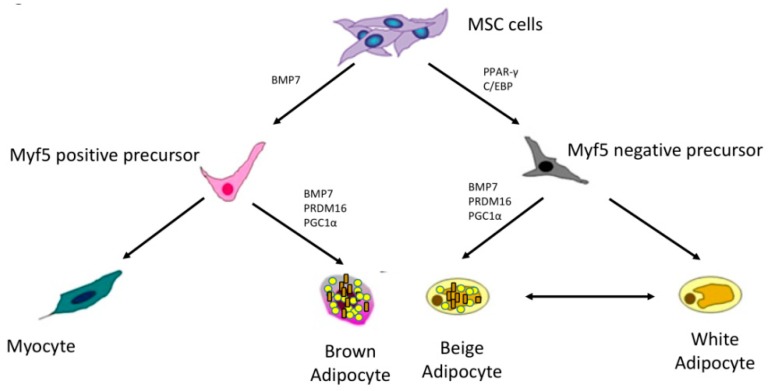
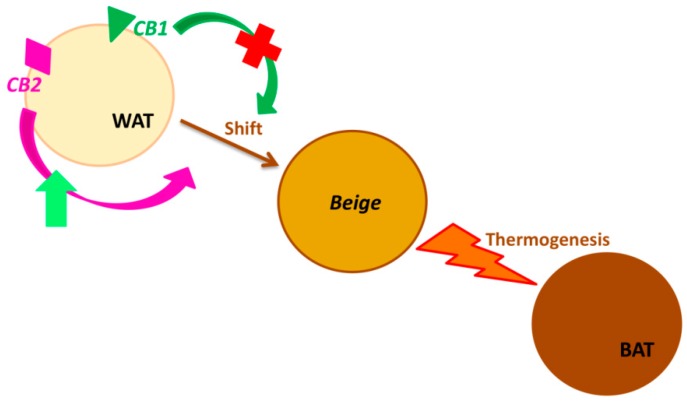
Obesity is an increasing health problem worldwide. Its related comorbidities imply a high cost for the National Health System and diminish a patient's life quality. Adipose tissue is composed of three types of cells. White adipocytes are involved in fat storage and secretion of hormones. Brown adipocytes are involved in thermogenesis and caloric expenditure. Beige adipocytes are transitional adipocytes that in response to various stimuli can turn from white to brown and could be protective against the obesity, enhancing energy expenditure. The conversion of white in beige adipose tissue is a potential new therapeutic target for obesity. Cannabinoid receptors (CB) regulate thermogenesis, food intake and inflammation. CB1 ablation or inhibition helps reducing body weight and food intake. Stimulation of CB2 limits inflammation and promotes anti-obesity effects by reducing food intake and weight gain. Its genetic ablation results in adiposity development. CB receptors are also responsible for transforming white adipose tissue towards beige or brown adipocytes, therefore their modulation can be considered potential anti-obesity target. CB1 principal localization in central nervous system represents an important limit. Stimulation of CB2, principally localized on peripheral cells instead, should facilitate the anti-obesity effects without exerting remarkable psychotropic activity.
肥胖是一个日益严重的全球健康问题。它的相关并发症意味着国家卫生系统的高成本,并降低了患者的生活质量。脂肪组织由三种类型的细胞组成。白色脂肪细胞参与脂肪储存和激素分泌。棕色脂肪细胞参与产热和热量消耗。米色脂肪细胞是过渡脂肪细胞,可响应各种刺激从白色变为棕色,并且可能对肥胖具有保护作用,增加能量消耗。白色脂肪组织向米色脂肪组织的转化是肥胖的一个潜在新治疗靶点。大麻素受体 (CB) 调节产热、食物摄入和炎症。CB1 消融或抑制有助于减轻体重和减少食物摄入。CB2 的刺激可通过减少食物摄入和体重增加来限制炎症并促进抗肥胖作用。其基因消融导致脂肪发育。CB 受体还负责将白色脂肪组织转化为米色或棕色脂肪细胞,因此它们的调节可以被认为是潜在的抗肥胖靶点。CB1 主要定位于中枢神经系统,这是一个重要的限制。刺激主要位于外周细胞上的 CB2 应该可以促进抗肥胖作用,而不会产生明显的精神活性。