Department of Environmental Engineering, College of Environmental Science and Engineering, China West Normal University, Nanchong, Sichuan 637009; Department of Engineering and Applied Biology, College of Life Science, Sichuan Agricultural University, Ya'an, Sichuan 625014, China.
Department of Environmental Engineering, College of Environmental Science and Engineering, China West Normal University, Nanchong, Sichuan 637009, China.
Chin Med J (Engl). 2018 Sep 20;131(18):2216-2225. doi: 10.4103/0366-6999.240817.
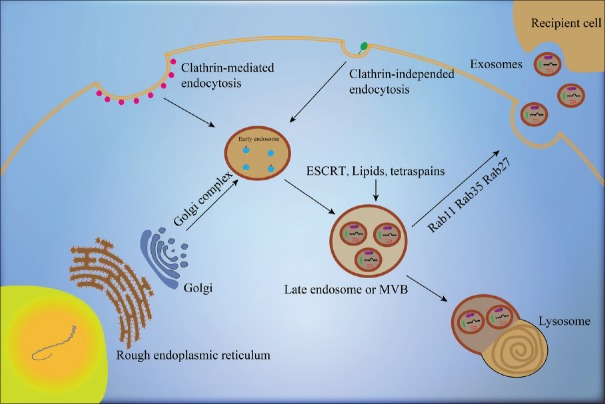
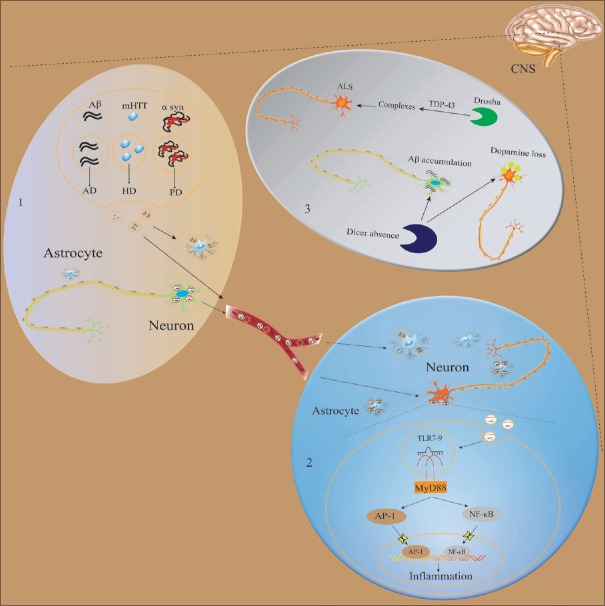
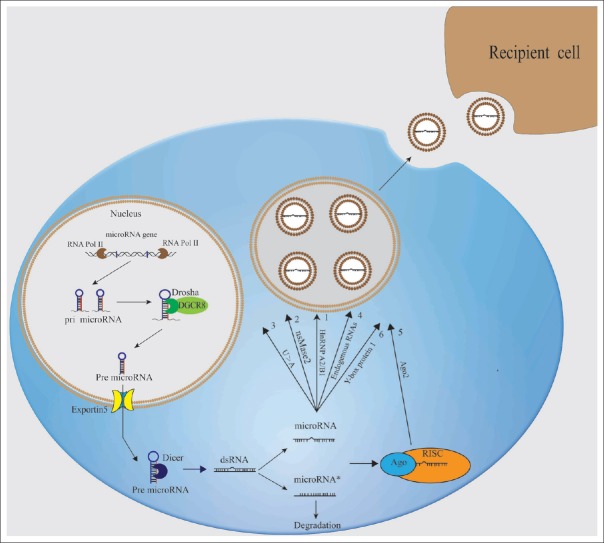
A comprehensive review of the network regulation of exosomes and microRNAs (miRNAs) in neurodegenerative diseases was done, centering on the mechanism of the formation of exosomes and miRNAs and the sorting mechanism of exosomal miRNAs, with the aim to provide a theoretical basis in the search of biomarkers and the treatment of neurodegenerative diseases.
The comprehensive search used online literature databases including NCBI PubMed, Web of Science, Google Scholar, and Baidu Scholar.
The study selection was based on the following keywords: exosomes, miRNAs, central nervous system (CNS), and neurodegenerative diseases. The time limit for literature retrieval was from the year 2000 to 2018, with language restriction in English. Relevant articles were carefully reviewed, with no exclusions applied to study design and publication type.
Exosomes are the smallest nanoscale membranous microvesicles secreted by cells and contain important miRNAs, among other rich contents. In the CNS, exosomes can transport amyloid β-protein, α-synuclein, Huntington-associated protein 1, and superoxide dismutase I to other cells. These events relieve the abnormal accumulation of proteins and aggravating neurological diseases. In some neurodegenerative diseases including Alzheimer's disease, Parkinson's disease, Huntington's disease, and amyotrophic lateral sclerosis, miRNAs are pathologically altered as an inexorable course, suggesting that miRNAs may contribute neurodegeneration. Exosomes and miRNAs form a network to regulate the homeostasis of the CNS, both synergistically and individually.
The network of exosomes and miRNAs that regulates CNS homeostasis is a promising biomarker for the diagnosis and treatment of neurodegenerative diseases.
对神经退行性疾病中外泌体和 microRNAs(miRNAs)的网络调控进行综述,重点阐述外泌体和 miRNAs 的形成机制及外泌体 miRNAs 的分选机制,以期为神经退行性疾病的生物标志物寻找和治疗提供理论依据。
综合检索使用了包括 NCBI PubMed、Web of Science、Google Scholar 和百度学术在内的在线文献数据库。
研究选择基于以下关键词:外泌体、miRNAs、中枢神经系统(CNS)和神经退行性疾病。文献检索时间限定为 2000 年至 2018 年,语言限制为英语。仔细审查了相关文章,对研究设计和出版物类型没有任何排除。
外泌体是细胞分泌的最小纳米级膜性微囊泡,含有重要的 miRNAs 等丰富内容。在中枢神经系统中,外泌体可以将淀粉样β蛋白、α-突触核蛋白、亨廷顿相关蛋白 1 和超氧化物歧化酶 I 转运到其他细胞。这些事件缓解了蛋白质的异常积累和加重神经疾病。在一些神经退行性疾病中,包括阿尔茨海默病、帕金森病、亨廷顿病和肌萎缩侧索硬化症,miRNAs 作为一个不可避免的过程发生病理性改变,提示 miRNAs 可能导致神经退行性变。外泌体和 miRNAs 形成网络调节中枢神经系统的内稳态,协同作用和单独作用。
调节中枢神经系统内稳态的外泌体和 miRNAs 网络是神经退行性疾病诊断和治疗的有前途的生物标志物。