School of Biomedical Engineering & Imaging Sciences, King's College London, UK.
School of Biomedical Engineering & Imaging Sciences, King's College London, UK.
Med Image Anal. 2018 Dec;50:36-53. doi: 10.1016/j.media.2018.08.004. Epub 2018 Aug 24.
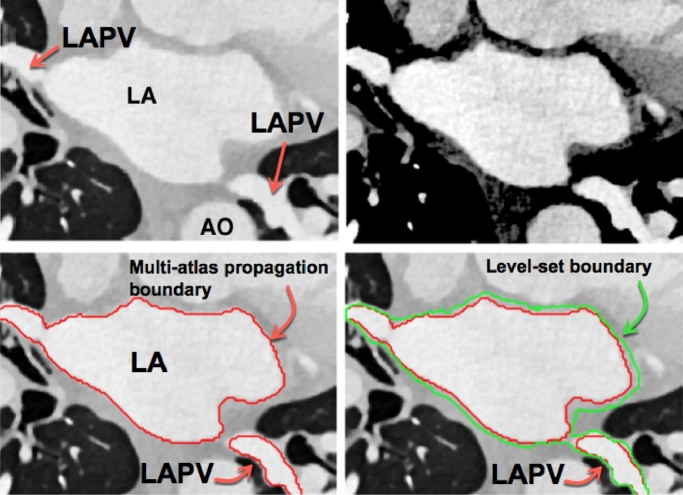
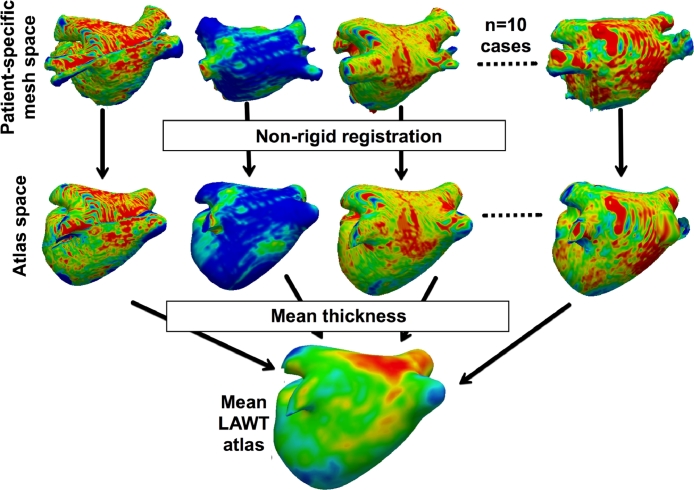
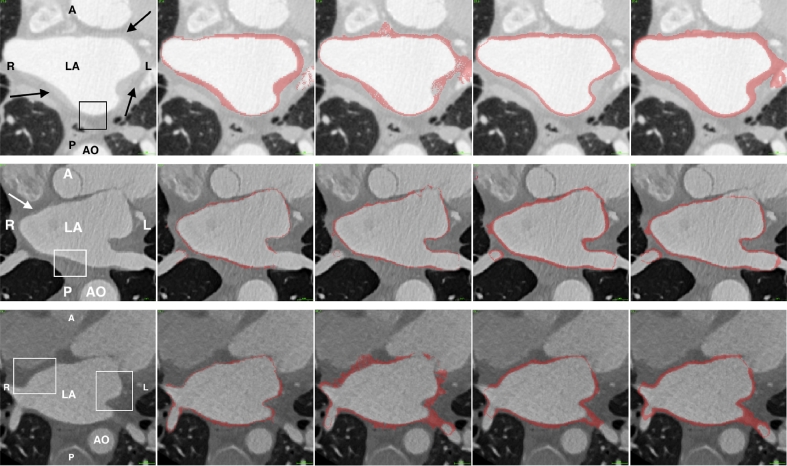
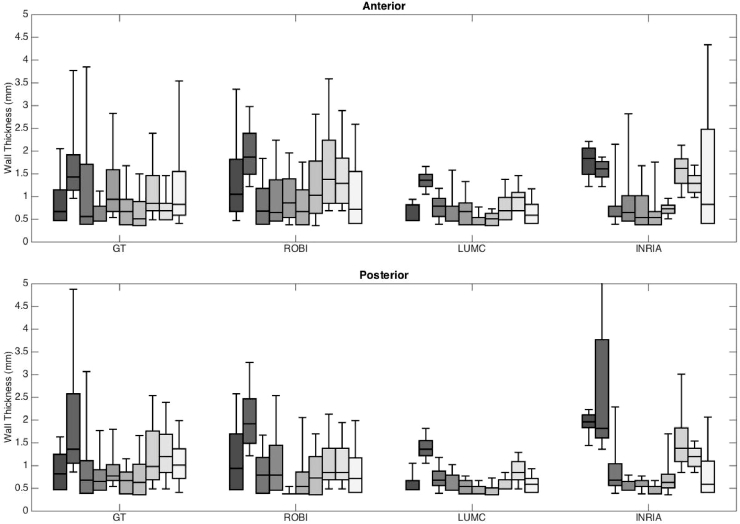
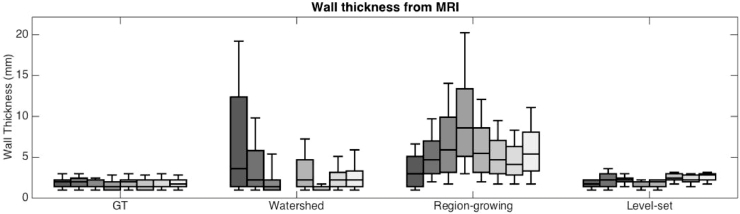
Structural changes to the wall of the left atrium are known to occur with conditions that predispose to Atrial fibrillation. Imaging studies have demonstrated that these changes may be detected non-invasively. An important indicator of this structural change is the wall's thickness. Present studies have commonly measured the wall thickness at few discrete locations. Dense measurements with computer algorithms may be possible on cardiac scans of Computed Tomography (CT) and Magnetic Resonance Imaging (MRI). The task is challenging as the atrial wall is a thin tissue and the imaging resolution is a limiting factor. It is unclear how accurate algorithms may get and how they compare in this new emerging area. We approached this problem of comparability with the Segmentation of Left Atrial Wall for Thickness (SLAWT) challenge organised in conjunction with MICCAI 2016 conference. This manuscript presents the algorithms that had participated and evaluation strategies for comparing them on the challenge image database that is now open-source. The image database consisted of cardiac CT (n=10) and MRI (n=10) of healthy and diseased subjects. A total of 6 algorithms were evaluated with different metrics, with 3 algorithms in each modality. Segmentation of the wall with algorithms was found to be feasible in both modalities. There was generally a lack of accuracy in the algorithms and inter-rater differences showed that algorithms could do better. Benchmarks were determined and algorithms were ranked to allow future algorithms to be ranked alongside the state-of-the-art techniques presented in this work. A mean atlas was also constructed from both modalities to illustrate the variation in thickness within this small cohort.
左心房壁的结构变化已知会发生在易患心房颤动的情况下。影像学研究表明,这些变化可以通过非侵入性方法检测到。这种结构变化的一个重要指标是壁的厚度。目前的研究通常在少数离散位置测量壁的厚度。计算机算法的密集测量可能在心脏 CT(计算机断层扫描)和磁共振成像(MRI)扫描上实现。由于心房壁是一种薄组织,成像分辨率是一个限制因素,因此这项任务具有挑战性。目前还不清楚算法的准确性如何,以及在这个新出现的领域中它们的比较情况如何。我们在 2016 年 MICCAI 会议上共同组织的左心房壁厚度分割挑战赛(SLAWT)中解决了这个可比性问题。本文介绍了参与挑战赛的算法,以及在现在开源的挑战图像数据库上比较它们的评估策略。该图像数据库包含了健康和患病受试者的心脏 CT(n=10)和 MRI(n=10)。共有 6 种算法使用不同的指标进行了评估,每种模态有 3 种算法。在两种模态中,使用算法分割壁是可行的。算法的准确性普遍不足,并且评分者之间的差异表明算法可以做得更好。确定了基准,并对算法进行了排名,以便未来的算法能够与本工作中提出的最新技术一起排名。还从两种模态构建了平均图谱,以说明在这个小队列中厚度的变化。