Basse Astrid L, Dalbram Emilie, Larsson Louise, Gerhart-Hines Zach, Zierath Juleen R, Treebak Jonas T
Section of Integrative Physiology, Novo Nordisk Foundation Center for Basic Metabolic Research, University of Copenhagen, Copenhagen, Denmark.
Section for Metabolic Receptology, Novo Nordisk Foundation Center for Basic Metabolic Research, University of Copenhagen, Copenhagen, Denmark.
Front Physiol. 2018 Aug 28;9:1198. doi: 10.3389/fphys.2018.01198. eCollection 2018.
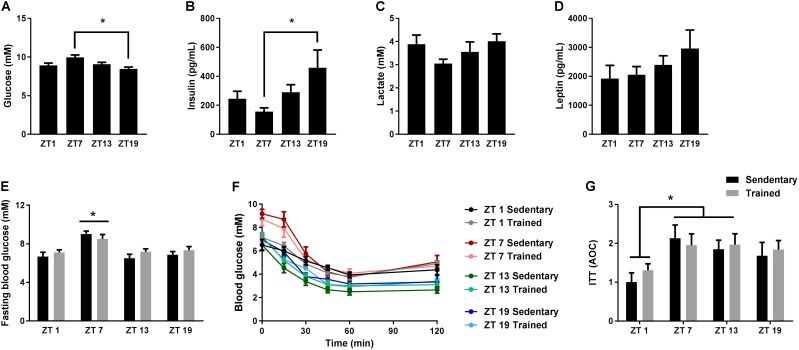
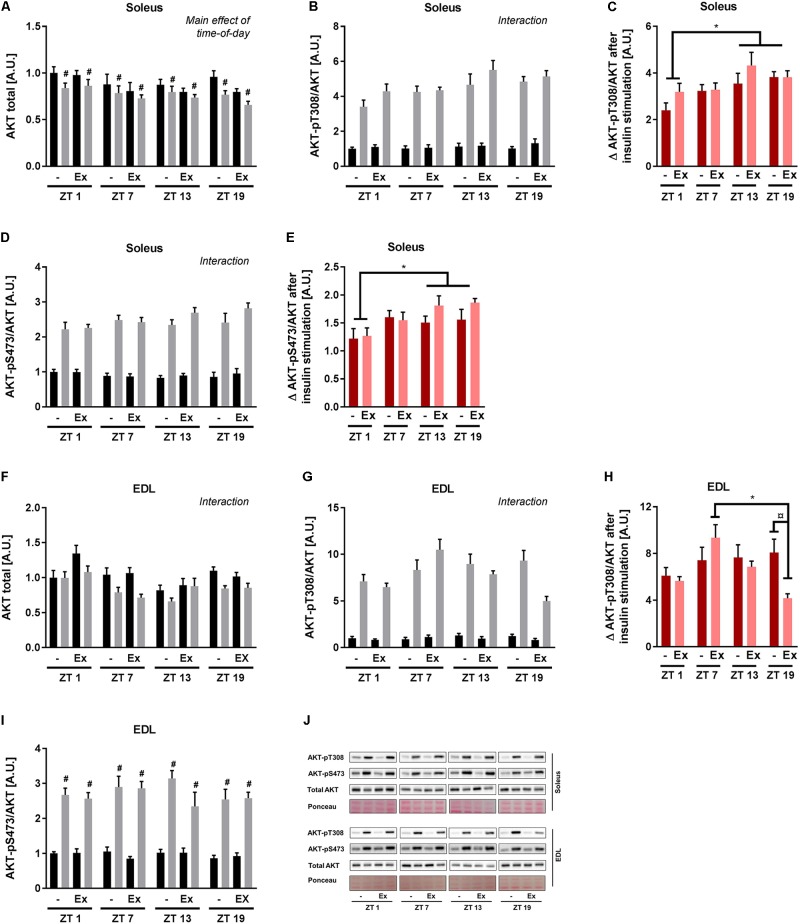
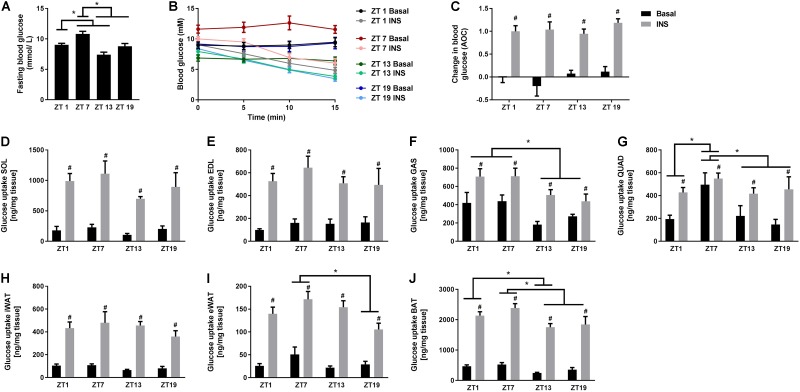
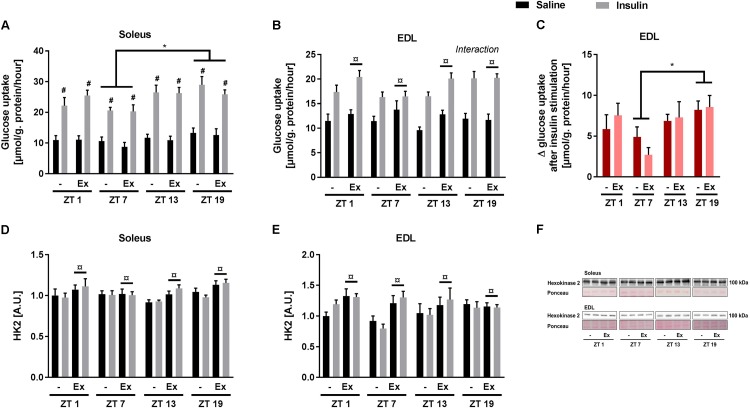
Circadian rhythms can be perturbed by shift work, travel across time zones, many occupational tasks, or genetic mutations. Perturbed circadian rhythms are associated with the increasing problem of obesity, metabolic dysfunction, and insulin resistance. We hypothesized that insulin sensitivity in skeletal muscle follows a circadian pattern and that this pattern is important for overall metabolic function. This hypothesis was verified using mice as a model system. We observed circadian rhythmicity in whole body insulin tolerance, as well as in signaling pathways regulating insulin- and exercise-induced glucose uptake in skeletal muscle, including AKT, 5'-adenosine monophosphate-activated protein kinase (AMPK) and TBC1 domain family member 4 (TBC1D4) phosphorylation. Basal and insulin-stimulated glucose uptake in skeletal muscle and adipose tissues also differed between day- and nighttime. However, the rhythmicity of glucose uptake differed from the rhythm of whole-body insulin tolerance. These results indicate that neither skeletal muscle nor adipose tissue play a major role for the circadian rhythmicity in whole-body insulin tolerance. To study the circadian pattern of insulin sensitivity directly in skeletal muscle, we determined glucose uptake under basal and submaximal insulin-stimulated conditions every sixth hour. Both insulin sensitivity and signaling of isolated skeletal muscle peaked during the dark period. We next examined the effect of exercise training on the circadian rhythmicity of insulin sensitivity. As expected, voluntary exercise training enhanced glucose uptake in skeletal muscle. Nevertheless, exercise training did not affect the circadian rhythmicity of skeletal muscle insulin sensitivity. Taken together, our results provide evidence that skeletal muscle insulin sensitivity exhibits circadian rhythmicity.
昼夜节律会受到轮班工作、跨时区旅行、许多职业任务或基因突变的干扰。受干扰的昼夜节律与肥胖、代谢功能障碍和胰岛素抵抗等日益严重的问题相关。我们假设骨骼肌中的胰岛素敏感性遵循昼夜模式,并且这种模式对整体代谢功能很重要。使用小鼠作为模型系统验证了这一假设。我们观察到全身胰岛素耐受性以及调节骨骼肌中胰岛素和运动诱导的葡萄糖摄取的信号通路(包括AKT、5'-腺苷单磷酸激活蛋白激酶 (AMPK) 和TBC1结构域家族成员4 (TBC1D4) 磷酸化)存在昼夜节律。白天和夜间骨骼肌和脂肪组织中基础和胰岛素刺激的葡萄糖摄取也有所不同。然而,葡萄糖摄取的节律与全身胰岛素耐受性的节律不同。这些结果表明,骨骼肌和脂肪组织在全身胰岛素耐受性的昼夜节律中均不起主要作用。为了直接研究骨骼肌中胰岛素敏感性的昼夜模式,我们每隔六小时测定一次基础和次最大胰岛素刺激条件下的葡萄糖摄取。分离的骨骼肌的胰岛素敏感性和信号传导在黑暗期均达到峰值。接下来,我们研究了运动训练对胰岛素敏感性昼夜节律的影响。正如预期的那样,自愿运动训练增强了骨骼肌中的葡萄糖摄取。然而,运动训练并未影响骨骼肌胰岛素敏感性的昼夜节律。综上所述,我们的结果提供了证据表明骨骼肌胰岛素敏感性表现出昼夜节律。