Kiberd James, Khan Usman, Stockman Cynthia, Radhakrishnan Arun, Phillips Matthew, Kiberd Bryce A, West Kenneth A, Soroka Steven, Chan Christopher, Tennankore Karthik K
Dalhousie University, Halifax, NS, Canada.
Nova Scotia Health Authority, Halifax, Canada.
Can J Kidney Health Dis. 2018 Sep 7;5:2054358118794415. doi: 10.1177/2054358118794415. eCollection 2018.
Improving a patient's experience with their care through an online interface for communication (an eHealth patient portal) has been shown to be beneficial in some studies of chronic disease populations. However, little is known about the effectiveness of an eHealth portal for delivery of care to home dialysis patients.
To determine whether an eHealth portal is effective at improving a patient's experience with their home dialysis care. : (1) To determine whether an eHealth portal improves health-related quality of life for home dialysis patients, (2) to assess patient satisfaction with an eHealth portal and perceived impact on aspects of their home dialysis therapy and health, (3) to determine the acceptability of the eHealth portal software, and (4) to determine the change in telephone usage for communication after patient adoption of an eHealth portal.
Single-arm pilot trial with recruitment over a 4-month period.
The multidisciplinary home dialysis clinic in Halifax Nova Scotia Canada.
Adults (>18 years) receiving either home hemodialysis or peritoneal dialysis.
Consumer quality index (CQI), health-related quality of life using the EuroQol Five Dimensions Questionnaire (EQ-5D), acceptability of the eHealth portal software (using the Acceptability E-scale), and satisfaction/perceived impact (using a modified questionnaire).
A web-based application (McKesson, Canada, RelayHealth®) allowed patients and health care workers to communicate through a secure, password-protected online portal that permitted visualization of the messaging history by patient and provider. Patients and the home dialysis health care team had the ability to send messages related to patient care at any time including proposed changes to medication, instructions after a clinic visit, times of new appointments, upcoming investigations, or questions about care. Patient experience with home dialysis care using the CQI, health-related quality of life using the EQ-5D, acceptability of the eHealth portal software, and satisfaction/perceived impact were assessed at baseline, 6, and 12 months of follow-up (where applicable). Total minutes of telephone communication was assessed prior to and after adoption of the portal.
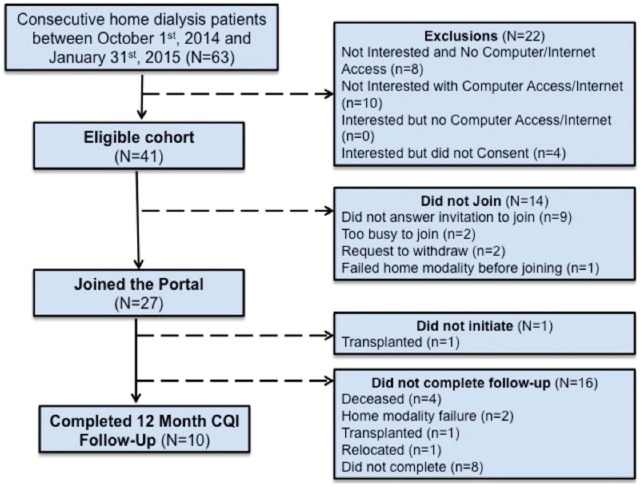
Of the 41 patients who consented to join the portal, 27 (66%) created an online account. At baseline, patients had a positive experience for the care and communication provided by their nephrologist (CQI: 3.63, 95% confidence interval [CI]: 3.50-3.76) and this did not change significantly over the study period. Similar results were observed for the care provided by other nephrology health care team members. Health-related quality of life using the EQ-5D score was 0.80 (interquartile range [IQR]: 0.71-0.83) at baseline and this also did not significantly change over the study period. Patients were satisfied with the eHealth portal (mean Likert scale score of 6.5 ± 0.6 in overall satisfaction, scale ranging from 1 completely dissatisfied to 10 completely satisfied), but only a minority (N = 12) completed a satisfaction questionnaire. Median monthly phone usage decreased from 12.5 to 10 minutes ( = .02) after adoption of the portal.
The study is limited by the small sample size, high rate of patient dropout, and limited response rate.
In this study of home dialysis patients, we identified that an eHealth communication did not lead to significant improvements in patient experience with home dialysis care.
ClinicalTrials.gov number NCT02128347.
在一些针对慢性病患者群体的研究中,通过在线交流界面(电子健康患者门户网站)改善患者的就医体验已被证明是有益的。然而,对于电子健康门户网站为家庭透析患者提供护理的效果知之甚少。
确定电子健康门户网站是否能有效改善患者的家庭透析护理体验。(1)确定电子健康门户网站是否能提高家庭透析患者的健康相关生活质量;(2)评估患者对电子健康门户网站的满意度以及对其家庭透析治疗和健康方面的感知影响;(3)确定电子健康门户网站软件的可接受性;(4)确定患者采用电子健康门户网站后沟通电话使用情况的变化。
为期4个月的单臂试点试验。
加拿大新斯科舍省哈利法克斯的多学科家庭透析诊所。
接受家庭血液透析或腹膜透析的成年人(>18岁)。
消费者质量指数(CQI)、使用欧洲五维健康量表(EQ - 5D)评估的健康相关生活质量、电子健康门户网站软件的可接受性(使用可接受性E量表)以及满意度/感知影响(使用修改后的问卷)。
一个基于网络的应用程序(加拿大麦克森公司的RelayHealth®)允许患者和医护人员通过一个安全的、受密码保护的在线门户网站进行沟通,患者和提供者都可以查看消息历史记录。患者和家庭透析医护团队能够随时发送与患者护理相关的消息,包括药物调整建议、门诊就诊后的指示、新预约时间、即将进行的检查或护理问题。在基线、随访6个月和12个月(如适用)时,使用CQI评估患者的家庭透析护理体验,使用EQ - 5D评估健康相关生活质量,评估电子健康门户网站软件的可接受性,以及满意度/感知影响。在采用门户网站之前和之后评估电话沟通的总时长。
在41名同意加入该门户网站的患者中,27名(66%)创建了在线账户。在基线时,患者对其肾病医生提供的护理和沟通体验良好(CQI:3.63,95%置信区间[CI]:3.50 - 3.76),在研究期间这一情况没有显著变化。其他肾病医护团队成员提供的护理也有类似结果。使用EQ - 5D评分的健康相关生活质量在基线时为0.80(四分位间距[IQR]:0.71 - 0.83),在研究期间也没有显著变化。患者对电子健康门户网站感到满意(总体满意度的平均李克特量表评分为6.5±0.6,量表范围从1完全不满意到10完全满意)。但只有少数患者(N = 12)完成了满意度问卷。采用门户网站后,每月电话使用时长中位数从12.5分钟降至10分钟(P = 0.02)。
本研究受到样本量小、患者退出率高和回复率有限的限制。
在这项针对家庭透析患者的研究中,我们发现电子健康沟通并未显著改善患者的家庭透析护理体验。
ClinicalTrials.gov编号NCT02128347。