Bamps Marieke, Dok Rüveyda, Nuyts Sandra
Laboratory of Experimental Radiotherapy, Department of Oncology, KU Leuven Leuven, Belgium.
Department of Radiation Oncology, Leuven Cancer Institute, University Hospitals Leuven, Leuven, Belgium.
Front Oncol. 2018 Aug 28;8:343. doi: 10.3389/fonc.2018.00343. eCollection 2018.
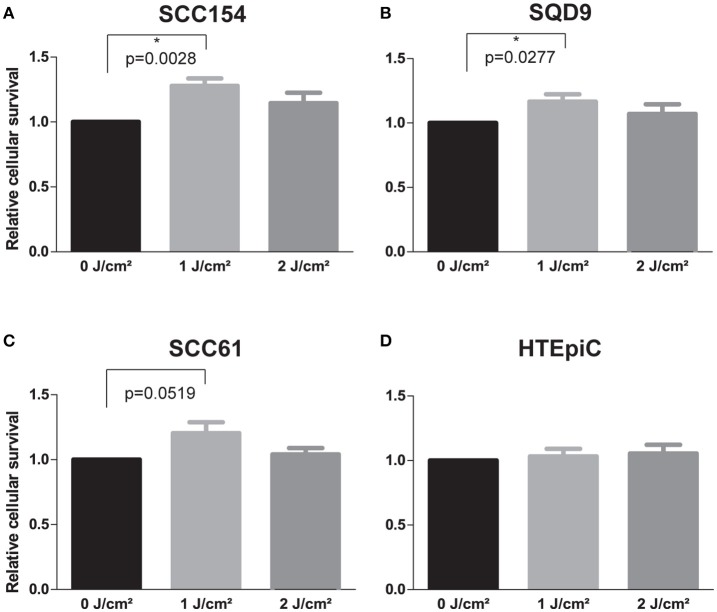
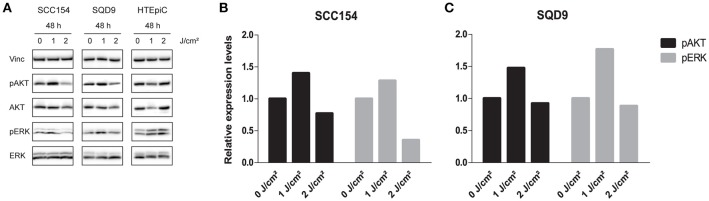
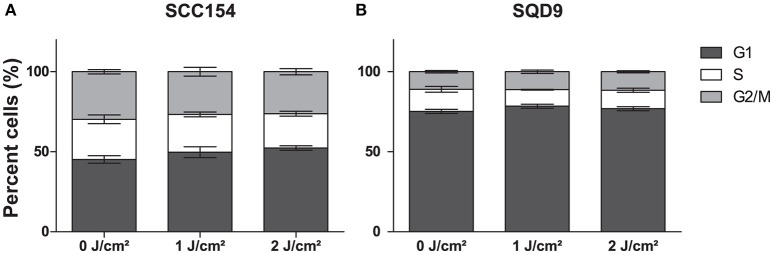
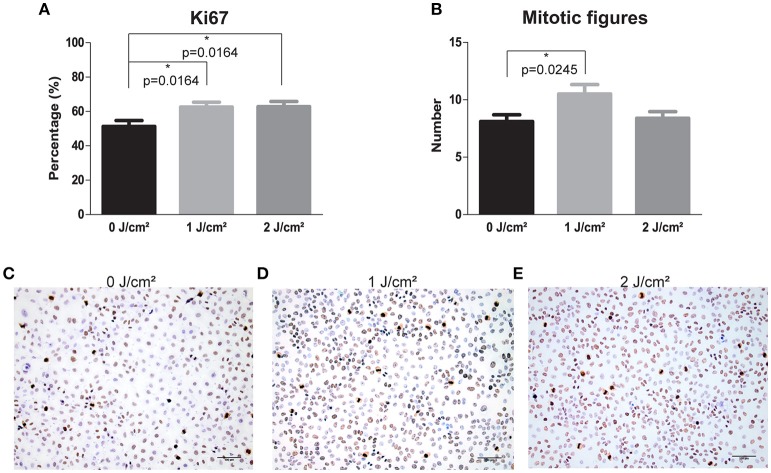
Low-level laser therapy (LLLT) is a promising non-invasive treatment option for oropharyngeal mucositis, which is a common side effect of many oncological treatments. LLLT is known for its wound healing properties due to the stimulation of cellular processes, such as proliferation, migration and differentiation. Controversy exists on the possible stimulatory effect of LLLT on head and neck cancer (HNSCC) cells in patients treated with radiotherapy. The aim of this study was to evaluate the biostimulatory effect together with the underlying mechanisms of LLLT on HNSCC cancer cells and normal epithelial cells. HNSCC cell lines (SCC154, SQD9, and SCC61) and human tonsil epithelial cells were exposed to a Gallium-Aluminum-Arsenide diode laser (830 nm, 150 mW) with energy densities of 0, 1, and 2 J/cm2. The proliferation potential of the cells was assessed by Sulforhodamine B assay, immunoblotting (mitogenic pathways), immunocytochemistry (Ki67), and flow cytometry (PI cell cycle staining). Cell proliferation was increased in HNSCC cell lines after laser irradiation with 1 J/cm2, whereas no significant increase was seen after laser irradiation with 2 J/cm2. In contrast, no effect on cell proliferation was seen in the human tonsil epithelial cells after laser irradiation with any of the energy densities. The increased proliferation was associated with elevated levels of pAKT, pERK, and Ki67 protein expression and cell cycle progression. Our results show that LLLT increases cell proliferation in a dose-dependent manner in HNSCC cells but not in normal epithelial tonsil cells. These results suggest that LLLT has to be used with caution when treating oropharyngeal mucositis in HNSCC patients since tumor cells present in the LLLT irradiation field could be triggered by LLLT.
低强度激光疗法(LLLT)是一种有前景的治疗口咽黏膜炎的非侵入性方法,口咽黏膜炎是许多肿瘤治疗常见的副作用。由于能刺激细胞增殖、迁移和分化等过程,LLLT以其促进伤口愈合的特性而闻名。对于接受放疗的患者,LLLT对头颈部癌细胞(HNSCC)可能的刺激作用存在争议。本研究的目的是评估LLLT对HNSCC癌细胞和正常上皮细胞的生物刺激作用及其潜在机制。将HNSCC细胞系(SCC154、SQD9和SCC61)和人扁桃体上皮细胞暴露于能量密度为0、1和2 J/cm²的砷化镓铝二极管激光(830 nm,150 mW)下。通过磺酰罗丹明B测定法、免疫印迹(促有丝分裂途径)、免疫细胞化学(Ki67)和流式细胞术(PI细胞周期染色)评估细胞的增殖潜能。用1 J/cm²激光照射后,HNSCC细胞系的细胞增殖增加,而用2 J/cm²激光照射后未观察到显著增加。相比之下,用任何能量密度的激光照射后人扁桃体上皮细胞的细胞增殖均未受影响。增殖增加与pAKT、pERK和Ki67蛋白表达水平升高以及细胞周期进展有关。我们的结果表明,LLLT以剂量依赖的方式增加HNSCC细胞的增殖,但对正常扁桃体上皮细胞无此作用。这些结果表明,在治疗HNSCC患者的口咽黏膜炎时,必须谨慎使用LLLT,因为LLLT照射区域内存在的肿瘤细胞可能会被LLLT触发。