VA San Diego Healthcare System.
Monash Institute for Cognitive and Clinical Neuroscience.
Psychol Trauma. 2019 Jan;11(1):107-113. doi: 10.1037/tra0000402. Epub 2018 Sep 13.
Approximately 35-61% of individuals with posttraumatic stress disorder (PTSD) report insomnia. Further, upward of 70% report clinically significant insomnia following PTSD treatment. There are converging lines of evidence suggesting that insomnia not only independently affects daytime functioning and worsens PTSD symptoms but also may compromise response to PTSD treatment, such as prolonged exposure (PE). Taken together, integrated insomnia and PTSD treatment may increase client-centered care and treatment outcomes.
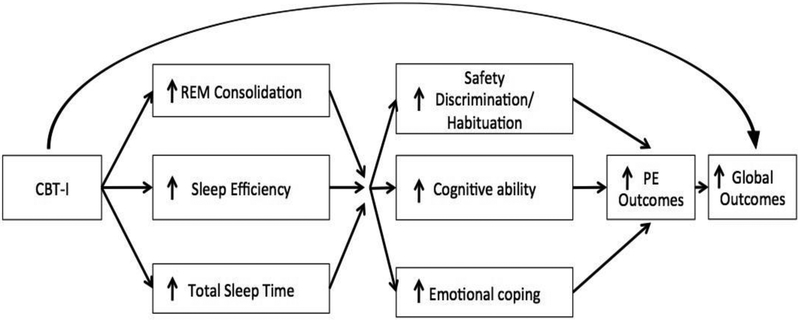
This article reviews the theory and evidence for treating sleep prior to PTSD treatment, describes the key elements of integrated cognitive-behavioral treatment for insomnia (CBT-I) and PE (2NITE protocol), and presents pilot data from a sample of 12 treatment-seeking veterans with PTSD and insomnia who completed the 2NITE protocol. Sleep data were collected with sleep diaries and actigraphy watches.
The Client Satisfaction Questionnaire indicated high satisfaction with the 2NITE protocol (mean score 29.66 out of 32 points). On average, there were statistical and clinically significant changes in all measures, including a 20.17-point decrease in the PTSD Checklist DSM-5, a 11.75-point decrease in the insomnia severity index, an 18.58-point increase in the World Health Organization Quality of Life index, a 11% increase in sleep efficiency, and a 51-min increase in total sleep time from the actigraphy data.
Among individuals with insomnia and PTSD, integrating CBT-I and PE with the 2NITE protocol represents a logical, innovative, and empirically informed method for augmenting existing treatments and optimizing outcomes that justifies further investigation. (PsycINFO Database Record (c) 2018 APA, all rights reserved).
大约 35-61%的创伤后应激障碍(PTSD)患者报告存在失眠。此外,超过 70%的 PTSD 治疗后报告存在临床显著的失眠。有越来越多的证据表明,失眠不仅会独立影响白天的功能,使 PTSD 症状恶化,而且可能会影响 PTSD 治疗的效果,例如延长暴露(PE)。综上所述,综合治疗失眠和 PTSD 可能会提高以客户为中心的护理和治疗效果。
本文回顾了在 PTSD 治疗之前治疗睡眠的理论和证据,描述了针对失眠和 PTSD 的认知行为治疗(CBT-I)和延长暴露(PE)的综合治疗(2NITE 方案)的关键要素,并介绍了 12 名寻求 PTSD 和失眠治疗的退伍军人完成 2NITE 方案的试点数据。睡眠数据是通过睡眠日记和活动记录仪收集的。
客户满意度问卷表明,退伍军人对 2NITE 方案的满意度很高(平均得分为 32 分中的 29.66 分)。平均而言,所有指标都有统计学和临床意义上的变化,包括 PTSD 检查表 DSM-5 降低 20.17 分,失眠严重程度指数降低 11.75 分,世界卫生组织生活质量指数提高 18.58 分,睡眠效率提高 11%,活动记录仪数据显示总睡眠时间增加 51 分钟。
在失眠和 PTSD 的个体中,将 CBT-I 和 PE 与 2NITE 方案相结合,代表了一种逻辑、创新和基于证据的方法,可以增强现有治疗方法,并优化结果,这值得进一步研究。